Domestic violence custody case evidence: safety first, then a record
By EJ Archuleta, Licensed attorney · Updated
Evidence in a domestic violence custody case usually comes from a few sources: dated, factual records of incidents; photos of injuries and damage; complete message threads that show who sent what and when; medical and police records; and people who saw or heard something. Before you collect any of it, talk to a domestic violence advocate and a family law attorney. Make sure the device and accounts you document on are ones the other parent cannot see.
A record helps a case. It does not keep anyone safe. Safety planning belongs to people trained for it, so this page puts them first and the documentation second.
This page is general information, not legal or safety advice. Laws and court practice vary by state. For your situation, talk to a qualified attorney and a domestic violence advocate.
Start with people, not software
If you are in immediate danger, call 911.
For everything else, three kinds of help matter, and they do different jobs:
- A domestic violence advocate helps with safety planning, technology safety, shelter, and local resources. The National Domestic Violence Hotline (thehotline.org, 1-800-799-7233) can connect you with one. Many local programs also have court advocates who know how your county's family court works.
- A family law attorney decides what evidence matters, how to get it, and how to present it. If cost is a barrier, ask an advocate about legal aid in your area.
- Medical providers document injuries in records that carry their own weight. Seek care even when nothing is visible, especially after any choking or strangulation.
One fact worth knowing before you plan: separation often raises risk instead of lowering it. Judicial guidance on custody and domestic violence notes that serious violence happens more often during and after separation, and that children can become targets or witnesses. This is part of why the order matters: safety plan first, documentation second.
Check your devices and accounts before you write anything
A private record is only private if the device holding it is. Many people document abuse on a phone the other parent set up, pays for, or can unlock. Before you start, go through these questions with an advocate:
- Shared devices. Does anyone else know the passcode to your phone, tablet, or laptop? Has anyone else had it in hand for long stretches?
- Family and cloud accounts. Is your phone on a family plan or a shared cloud account? Shared accounts can sync photos, notes, messages, and backups to another person's device without any alert.
- Synced photo libraries. A photo of a bruise taken on a synced phone can show up in a shared album or a family member's library.
- Location sharing. Check the phone's settings, map apps, and any family-locator service.
- Email and browser. Is your email signed in on a shared computer? Does your browser history sync across devices?
Changing settings suddenly can be noticed. An advocate can help you decide what to change, when to change it, and what to leave alone for now.
Some practical options many survivors use:
- A separate email address used only for documentation, with a password you have memorized and never written down.
- A public library computer if you have no safe device of your own.
- Copies kept by a trusted friend or relative.
Avoid mentioning plans in texts or on social media if your messages may be monitored.
What to document
Incidents
Write each incident down as soon as it is safe:
- The date and time, and how you know the time ("at 7:40 p.m., per my phone's call log").
- The location.
- What was said, in quotation marks, as close to word for word as you can recall. Include statements made before, during, and after.
- What was done, in order.
- Who was present, including the children, and where the children were.
- What happened afterward: police called, report number, medical visit, missed exchange.
Physical evidence
- Injuries. Photograph every injury, however small. Take more photos over the following days as bruising changes.
- The scene. If furniture was overturned or something was thrown or broken, describe it and photograph it before cleaning up.
- Weapons. If a weapon was used or shown, photograph it if that is safe to do. Tell your attorney and advocate either way.
Messages, calls, and posts
Technology-based evidence disappears easily. It can be deleted on purpose or by accident, so capture it quickly.
- Capture whole conversations. A single message invites the question of what came before and after it. Courts often want the full exchange.
- Overlap long screenshots. When a thread runs several screens, let each screenshot repeat the last line or two of the one before. The overlap shows nothing was skipped.
- Show who sent it. Include the name, phone number, username, or email address tied to the message, plus the date and time.
- Keep call logs and voicemails. Save voicemails with their date and time. If you print emails or logs, make sure the sender, recipient, date, and time are visible.
- No screenshot function? Photograph the screen with a different device.
Records others hold
Police reports, medical records, prior protective orders, and earlier court filings can all matter. These records have to be formally obtained before they can be used, and the process varies by court. Your attorney will know how to request them. Write down that they exist: the agency, the date, and any report or case number.
Patterns over time: post-separation abuse and coercive control
Much post-separation abuse does not look like a single dramatic incident. It looks like a pattern, and each piece can seem small on its own. Common examples:
- Exchanges used to intimidate.
- Constant messages at all hours.
- Showing up uninvited.
- Withholding agreed money.
- Monitoring your location.
- Threats routed through the children.
- Repeated filings meant to exhaust you.
Judicial guidance recognizes that abuse of or threats toward children after separation can be a way to keep controlling the other parent.
Patterns only become visible when the entries are dated and consistent. "He texted 41 times between 11 p.m. and 2 a.m. on March 3" is a data point. Twelve such entries across four months is a pattern your attorney can show. Record routine events too, like an exchange that went fine, so the record reads as complete rather than selective.
Write facts, not conclusions
A judge reads hundreds of declarations. Entries that describe what happened are easier to rely on than entries that characterize it. Your fear is real, and it belongs in the record as a fact about you ("I locked the door and called my sister"). It should not replace the description of what happened.
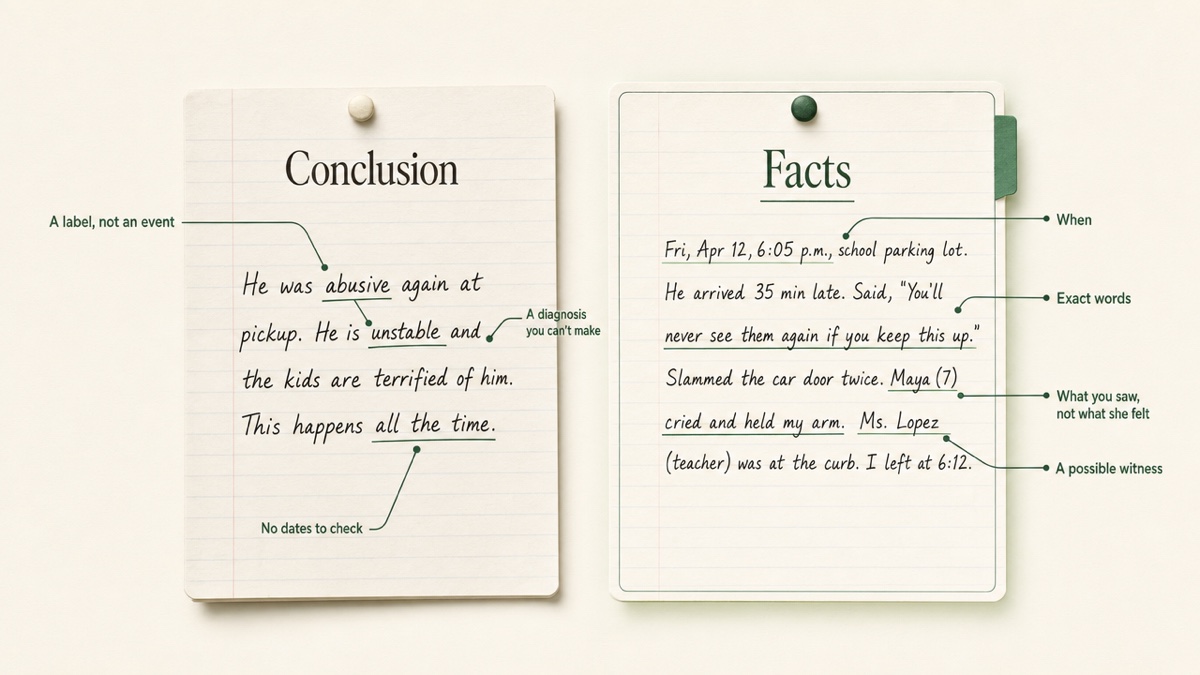
A few rules of thumb:
- Replace adjectives with actions. "Threatening" becomes the words that were said.
- Replace "always" and "never" with dates.
- Leave diagnoses to professionals. Describe behavior, not mental state.
- Never add details you are unsure of. Write "I don't remember" if that is the truth.
Children: observe, don't question
Effects on children often matter most in a custody case. They are also the easiest thing to document badly.
- Record what you see. Note sleep changes, regression, fear before exchanges, and new behaviors, with dates.
- Record what the child says, in their words, when they bring it up. Note the date, the time, what prompted it, and what you said back.
- Don't interview, repeat questions, or suggest answers. Leading a child, even gently, can harm the child and the credibility of what they said. If your child discloses abuse, contact the appropriate professionals, and ask your attorney and advocate how to proceed.
- Let professionals document too. Pediatricians, therapists, teachers, and child care providers keep their own records. In court they may testify about what they observed.
Recordings: ask first
Whether you can lawfully record a call or conversation depends on your state. Most states require only one party's consent, while some require everyone's. The rules can be more complicated when people on a call are in different states. Whether a recording can be used in court is a separate question again. Ask your attorney before you record anything. A recording made unlawfully can create problems for you.
Store it securely and keep the originals
- Keep originals untouched. Don't crop, filter, or edit the original photo or screenshot. If you need a marked-up version, make a copy.
- Preserve dates and file information. Original files often carry capture dates and other details that help an attorney show an exhibit is what you say it is. Forwarding or re-saving a file can strip that information.
- Back up. Keep a second copy somewhere the other parent cannot reach, such as a backup drive kept elsewhere or a trusted person's copy.
- Don't delete. Keep everything until your attorney tells you otherwise, including entries that seem minor.
How attorneys and courts may use documentation
Evidence reaches a judge in two forms:
- Testimony. People speak to the court. That can be you, police officers, doctors, teachers, child care providers, or neighbors.
- Exhibits. Photos, messages, voicemails, videos, and documents.
Your record does several jobs:
- It refreshes your memory before you testify.
- It points your attorney to witnesses and to records worth requesting.
- It supplies the dates that turn scattered events into a pattern.
Courts generally treat the safety of children and the abused parent as a central concern in custody decisions. How that plays out depends on your state's laws and your judge. An attorney, or a legal aid office or court advocate if you don't have one, can explain how it applies to your case.
Some practitioners organize hearing prep into a notebook. It typically holds what you are asking the court to order, what you need to prove, a witness list, an exhibit list, and the exhibits themselves. Your attorney decides what is used and how. For structure, see how to document custody for court.
Where Custody Proof fits, and where it doesn't
Custody Proof is documentation software for one parent. The other parent is never invited, has no account, and receives no notification of anything you log. There is no shared calendar or messaging channel to put you in contact with them.
What you get:
- Time-stamped entries in an encrypted evidence vault. Files are encrypted with AES-256 before they are stored.
- Seven categories, including Incidents, Communications, Health, Emotional, and Witness.
- Overnight and exchange tracking, so missed or disrupted exchanges sit on the same timeline as incidents.
- PDF reports with exhibits that you export and hand to your attorney yourself.
What it is not: it is not a safety tool, and it cannot protect anyone. It cannot tell whether your phone or browser is being monitored. It is a web app, so the device-safety questions above still apply. If you ever receive a subpoena involving your records, contact support and your attorney. See your account, data, and privacy.
Plans start at $14.75/month. If you have talked with an advocate and have a safe device, you can start a private record.
Frequently asked questions
Will the other parent know I'm keeping a record?
Not through Custody Proof. There is no invitation, shared account, or notification. If they have access to your device, email, or browser, though, they may see that you use it. That is why the device check comes first.
Is Custody Proof a safety app?
No. It is a documentation tool. For safety planning, contact a domestic violence advocate or the National Domestic Violence Hotline. In an emergency, call 911.
Can I record phone calls with the other parent?
It depends on your state's consent rules. Usability in court is a separate question. Ask your attorney before recording.
My phone is shared or was set up by the other parent. Should I document on it?
Talk with an advocate first. Synced photos, family cloud accounts, and location sharing can expose what you save. A library computer or a separate, secured device may be safer.
Are screenshots enough, or do I need the original messages?
Keep both. Screenshots should show the full thread, overlap one another, and include the sender's details and the date and time. Keep the original messages and files unedited as well, so your attorney can work with them.
Keep reading
- High-Conflict Custody Exchanges: Handle and Document Them
- How to Prepare for Child Custody Court: A Checklist
- Co-Parent Lying About You in Court? Answer With Records
- Which custody app fits your situation
Custody Proof is a documentation tool, not a law firm. Nothing on this page is legal advice. Whether and how a record is used in a case is a question for your attorney.