Co-parent not following the custody schedule? Log facts, then enforce
By EJ Archuleta, Licensed attorney · Updated
If your co-parent is not following the custody schedule by missing exchanges, showing up late, or withholding your time, document each incident the same day: the scheduled time, the actual time, and what you did. Send one short written follow-up, and keep following the order yourself. Once a pattern is on paper, take it to a family law attorney, who can tell you whether a makeup-time request, mediation, or a motion to enforce fits your state.

The order matters. Courts and attorneys can enforce a record. They cannot enforce a feeling. This page is general information, not legal advice. Enforcement rules differ by state, so ask your own attorney about your order.
Write it down the same day
"They were late a lot in March" will not survive a hearing. "Friday, March 7: pickup ordered 6:00 p.m. at the library; arrived 7:42 p.m." can be checked.
Record these the day it happens:
- The plan. What the order or your saved schedule says, such as Friday 6:00 p.m. pickup at the library.
- The actual. Arrived 7:42 p.m. Child not produced. Exchange moved to Saturday morning.
- Who and where. Which child, which adult was present, which location.
- Clock times. Write "6:00" and "7:42," not "evening." If you don't know the exact time, say so.
- Overnight or timed visit. A missed Friday-to-Sunday weekend is lost nights. A missed Wednesday 3:30–7:30 p.m. dinner is a lost timed visit. Courts commonly count overnights as nights slept, so a Friday-to-Sunday weekend is 2 nights. The return day is not counted. See how courts count parenting time.
- What you did. Waited 40 minutes, sent one text, drove home. Leave out what you think they meant.
Common categories of schedule problems include:
- Denied visitation
- Blocked phone or video calls
- Repeated late or missed exchanges
- Major decisions made alone when the order requires consultation
Log whichever one actually happened, in the order's own terms where you can.
Follow up in writing, once
A short written message turns your account into a two-sided record. Keep it to one fact-only message per incident:
> "Today's pickup was scheduled for 6:00 p.m. at the library. You arrived at 7:42 p.m. Please confirm Friday's 6:00 p.m. pickup."
Leave out adjectives, history, and threats. If they reply with a reason, that reply belongs in the record too, even if it helps them.
The message does not need an answer to be useful. Its job is to show that you raised the issue promptly and calmly. Silence is also a fact you can log.
Screenshots are convenient, but your state's evidence rules decide what a court accepts. Screenshots of texts are often accepted, but they can be challenged if they lack dates, phone numbers or other details, or if someone disputes who wrote them or whether the originals still exist.. Keep the original messages on your phone. Ask your attorney whether they want a full export of the thread instead of selected images. Save screenshots anyway as a working copy, dated and attached to the incident.
Patterns vs. one-offs, and the denominator
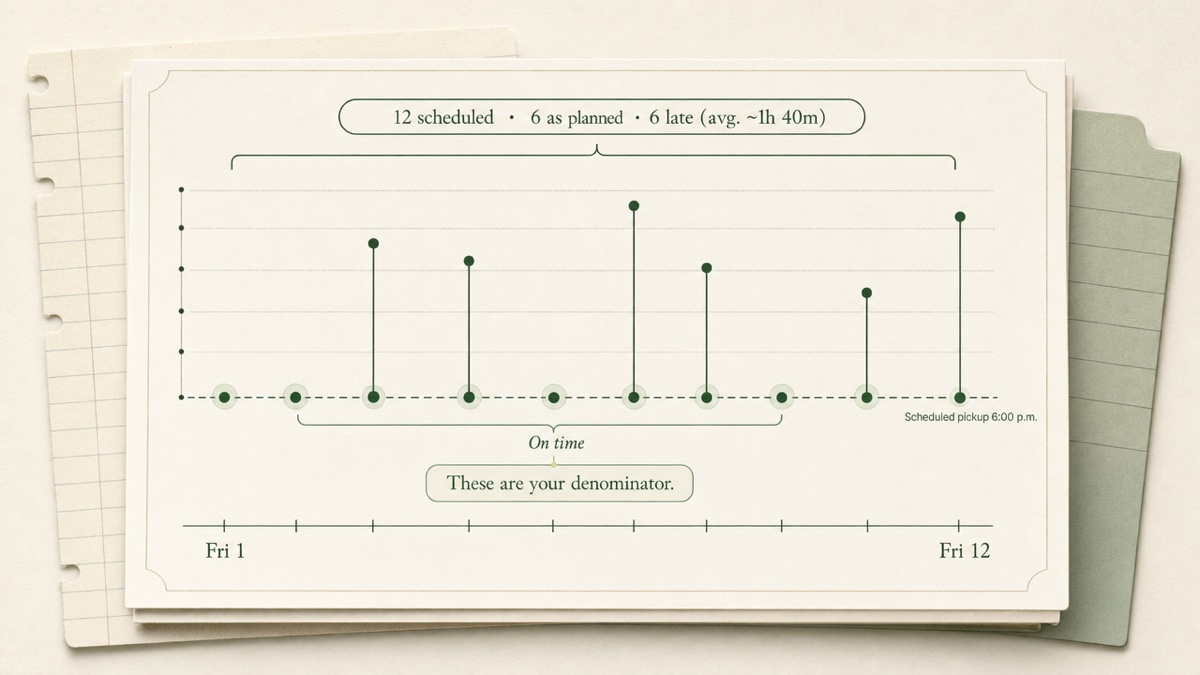
One late Friday is one late Friday. Six Fridays at roughly 7:40 is a pattern. You only get the pattern by logging each one plainly when it happens.
A pattern also needs context. If 6 of 52 exchanges went wrong, the other 46 matter. A log made up only of bad days reads like a highlight reel, and opposing counsel will say so.
Record the weeks that went as planned too. That gives you the denominator:
- How many exchanges were scheduled
- How many happened as written
- How many were late, missed, or changed
That comparison is planned vs. actual. It is what turns "they never follow the order" into a number. How to document custody for court covers the full system.
Requesting makeup time
When a parent loses scheduled time, a common fix is makeup time: substitute time in the future for the time that was denied. Some orders spell out a makeup process. Some states have default makeup-time policies, and these may include steps such as giving written notice before the makeup time is taken..
To request it:
- Put it in writing. Name the missed date and propose a specific replacement: "I'd like to make up the weekend of March 7–9 on March 21–23."
- Match what was lost. One missed weekend, one proposed weekend.
- Log the request and the response, including no response.
Makeup time tends to fit a one-off problem, like a late return that caused a missed pickup. It fits poorly when time is withheld again and again, because each makeup weekend just pushes the real problem back. If you are asking for makeup time every month, the pattern is the issue to raise with your attorney.
Don't retaliate with time or money
When the other parent keeps your weekend, it is tempting to keep theirs. Don't. Withholding their time puts your own violation in the record, right next to theirs.
The same goes for child support. Courts treat custody and support as separate obligations, so stopping payments because time was denied is a support violation of its own.
Keep paying as ordered. Keep producing the child as ordered. Your compliance is part of your evidence.
Safety concerns are a different track
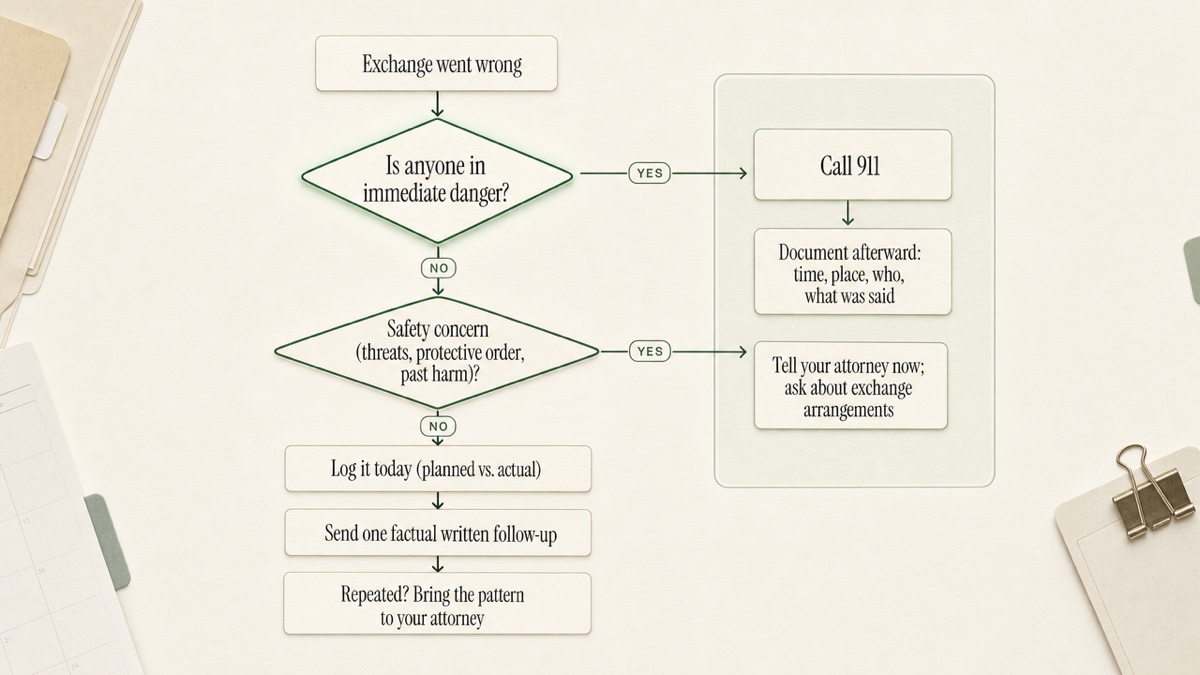
Routine lateness and missed weekends are documentation-and-enforcement problems. A risk of harm is not.
If a child is in immediate danger, call 911 first and document afterward. If an exchange keeps turning volatile, talk to your attorney about safer arrangements. Options may include a public or police-monitored exchange location, a supervised exchange program, or, where local police offer it, a standby with an officer present during the exchange.. Police often treat custody-order disputes as civil matters. Police response varies by state and agency, and some officers will not get involved in a routine late pickup, so don't count on them to hand a child over..
Some facts change which remedies make sense: a crime against the child or a parent, or a violated protective order. Tell your attorney about these first, not as item 14 in a list of late pickups.
When the child refuses to go
Sometimes the problem is a child who won't get in the car. Log it the same way: scheduled time, actual time, what the child said in their own words, and what each adult did.
Courts generally separate a child's own reluctance from a parent who discourages or allows the refusal. A parent's duty to make the child available may not end just because the child resists, though how courts handle refusal depends on the state and the child's age.. This is a fact-heavy question, and an early one for your attorney. Write down what you observe, not why you believe it happened.
What enforcement typically looks like
The path usually escalates in steps, and each step needs the record.
- A written request to the other parent naming the missed exchanges. Many disputes start here.
- Mediation or a court-connected conference. These are often used for pickup times and small schedule fixes. If you reach an agreement, it may become an order.
- A motion to enforce the parenting plan. These filings typically describe how the order was not followed and may need to include a copy of the order or schedule, depending on local rules..
- Contempt or show-cause proceedings, generally reserved for serious or repeated violations. The other parent gets a chance to explain.
Courts may order makeup time, clarify days and times in the plan, require parenting classes, award attorney fees, or, in some cases, revisit custody. What is available depends on your state and judge..
Timing matters too. Some court offices that handle parenting-time complaints won't act on older violations. In Michigan, for example, the friend of the court may decline if the violation happened more than 56 days before the complaint.. Logging the same day means you are never trying to report a stale incident from memory.
Build a violations packet for your attorney
Your attorney's time is expensive. Don't hand over a camera roll. Hand over something they can read in a minute:
- A one-page summary for the window they asked about (example below).
- Planned vs. actual totals for the same window.
- The incident entries, each with its attachments, in date order.
- The written follow-ups you sent, and any replies.
- The order, with the relevant section marked.
- Original files, only if they ask for them.
| Date | Scheduled | Actual | What happened | Written follow-up |
|---|---|---|---|---|
| Fri Mar 7 | Pickup 6:00 p.m., library | 7:42 p.m. | No text before arrival | Text 7:55 p.m. |
| Fri Mar 21 | Pickup 6:00 p.m., library | Not produced | "Kids are busy" text at 5:10 p.m. | Text 5:20 p.m.; makeup proposed |
| Wed Apr 2 | Visit 3:30–7:30 p.m. | 4:45–7:30 p.m. | Late from school pickup | Text 4:50 p.m. |
Fictional example.
Ask your attorney what period and format they want before you export anything.
Doing this in Custody Proof
Custody Proof is private documentation software for one parent. The other parent is never invited, never has an account, and is never notified.
Logging an incident
- Open the day on your calendar and choose Log violation, or check Mark as Violation on any overnight or timed visit.
- Add the children, times, and notes, and attach the screenshot. Event attachments can be JPG, PNG, GIF, or PDF, up to 5 MB each.
- For longer threads, use the evidence vault's Communications category, which accepts files up to 25 MB.
- Flagged days show solid red on the calendar. An amber dot means evidence was logged for that day.
A red flag is your own label. It is not a finding that anyone violated anything. Step-by-step: Adding custody time.
Keeping the denominator honest
- Turn your order into a recurring schedule.
- When the weekly check-in asks whether the week went as planned, confirm it or review the days that differed.
- Violations are never offered for removal in that review.
- Your reports can cite a "Confirmed through" date. See Keeping your schedule accurate.
Exporting
- The Stats Summary
- The Detailed PDF Report, with Planned vs. Actual turned on when the dispute is about who followed the schedule
- The Evidence PDF
- The Evidence ZIP, if your attorney asks for the files
Each export covers the time period and child you select.
Documentation is $14.75/month. Case Builder ($29/month) adds Vero, who turns a voice note or pasted thread into a draft entry you review. Vero has starting templates for missed visitation and late pickups.
Start your record tonight instead of rebuilding March from memory.
Frequently asked questions
Does flagging a violation in Custody Proof notify the other parent?
No. Nothing you log is sent to anyone. If you want to share your record, you export a file and hand it over yourself, usually to your attorney.
Is a flagged violation proof that the order was broken?
No. It is your dated label on your own record. Whether something violates your order, and what a court will accept as evidence, are questions for your attorney.
Should I keep a parent's time if they kept mine?
No. Withholding time, or withholding child support, puts your own violation in the record. Keep following the order and document theirs.
How many incidents do I need before talking to a lawyer?
There is no set number. Raise safety concerns right away. For routine lateness, bring a few weeks of same-day entries plus your planned-vs-actual totals, so your attorney can judge the pattern rather than a single bad Friday.
Can I add incidents from months ago?
Yes. Enter them with their real dates and attach what you have. Older entries are weaker than same-day ones, and some enforcement routes have time limits, so ask your attorney how far back to go.
Keep reading
- Private Custody Calendar App
- Parallel Parenting in High-Conflict Cases
- How to Prove Parental Alienation in Court: Document Facts
- Which custody app fits your situation
Custody Proof is a documentation tool, not a law firm. Nothing on this page is legal advice. Whether and how a record is used in a case is a question for your attorney.