How to prove parental alienation in court with facts, not labels
By EJ Archuleta, Licensed attorney · Updated
You prove parental alienation in court mostly by not leading with the word. Courts respond to a dated record: time that was scheduled and didn't happen, specific acts of interference, and your child's own words written down exactly, with the date and what was going on. A judge, and usually an evaluator, then decides what that pattern means. Your job is to make the pattern visible. It is not your job to diagnose it.

This page covers how alienation differs from estrangement, which behaviors professionals look for, why the label can work against you, and how to build a record your attorney can use. It is general information, not legal advice. Custody law and procedure vary by state, so take questions about your case to your own family law attorney.
Alienation, estrangement, and justified rejection
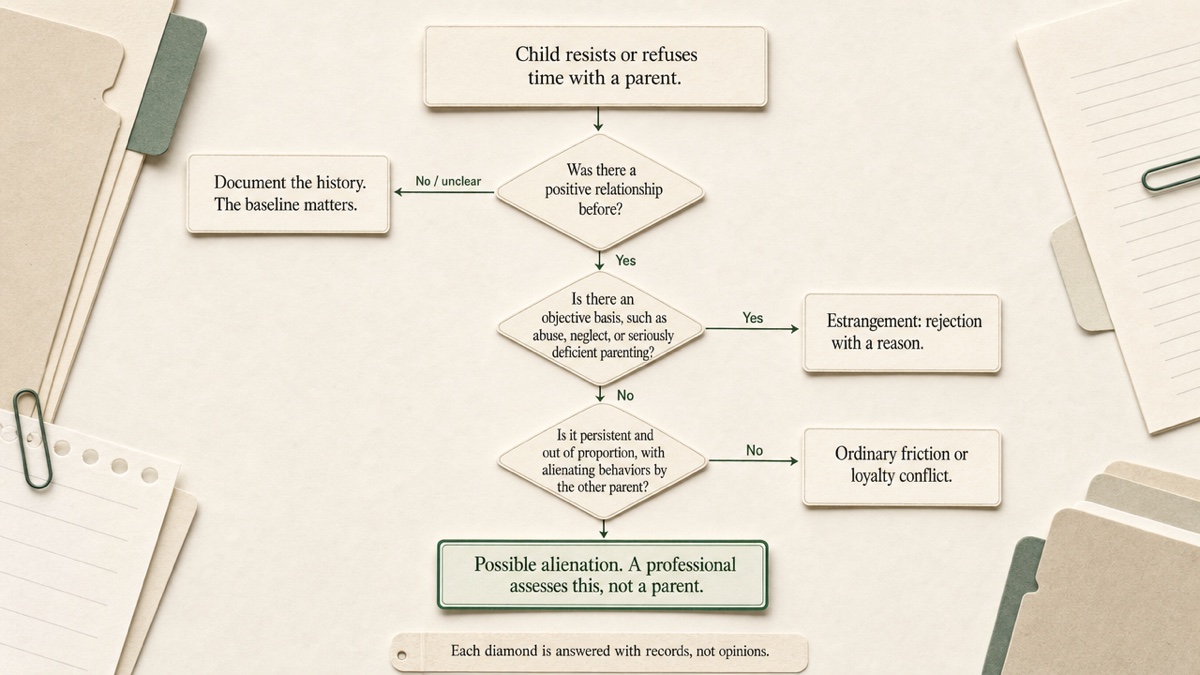
When a child refuses to see a parent after separation, there are several possible explanations, and only one of them is alienation.
Parental alienation is generally described as a child rejecting a parent without a legitimate reason, usually after one parent's sustained influence. The rejection is out of proportion to anything the rejected parent did.
Estrangement, sometimes called realistic estrangement, is rejection with a reason. If the rejected parent has a history of family violence, abuse, neglect, or seriously deficient parenting, mental health professionals generally treat the child's pulling away as a response to real events, not as programming.
Ordinary friction sits between those two. Teenagers resist schedules. A child may prefer the house closer to their friends or be angry about the divorce itself. Normal loyalty conflicts and influence from either parent are not automatically alienation.
One framework used by some professionals, the Five-Factor Model, looks for five conditions together:
- The child avoids, resists, or refuses a relationship with one parent.
- The child previously had a positive relationship with that parent.
- The rejected parent did not abuse, neglect, or seriously under-parent the child.
- The favored parent used multiple alienating behaviors.
- The child shows behavioral signs of alienation.
The second and third conditions matter most for your record. A judge has to decide whether there is an objective basis for the rejection. That decision rests on facts, not on how either parent feels about it.
A note on terms: you will see "parental alienation syndrome" online. Whether alienation is a diagnosable syndrome is disputed among mental health professionals, and how courts treat that term varies.. Describing behavior is safer than invoking a syndrome.
Behaviors and signs professionals commonly cite
Lists of alienating behaviors are long. Attorney guidance published by the American Bar Association catalogs 17 strategies, and researchers have described 25 detection factors for programming. The behaviors that show up most often in records include:
- Blocking or "forgetting" calls and video chats during scheduled times
- Scheduling activities on top of the other parent's time, then telling the child they get to choose
- Withholding school, medical, or activity information
- Speaking badly about the other parent to or around the child
- Making the child the messenger, or asking the child to keep secrets
- Treating the child's reluctance as a final decision ("she doesn't want to go, and I won't force her")
Signs in the child that professionals look for include:
- A gap between words and actions. The child says they hate a parent, then runs to hug them at the exchange.
- Contradictory accounts to each parent. The child happily asks for pizza and a movie, then later tells the other parent they were made to eat junk food and watch boring TV.
- Borrowed language. Adult phrases or legal terms a child that age wouldn't produce on their own.
Treat these lists as a guide to what to notice, not a test to score. A record that says "Signs 2, 4, and 7 present" is a conclusion. A record that says what happened, when, and in what words is evidence.
Why the label alone can backfire
Telling a judge "this is alienation" asks them to accept your conclusion before they've seen your facts. That causes three problems.
First, it reads as an attack. In a high-conflict case, both parents usually say the other is the problem. The label sounds like one more accusation.
Second, it invites the other side to answer with estrangement: the child pulled away because of something you did. If your record is thin, it becomes your word against theirs, and the dispute moves to your parenting instead of their conduct.
Third, unsupported claims cost you credibility you'll need later. Judges describe documentary evidence as extremely important in these cases. That includes texts, phone records, photos, and third-party accounts of how parent and child behave. Findings built on a detailed factual record are also harder to overturn if the case is appealed.
The stronger approach is to let the facts carry the argument. Six missed weekends in four months is a fact. "Turning my son against me" is a characterization the other side will dispute.
What to record
Interference
Write down each specific act that blocked, shortened, or soured your time. Record what was scheduled, what happened instead, and how you found out. Keep the other parent's messages as screenshots, attached to the entry they belong to. "Unanswered call at 7:00 p.m., the agreed call time; text at 9:40 p.m. said 'she was busy'" is useful. "She always blocks my calls" is not.
Missed and changed time
Every missed exchange, late return, cut-short visit, and "the child didn't want to come" belongs on the record with a date and time. A late pickup is a clock reading. A cancelled weekend is a date on the calendar. For the mechanics, see missed visitation and late pickups.
The child's words, verbatim
When your child says something that matters, write it down soon after, word for word, in quotation marks. Don't summarize it, clean it up, or interpret it. Then note:
- Date and time
- Setting: in the car after pickup, at bedtime, on the phone
- What came right before: what prompted it, including anything you said
- What the child did: tone, and whether their behavior matched their words
"'Mom says you don't really want us.' Said in the car about ten minutes after Friday pickup, unprompted, while looking out the window. Asked for the radio two minutes later and sang along." That entry gives an evaluator words, context, and the mismatch between words and behavior, without any label.
The baseline
Alienation describes a change, so document what came before it. Photos, school event programs, old messages, and cards from the years when the relationship was good show where things started. Enter them with their real dates. The record shows the change only if you have the earlier period on file.
For why entries written at the time hold up better than accounts written later, see records, not memories.
Planned vs. actual: turning incidents into a pattern
A single missed weekend is an incident. A record that sets every scheduled night next to what actually happened shows a trend. It also shows the weeks that went as planned, which makes the missed ones more credible.
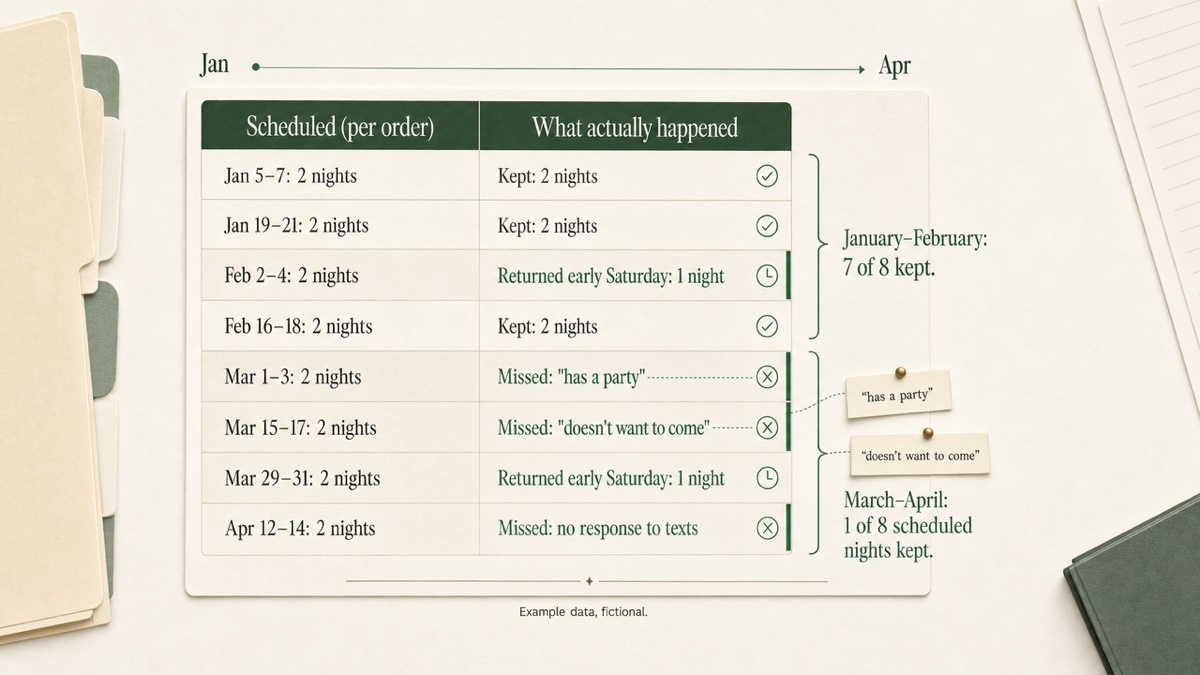
The quoted reason belongs in the record. "Doesn't want to come" repeated across several weekends, each one dated, carries more weight than one long statement describing the pattern.
Don't interrogate the child, and be careful with recordings
This part protects your child and your credibility.
Don't question your child to build evidence. Asking "Did your dad tell you to say that?" or "What does Mom say about me?" puts the child in the middle and teaches them that every visit is a test. It also contaminates what they say next. If you led the conversation, an evaluator may discount it. Record what your child offers without prompting. If you asked a question, write down the exact question.
Don't ask your child to repeat things for a phone, a relative, or you.
Be careful with secret recordings. States differ on whether one person in a conversation can record it or whether everyone must consent.. Secretly recording the other parent, or coaching or recording your child, can make the evidence inadmissible. It can also make you look like the parent doing the manipulating. Ask your attorney before you record anyone. Keep only information you lawfully have access to.
Evaluators, guardians ad litem, and therapists
In contested alienation cases, the most persuasive evidence usually comes from professionals who interview and observe the child carefully, not from either parent. Depending on your state and your judge, these may include a custody evaluator, a guardian ad litem or attorney for the child, and therapists. Some courts appoint a best-interests attorney for the child who decides things like whether the child testifies or is evaluated.
Your record helps these professionals in several ways. It gives an evaluator dates to ask about and a timeline to compare against what the child and each parent say. It shows a guardian ad litem the planned-vs-actual pattern in a few minutes. If a therapist is involved, it gives them history without making the child retell it.
Don't hand material to these professionals on your own. Your attorney decides what goes to whom, in what form, and when. Some of what you write, especially your own reflections, may belong only with counsel. Experts who testify about alienation also have to meet the court's standards for expert evidence, which is another reason your attorney should manage that side.
If a court finds alienation, possible responses include reunification therapy, schedule changes, and in some cases a custody modification.. Many of these cases reach court as a motion to change custody. Courts make these decisions under the best-interests-of-the-child standard, so the record should show what the pattern is doing to your child, not only what it costs you.
Organizing the record for your attorney
Before you meet with your attorney, have:
- A one-page summary: date range, scheduled overnights vs. actual, number of missed or shortened exchanges.
- A chronological log: every incident with date, time, what happened, and the attachment that supports it.
- Child statements, quoted, with setting and context, in date order.
- Communications: screenshots tied to specific dates, not a camera roll.
- Baseline material from before the change.
- A list of possible witnesses: coaches, teachers, relatives who saw exchanges or the child's behavior, and what each one saw.
Keep the log factual and in the same tone throughout. If an entry reads like a complaint, rewrite it as a description. For the general structure, see how to document custody for court.
Where Custody Proof fits
Custody Proof is a private documentation tool for one parent. The other parent is never invited or notified. It does not identify alienation or diagnose anything. It keeps your record dated and organized:
- Your schedule becomes a calendar. Upload your order or describe it in plain words. The Plan vs. Actual view then compares each scheduled day against what you logged.
- Missed time gets flagged on your own timeline using preset violation categories.
- Evidence attaches to dates in an encrypted vault. Categories include Incidents, Communications, Emotional, and Witness.
- You confirm the record as you go, so your reports carry a "Confirmed through" date.
- Exports are ready for your attorney. The Court Packet groups evidence under best-interests factors.
On the Case Builder plan, Vero turns a voice note or pasted text into a draft entry you review. Vero never guesses dates.
Documentation is $14.75/month; Case Builder is $29/month. Both come with a 30-day money-back guarantee on your first charge. Start your record.
Frequently asked questions
Can I just tell the judge my child is being alienated?
You can, but the word alone rarely helps. Judges weigh documented patterns: missed time, specific interference, and the child's statements in context. Let your attorney decide how and whether to use the term.
What's the difference between parental alienation and estrangement?
Estrangement is a child's rejection of a parent for a real reason, such as abuse or neglect. Alienation is rejection without a legitimate justification. Whether there is an objective basis for the rejection is the key question, and it is answered with facts.
Should I record my child talking about the other parent?
Ask your attorney first. Recording laws vary by state, and secretly recording or prompting a child can hurt your credibility. A written, word-for-word note made soon afterward is usually safer.
Will the other parent see what I log?
Not in Custody Proof. There is no shared account and no notification. You share a record only by exporting a file yourself.
Does Custody Proof tell me whether it's alienation?
No. It organizes dates, time, and evidence. Whether a pattern amounts to alienation is for the professionals in your case and the court to decide.
Keep reading
- Custody Lawyer Consultation: What to Bring and Ask
- How to Document a Narcissistic Co-Parent
- How to Document Coercive Control for Court
- Which custody app fits your situation
Custody Proof is a documentation tool, not a law firm. Nothing on this page is legal advice. Whether and how a record is used in a case is a question for your attorney.