What to bring to a custody lawyer consultation, and what to ask
By EJ Archuleta, Licensed attorney · Updated
To prepare for a custody lawyer consultation, bring four things: your existing orders, a dated timeline, your parenting time and expense records, and the messages that matter. Add a one-page summary of where things stand, then ask about the lawyer's custody experience, likely strategy, mediation, and exactly how billing works.

That is the short version. The rest of this page covers what each item should look like, which questions get useful answers, and what to do in the weeks after you sign.
This is general information, not legal advice. Custody law and procedure vary by state, so questions about your case belong with a licensed attorney where you live.
Bring documents, not a story
A first meeting is short. If the lawyer spends it pulling dates out of you, you leave with a vague opinion. If the dates are already on paper, you leave with a real one. Documents also help the lawyer estimate how long the case may take.
Orders and prior court papers
- Every existing custody order, child support order, and modification
- Any separation agreement or prenuptial agreement
- Papers from earlier proceedings involving the other parent or the children, including protective orders
- The children's birth certificates
If an order runs fifty pages, bring the whole thing. Flag the custody schedule and any notice deadlines with sticky tabs.
A timeline
List the key events in date order: separation, moves, school changes, the last time the schedule held, the first time it didn't. One line per event. A late pickup is a time and a date. "They're always late" is not a timeline entry.
Parenting time records
Bring what actually happened, not only what the order says. Count overnights separately from daytime visits. A Friday-to-Sunday weekend is two nights, and a Wednesday dinner is a visit, not a night. Mixing the two inflates a percentage in a way the other side can pick apart.
Child expenses
Bring the receipts you have for medical costs, childcare, school, and activities. Note what you asked to be reimbursed, when you asked, and what came back.
Communications
Bring screenshots of the texts and emails that show the problem, with dates visible. Choose the ten that matter. Five hundred unsorted screenshots make the lawyer's job harder.
Financial basics
For support issues, lawyers commonly ask for recent tax returns, proof of your current income, any information you have about the other parent's income, and major child-related costs such as tuition.
Bring copies the office can keep. Electronic copies are usually fine. Ask before the meeting which format the office prefers.
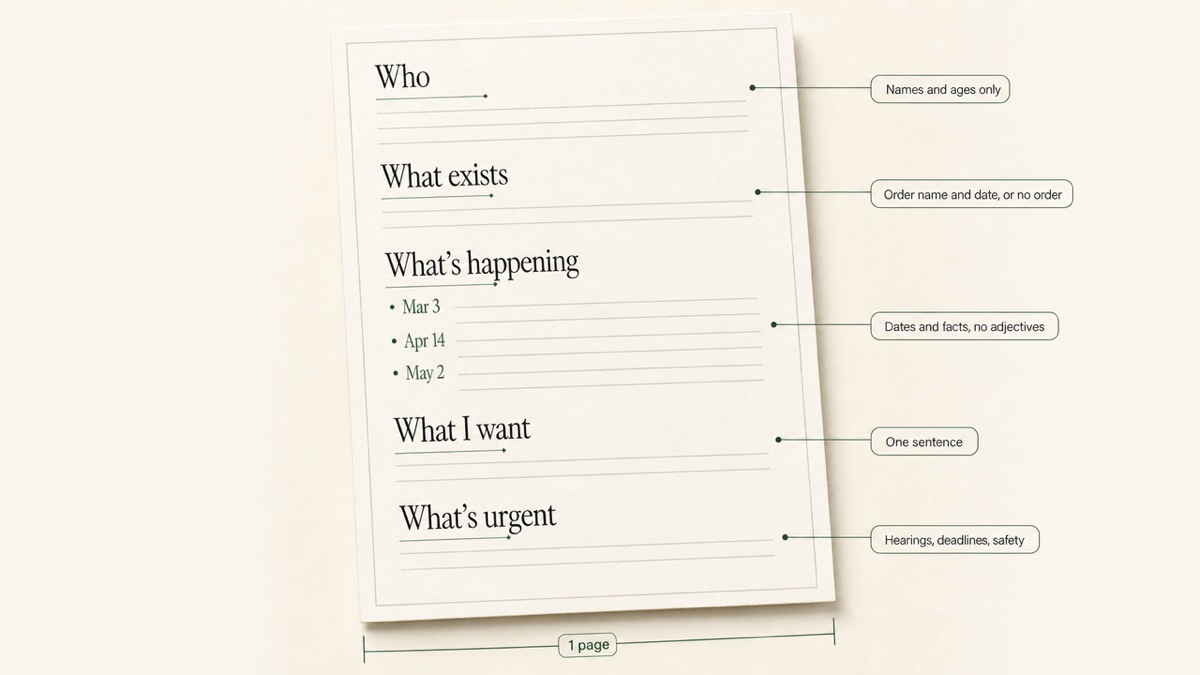
The one-page summary
This is the document lawyers rarely get and always want. It is one page, written in plain sentences, and it covers:
- Who. Your name, the children's names and ages, and the other parent's name.
- What exists. The current order and its date, or "no order."
- What's happening. Three to five dated facts, with no adjectives.
- What you want. The outcome you are asking about, in one sentence.
- What's urgent. Any upcoming hearing, deadline, or safety concern.
Writing it yourself also tells you what you actually know, as opposed to what you feel.
Questions to ask
Ask the same questions of every lawyer you meet. Comparing answers is the point.
Experience
- How long have you practiced, and what share of your work is custody?
- How often do you appear before the judges in this county?
- Who else at the firm will work on my case, and at what rate?
Strategy
- Based on what you've seen, what are the strengths and weaknesses of my position?
- Is a case like this more likely to settle or go to trial? What is your trial experience?
- What would you want me to start documenting now?
Mediation and settlement
- Will mediation likely be required here, and how do you prepare clients for it?
- What do you consider a good settlement versus a reason to go to court?
Billing
- Do you bill hourly or by flat fee? What is the rate for each person who touches the file?
- What is the retainer, and what happens when it runs low?
- Will I receive itemized monthly statements?
- What costs beyond fees will I pay, such as filing fees, copies, or experts?
- How do you charge for emails and phone calls?
Also ask what happens if the two of you disagree about strategy or a bill. The first meeting is the easiest time to raise it.
Retainers and billing, plainly
In most family cases, a retainer is a lump sum paid upfront into a trust account. With hourly billing, the lawyer draws from it as work is done, usually monthly. Until the money is earned, it generally belongs to you, and any unearned part must be refunded if the representation ends. Some states allow a separate, clearly labeled nonrefundable fee just for reserving the lawyer's availability, so check whether your agreement includes one.
The fee agreement should state the services covered, the fee type, what you're expected to pay, how other costs are handled, and the billing practices. Read it before you sign, and ask about any line you don't understand. Custody matters are generally not billed as a percentage of the outcome.
For a closer look at what drives the total, see what custody attorneys cost.
Red flags
- Guarantees. No honest lawyer promises you'll win custody or names an outcome before seeing the file.
- Escalation as a selling point. "We'll bury them" sounds satisfying. In practice it often means more motions, higher bills, and a judge who sees both parents fighting.
- No candor about weaknesses. If the lawyer can't name one problem with your case, they haven't looked.
- Vague billing. If they can't explain the rate, the retainer, and the invoices, expect surprises.
- Talking past you. If the joint-versus-sole custody explanation still makes no sense after two tries, that pattern will continue.
A strong advocate and an aggressive one are different. You want someone who picks fights worth having.
Confidentiality basics
What you tell a lawyer while genuinely seeking legal help is generally kept confidential, even if you don't hire them. Information you send a lawyer without being invited to may not get the same protection. Speak plainly. A lawyer working from half the facts gives you half an opinion.
There is a second effect. After you consult a lawyer, that lawyer may be unable to represent the other parent in the same matter. Don't book consultations just to block lawyers from the other side. It may not work anyway. Under ethics rules in many states, someone who consults a lawyer just to disqualify them isn't treated as a prospective client, and a court can refuse to disqualify that lawyer.
Keep your notes and records somewhere the other parent cannot reach. That means no shared cloud folders and no shared family computer.
If money is tight
Ask about limited-scope representation, where a lawyer handles one hearing or reviews your documents for a set fee. Legal aid organizations, state bar lawyer referral services, and court self-help centers are other options. What exists, and who qualifies, depends on your state and county. Organized records matter even more here, because limited-scope time is short.
Between the consultation and hiring
- Follow the current order exactly. Don't change the schedule on your own.
- Keep messages to the other parent brief, factual, and about the children.
- Don't post about the case, the other parent, or your plans on social media.
- Keep documenting. The record you build now is the record your lawyer will use.
After you hire
- Get the signed fee agreement and keep a copy.
- Set communication rules. Ask who to contact, how quickly to expect replies, and whether email or calls are cheaper.
- Send your records in the format the lawyer wants. Ask before you send anything.
- Read every invoice. Ask about entries you don't recognize while they're fresh.
- Prepare for what's next. Ask what a temporary orders hearing or mediation would require from you, and start gathering it.
Why organized records cost less
Attorney time spent sorting your screenshots is billed the same as time spent on strategy. A dated parenting time summary, a filtered expense report with receipts as labeled exhibits, and an evidence report tied to dates replace hours of reconstruction. Our own pricing page estimates savings of $750 to $3,000 in discovery time. Your results depend on your case and your lawyer.
Records don't win cases. They make your facts quick to check, which is what a lawyer needs before giving you a real answer. For the documentation side in depth, see how to document custody for court. For what to export and in what order, see reports and exports.
Custody Proof keeps that record for one parent: overnights and timed visits counted separately, violations logged with dates, an encrypted evidence vault, and an expense ledger. When your lawyer asks, you export the PDFs and send them yourself. The other parent is never invited or notified. Plans start at $14.75/month, with a 30-day money-back guarantee on your first charge. Start your record.
Frequently asked questions
Should I bring originals or copies?
Bring copies the office can keep, and keep the originals yourself. If you can't make copies, bring the originals and ask the office to copy them. Electronic copies usually work too.
How many lawyers should I consult?
Enough to compare answers to the same questions. For many people, that means two or three. Use the same list each time, and pay attention to who explains things clearly.
Can my lawyer log in to my Custody Proof account?
No. Only your account can see your records. You export reports, CSVs, or an evidence ZIP and send them to your lawyer yourself.
Will the other parent know I'm documenting?
Not through Custody Proof. There is no shared account, no invitation, and no notification. Whether and when your records are disclosed in the case is a question for your lawyer.
Is it too late to organize if my consultation is this week?
No. Start with the one-page summary and the timeline. Then add the most important records with their real dates. A partial, accurate record is more useful than a complete pile no one can read.
Keep reading
- How to Document a Narcissistic Co-Parent
- How to Document Coercive Control for Court
- How to Deal With an Uncooperative Co-Parent
- Which custody app fits your situation
Custody Proof is a documentation tool, not a law firm. Nothing on this page is legal advice. Whether and how a record is used in a case is a question for your attorney.