How to deal with an uncooperative co-parent who won't engage
By EJ Archuleta, Licensed attorney · Updated
To deal with an uncooperative co-parent, start from the fact that you can't make them cooperate, and most of what protects you doesn't require them to. Follow the written custody order as your default, keep every message short and in writing, and keep a dated record of what was scheduled and what actually happened. If the behavior becomes obstructive or unsafe, the response changes, and that is when your attorney or the police get involved.

Most advice on this topic assumes the other parent will eventually reply in a shared app. This page assumes they won't. It covers the three things still in your hands: the order, your own conduct, and your record.
This is general information, not legal advice. Custody law varies by state, so take questions about your case to your own attorney.
First, decide what kind of uncooperative you're dealing with
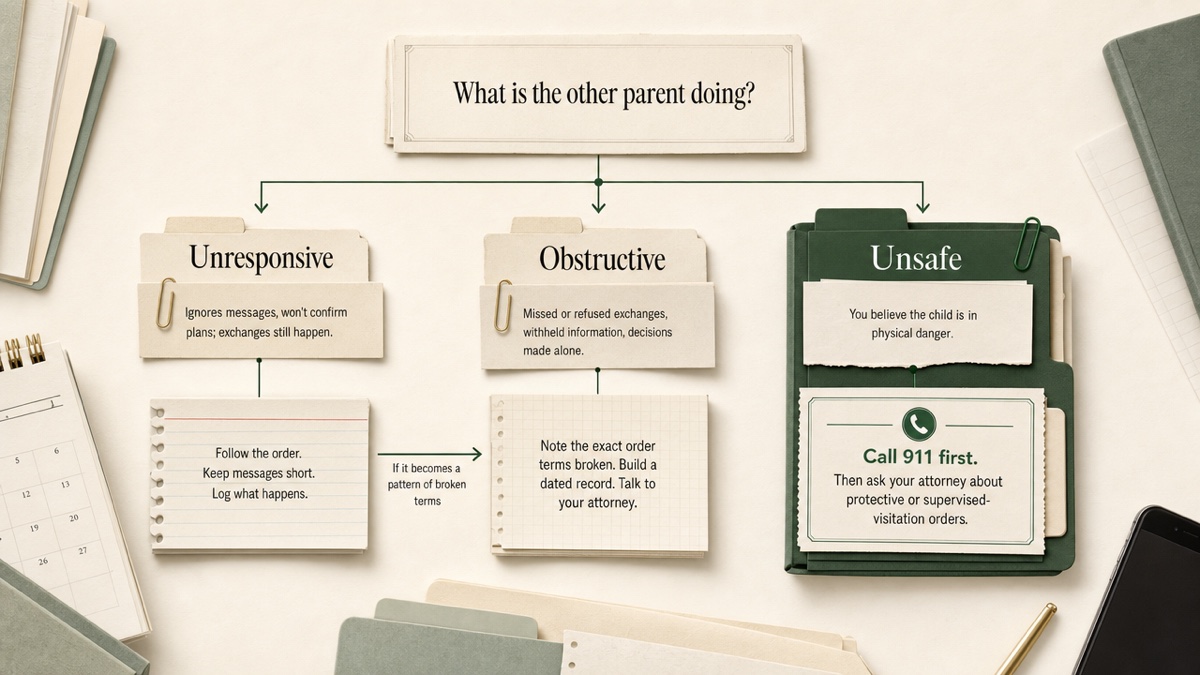
"Won't co-parent" covers very different situations. The right response depends on which one you're in.
Unresponsive. They ignore texts, don't confirm plans, and won't discuss schedule changes. The exchanges still happen roughly as the order says. This is frustrating, but it is mostly a communication problem. Your job is to follow the order, keep your messages clean, and log what happens.
Obstructive. They miss or cut short your parenting time, refuse exchanges, make decisions the order says you share, or hold back school and medical information. This is an order problem, not a manners problem. A parent generally doesn't have to be friendly. They do have to follow the order's terms on custody, exchanges, and any communication method it sets. Document the specific terms being broken and talk to your attorney about enforcement options in your state.
Unsafe. You believe the child is in physical danger. Call 911 or local police. Don't wait for a custody enforcement process. After the immediate situation is handled, ask your attorney about protective orders or supervised visitation.
Fall back on the written order
When the other parent won't negotiate, the order is the agreement. That makes it your most useful tool and your guide.
Read it again with a pen. Find the terms that cover what keeps going wrong:
- Exchange times and locations, and what happens if a parent is late
- Who provides transportation
- Holiday and summer schedules, including any notice deadlines for choosing dates
- How parents are supposed to communicate, and whether the order sets a method or response time
- Who makes school, medical, and other major decisions, and whether they are shared
- Whether disputes have to go to mediation before a parent can go back to court
If a proposed change requires their agreement and they won't answer, the order stays as written. Silence doesn't usually change the schedule. Where an order leaves things to "agreement of the parties," ask your attorney what happens if no agreement is reached. Some orders have a fallback schedule, and if yours doesn't, you may be able to ask the court to set a specific one.
Notice deadlines matter more with a silent co-parent, because there is no back-and-forth to remind you. If your order says something like "designate summer dates in writing by a certain date," put that date somewhere you'll see it. Then send your designation on time, in writing, whether or not they reply.
Write like it will be read by someone neutral
Assume a judge, a mediator, or your own attorney may eventually read every message. Write for that reader.
- Short. One topic per message. If you have several, number them so a reply can refer to each item.
- Child-focused and forward-looking. Pickup times, appointments, school deadlines. Don't relitigate last month.
- Business-like. No sarcasm, all caps, profanity, or demands. Skip "you always" and "you never," which read as blame even when they're accurate.
- A clear ask with a reasonable deadline. "Please confirm by Thursday at 6 p.m. whether you'll take her to the dentist on the 14th. If I don't hear back, I'll take her."
- From you. Not from a new partner or a relative.
- Limited. Don't stack five follow-ups on an unanswered message. One clear request, and one follow-up if it matters, makes a better record than a wall of texts.
Use whatever written channel the order specifies. If it doesn't specify one, use a channel that leaves a dated trail, such as text or email. Keep the originals on your phone or in your email account. Screenshots are convenient, but they often don't meet a state's evidence rules by themselves. Ask your attorney how they want message history preserved.
If the silence itself is the problem, you can ask your attorney whether the court can set a defined response time or communication method in your case. That's a request to the court, not something you need the other parent to agree to.
Parallel parenting: stop trying to coordinate
Parallel parenting means each parent runs their own household during their own time, with as little direct contact as possible. It doesn't depend on goodwill. It works because it needs so little from the other side.
In practice:
- Day-to-day decisions belong to whoever has the child. Bedtime, meals, screen rules, and weekend plans are yours on your time and theirs on theirs.
- Major decisions follow the order. If school or medical decisions are shared, the order still controls. Parallel parenting changes your contact, not your legal obligations.
- Information moves in writing, one way if necessary. Send the dentist appointment and the school concert date. You don't need a reply to have given notice.
- Consistency comes from your house. You can't enforce rules in their home. You can keep yours steady.
- The child is never the messenger. Don't send notes, schedule questions, or complaints through the child.
Some courts can order a formal parallel parenting plan or appoint a parenting coordinator for high-conflict cases. Ask your attorney whether that's available where you live.
Exchange and emergency protocols when they won't respond
Decide your defaults before the next bad Friday, so you aren't improvising in a parking lot.
Exchanges
- Go to the time and place the order sets, even if they haven't confirmed. Being there on time is part of your record.
- Send one dated confirmation beforehand. For example: "Confirming pickup at 6 p.m. Friday at the school, per the order."
- Note when you arrived and when they did, or that they didn't. Ask your attorney how long you should wait.
- Bring a neutral witness if exchanges keep going wrong. A neighbor or friend is better than a new partner, who isn't seen as unbiased.
- Don't withhold the child because they skipped your weekend or ignored your messages. Their violation doesn't create a right for you to commit one.
- Don't argue at the exchange. Hand off, leave, and write it down.
Not every lapse is a violation. Lateness caused by a highway closure, or keeping a child home because of a genuine safety emergency, is generally treated differently from deliberately ignoring the schedule. Log the facts and let your attorney sort out what they mean.
Emergencies
- If a child's safety is at risk, call 911 first.
- For urgent medical situations, notify the other parent in writing as soon as you reasonably can, and follow any notice timeline in your order. If your order or state law requires you to notify the other parent, their silence doesn't remove that duty.
- Keep the record: when it happened, what you did, when you sent notice, and whether they replied.
Document facts, not feelings
A record of one bad week is a complaint. A record of six months is evidence of a pattern, and judges tend to act on documented patterns, not general frustration.
For each incident, write down:
- Date and the scheduled time from the order
- What actually happened: arrival time, no-show, early return
- What you sent and when, and whether they replied
- Who was present
- Any attachments: the message, a photo of the empty parking lot, the school email
Write it the same day, in neutral terms. "Scheduled pickup 6:00 p.m. Arrived 6:00. Other parent arrived 7:25. No message received." That beats a paragraph about how they never respect anyone's time.
For specifics on logging late and skipped exchanges, see missed visitation and late pickups. For the broader method, see custody documentation. If you have nothing written down yet, start with tonight.
Patterns vs. one-offs: compare planned to actual
One late pickup in a year probably isn't worth a motion. Twelve late pickups on the same weekday is a different conversation. You can only tell the two apart if you record the weeks that went fine as well as the weeks that didn't.
That's the case for keeping planned and actual time side by side. Planned is what the order schedules. Actual is what happened. The gaps, such as missed nights, extra nights, and shortened visits, show whether you're looking at bad luck or a habit.
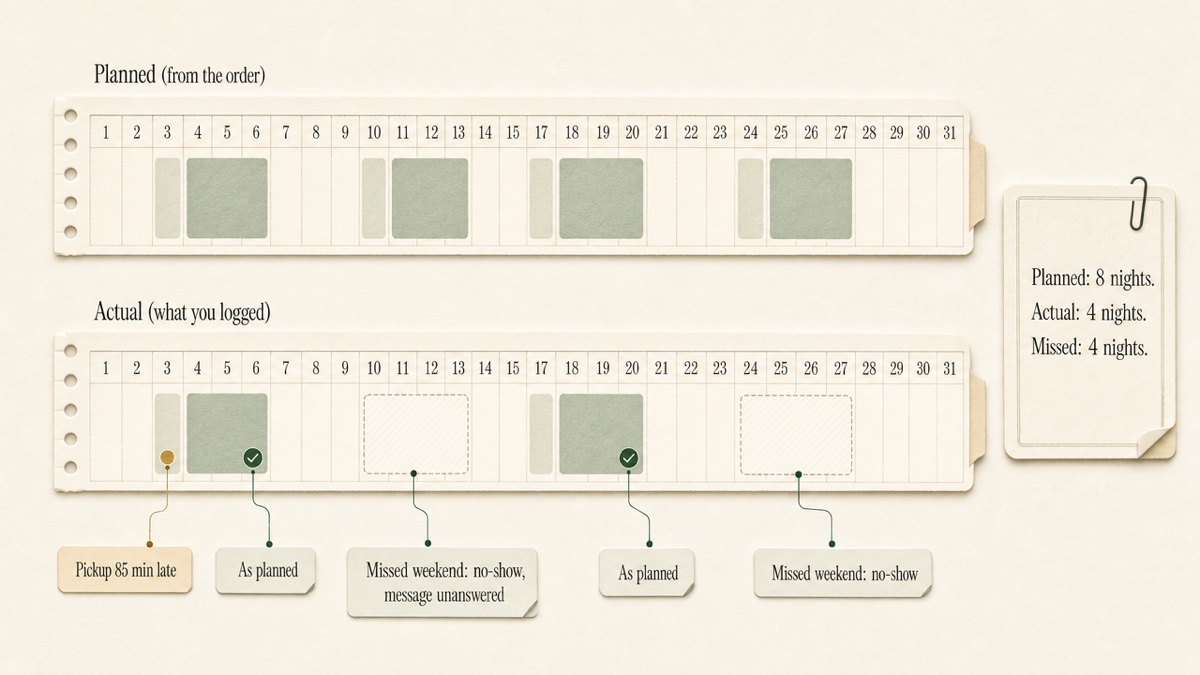
Custody Proof is built for this. You set up the schedule from your order, either by uploading it or by describing it in plain words, and review it week by week before it saves. You log what actually happened, and the Plan vs Actual view shows kept, missed, and extra time day by day. Reports can show a "Confirmed through" date to indicate you reviewed the record as you went. Violations are flagged in one of seven preset categories, with photos, screenshots, and files attached to the event they belong to. The record is private to you, and the other parent never has an account. For why a shared app is often the wrong tool when one parent won't participate, see why co-parenting apps fail.
When to involve your attorney
Bring your attorney in when:
- Parenting time is being denied or regularly cut short
- The other parent is making decisions alone that the order says are shared
- Information about school, medical care, or the child's whereabouts is being withheld
- There's a safety concern, after you've handled any emergency
- The order requires mediation and you want to make a documented good-faith attempt
- You're considering asking the court to enforce or modify the order
Bring your record organized by date, not a camera roll. An attorney who gets a filtered, chronological report can spend their time on strategy instead of piecing together what happened. Your attorney can tell you what the record supports in your state. No log guarantees a particular outcome.
Start the record now
You don't need the other parent's participation to document your time. Start your private record with Custody Proof. Documentation is $14.75/month or $144/year. Case Builder is $29/month or $278/year and adds Vero, the AI assistant. Your first charge is covered by a 30-day money-back guarantee.
Frequently asked questions
Does my ex have to answer my messages?
Usually not in the sense of being friendly or chatty. They do have to follow the order's terms on custody, exchanges, and any communication method or response time the order sets. Check your order's wording, and ask your attorney what applies in your state.
Can I skip their next visit since they skipped mine?
Withholding the child because they broke the order can create a violation of your own. Follow the schedule, document their missed time, and take the pattern to your attorney.
Should I keep texting when they ignore me?
Send one clear, dated message with a specific request and a reasonable deadline. Follow up once if it matters, then stop. A long run of unanswered texts adds clutter to your record, not strength.
What if they won't use any co-parenting app?
You don't need them to. Communicate through the written channel your order specifies, or one that leaves a dated trail, and keep your own record. Custody Proof is used by one parent only, and the other parent is never invited or notified.
Will Custody Proof notify my ex when I log a violation?
No. Flagging a violation notifies no one. If you want to share your record, you export a file and hand it to your attorney yourself.
Is a log enough to win in court?
No record guarantees a result. A dated, factual log makes your situation clearer and easier for your attorney to evaluate. What it supports in your case is your attorney's call.
Keep reading
- How to Organize a Custody Binder
- Holiday Custody Schedule Examples and How to Track Them
- How Overnights Affect Child Support
- Which custody app fits your situation
Custody Proof is a documentation tool, not a law firm. Nothing on this page is legal advice. Whether and how a record is used in a case is a question for your attorney.