Holiday custody schedule examples, and how to keep a record
By EJ Archuleta, Licensed attorney · Updated
Most US holiday custody schedule examples follow one of three patterns: alternating years, splitting the day, or fixed holidays. Alternating years means one parent has Thanksgiving in even years and the other in odd years. Splitting the day means one parent has the morning and the other has the afternoon. Fixed holidays means the same parent has the same day every year, as with Mother's Day and Father's Day. Plans then add birthdays, school breaks, and a summer vacation block, and most say holiday time takes priority over the regular weekly rotation.

That covers the drafting. This page also covers what happens on the actual day. Holiday time replaces the regular schedule, "dates to be designated" turn into arguments, and every holiday block changes your overnight count. If the holiday goes wrong, the record you keep that week usually matters more than the template you started with.
This is general information, not legal advice. Custody law and local default schedules vary by state and county. Your own order controls, and your attorney is the person to ask about it.
Common holiday arrangements, with examples
Alternating by year
Each major holiday goes to one parent in even years and the other in odd years. A common version gives each parent two or three major holidays per year, with holidays defined as 9 a.m. to 7 p.m. that day or 9 a.m. to 9 a.m. the next morning.
Example: Parent A has Thanksgiving and Easter in even years. Parent B has Christmas Eve and July 4. The assignments flip in odd years.
Trade-off: each parent gets a full, unhurried holiday. Each parent also misses that holiday every other year.
Splitting the day
The holiday is divided into two periods so the child sees both parents on the day itself. A common split runs 9 a.m. to 2 p.m. for the first period and 2 p.m. to 7 p.m. for the second. The periods can alternate each year. Or one parent can always take the first half, if that fits how each household celebrates.
An extended split shares the days around the holiday instead:
- Thanksgiving Thursday 9 a.m. to Friday 9 a.m., then Friday 9 a.m. to Saturday 9 a.m.
- December 24 at 9 a.m. to December 25 at 9 a.m., then December 25 at 9 a.m. to December 26 at 9 a.m.
Trade-off: both parents get some of the holiday. The cost is two exchanges in one day, and each exchange can go wrong.
Fixed holidays
The same parent has the holiday every year. Mother's Day and Father's Day are the usual examples, each assigned to the matching parent. Some families also fix holidays that matter to only one household, such as a religious observance or a family reunion weekend.
Evening holidays
Halloween and the Fourth of July happen mostly after dark. Many schedules give those holidays an evening window that becomes an overnight, so fireworks or trick-or-treating don't collide with a 7 p.m. return.
Birthdays, parent days, and school breaks
Child's birthday. This usually alternates by year, or it is a short window, such as a few hours after school, for the parent who doesn't have the child that day. Decide whether the birthday moves to a weekend or stays on the date.
Mother's Day and Father's Day. These are usually fixed to the matching parent. Write down the start and end times. "Mother's Day" alone does not say whether the day starts Saturday night or Sunday morning.
Parent birthdays. Some plans include them and many don't. If yours doesn't, the regular schedule applies.
School breaks. Winter break is often split into two equal halves, counted in calendar days including weekends, with the halves alternating by year. Spring break often goes entirely to one parent and alternates each year. Thanksgiving break may be treated as a holiday or as a break.
Two school districts. If the parents live in different districts, the breaks may not line up. Name whose calendar controls, for example "the school the child attends." Then define the exact start, such as "when school releases" or "6 p.m. the day school releases," and the exact end.
Summer vacation blocks and notice periods
Summer usually works differently from holidays. The plan may give each parent a set number of weeks, limit how many separate trips a parent can take, and require written notice of the chosen dates by a deadline. Many plans also require an itinerary for travel: departure and return dates, the destination, flight details, and an emergency phone number. Some plans give priority to the first proper request when both parents ask for the same weeks. Whether yours does, and what "proper" means, depends on your order and on any local default schedule that applies when the order is silent..
The notice deadline is the part people miss. If the order says you must designate summer dates in writing by a set date, missing that deadline can cost you the choice. Treat the deadline as its own calendar item, separate from the vacation itself.
How holiday time overrides the regular schedule
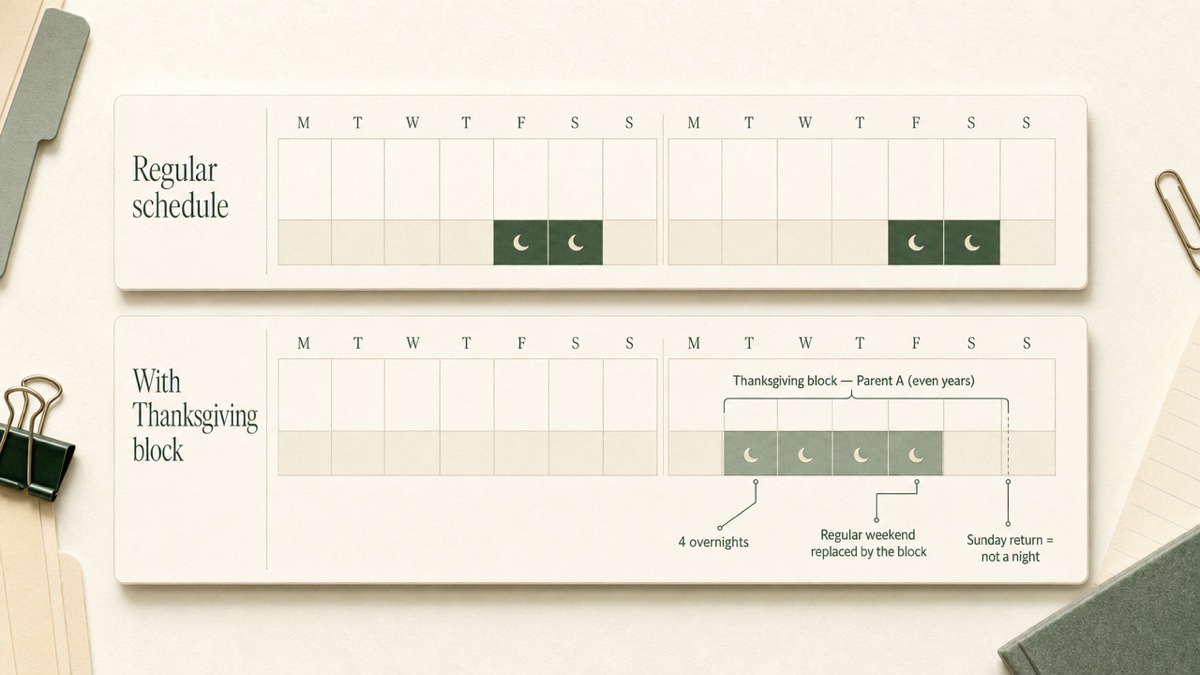
Most plans say that the holiday schedule takes priority over regular weekday, weekend, and sometimes summer time. Some add that if a holiday is not assigned to anyone, the child stays with whoever normally has that day. Some local schedules go further and let a parent keep both the holiday and the regular time when the holiday falls on that parent's weekend..
Two side effects to watch for:
- The three-weekend problem. A holiday weekend can give one parent three weekends in a row. Some plans restart the alternating-weekend pattern after the holiday so no one goes more than two weekends without the children. Check whether yours says anything about this. If it says nothing, that gap is a common source of disputes.
- The regular pattern resumes. Know exactly when the regular schedule starts again after a block, down to the day and the hour.
"To be designated" dates and moving holidays
Phrases like "dates to be designated" and "Easter weekend" feel clear when the plan is signed. A year later they are the most common reason a holiday becomes a fight. Every vague term invites two readings.
When drafting, or when asking your attorney to tighten an existing plan, pin down:
- Moving holidays by rule, not by name. For example: "Easter Sunday, 10 a.m. to 7 p.m." or "Thanksgiving: the fourth Thursday in November, Wednesday 6 p.m. to Sunday 6 p.m." Religious holidays that follow a lunar calendar need the rule written out, including which day counts as the start.
- Who designates, how, and by when. For example: "in writing, by the deadline stated."
- What happens if no one designates. Without a fallback, a missed deadline becomes an argument about what was "obviously" intended.
- Times and time zones. For long-distance holidays, state which time zone the exchange times use, who drives or flies with the child, and where the exchange happens, such as a named airport or a halfway point.
Handling last-minute holiday changes in writing
Holiday plans change: a flight moves, a grandparent gets sick, someone offers a swap. A change agreed on a phone call is very hard to prove in February.
You can protect your side of it without the other parent's cooperation:
- Put it in a message yourself. For example: "Confirming: you'll have the children Christmas Day 2 p.m. to Dec 26 9 a.m. instead of the order's 9 a.m. exchange." Your message is dated even if no one answers.
- Save the reply, or the silence. Screenshot the thread with its dates visible.
- Check your order's change clause. Some plans require temporary changes to be agreed in writing ahead of time. Others allow changes by agreement without saying it must be in writing, but a verbal agreement is hard to prove later, so confirm it in a message..
- Log what actually happened, not what was planned. If the swap went ahead, your record should show the swap.
Documenting denied or shortened holiday time
When a holiday is refused, cut short, or started late, write it down the same day. Record:
- The scheduled time under the order, and the clause it comes from.
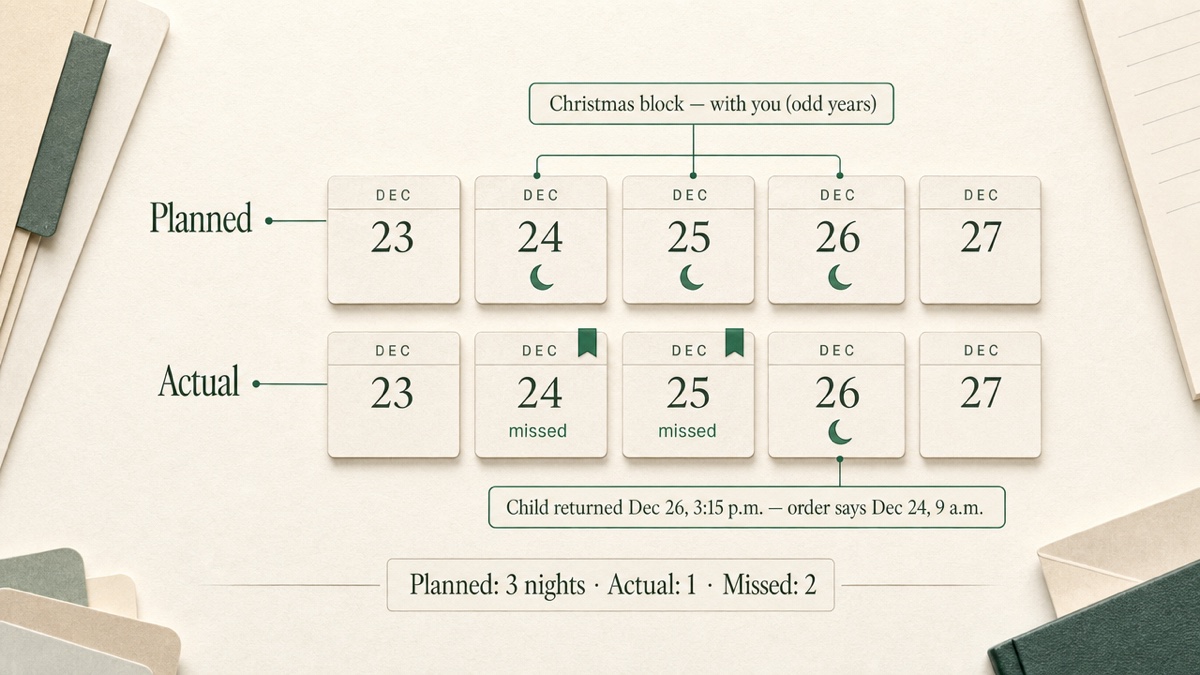
- The actual time. For example: "Order: 9 a.m. pickup. Child produced 11:40 a.m."
- Where you were, and whether anyone was with you.
- What was said or sent. Save messages as screenshots.
- Costs that followed, such as a missed flight or nonrefundable tickets, with receipts.
Keep the entry factual. "Child not at exchange point at 9:00, 9:30, or 10:00. Texted at 9:05 and 9:40. No reply." holds up better than a description of how the day felt. Whether makeup time is available, and how to ask for it, depends on your order and is a question for your attorney. Many plans allow makeup time only in limited situations. For the general method of logging these incidents, see missed visitation and late pickups.
How holidays affect overnight counts
Overnight counts are where holiday provisions quietly change the numbers. Parenting time is commonly counted by nights the child slept at your home. The full method is in how courts count parenting time.
- A Thursday 9 a.m. to Friday 9 a.m. Thanksgiving is one overnight.
- A 9 a.m. to 2 p.m. split-day holiday is zero overnights. It is daytime parenting time.
- Half of winter break can add several nights that come out of what would have been the other parent's regular weeks, or the reverse.
Each of these moves the annual percentage. Every 7 nights out of 365 is about 2 percentage points. Overnight counts can affect child support in many states, though some count the overnights set in the order rather than those actually exercised.. A record that shows only the regular rotation, and leaves out what holidays actually did, will be off in both directions.
Tracking holiday time in Custody Proof
Custody Proof is private documentation software for one parent. The other parent is never invited and never notified. Holidays work like this:
- Holidays are blocks of time on your schedule. Each block repeats one time, every year, in odd years, or in even years. You can type "Thanksgiving with me, even years," or let the schedule be read from your uploaded order, which shows the order's original wording on each block so you can check it. Blocks that follow a holiday whose date moves land on the right dates each year. Full details: holiday and vacation blocks.
- The block takes priority. During a block, your regular pattern is replaced for those dates. The calendar, statistics, plan-vs-actual comparison, and reports all follow it. A "with you" carve-out inside the other parent's block also wins.
- Undesignated dates stay open. You can save a block with no dates, marked "Dates to be set." The dashboard asks for the dates as the period approaches.
- Notice deadlines become reminders, such as "designate summer by April 1." Yearly reminders roll forward on their own.
- Plan vs. actual compares what was scheduled with what you logged. It shows missed and extra nights, and you can flag violations and attach screenshots in the encrypted evidence vault. Split-day holidays can be logged as timed visits, which stay out of the overnight percentage.
When your attorney asks, you can export a dated, filtered report instead of retelling the holiday from memory. Start your record. Plans start at $14.75/month, with a 30-day money-back guarantee on your first charge.
Frequently asked questions
Does holiday time always override the regular schedule?
Usually, but not always. Many plans say so explicitly. Some local default schedules handle overlaps differently, for example by letting a parent keep both the holiday and the regular time. Read your order's priority clause and ask your attorney if it is unclear.
What happens if the order says "dates to be designated" and no one designates?
That depends on whether the order includes a fallback. If it doesn't, the gap is a common source of disputes. Keep a dated record of when you designated or tried to designate, and raise the gap with your attorney before the next holiday.
Does a split-day holiday count as an overnight?
No, if the child returns the same evening. A 9 a.m. to 2 p.m. period is daytime parenting time. Only a period that runs through the night adds an overnight.
Can I track holidays that alternate between odd and even years?
Yes. Blocks in Custody Proof can repeat every year, in odd years only, or in even years only. Alternating holidays are a built-in option.
Will the other parent see my holiday schedule or my notes?
No. There is no shared account and no notification. If you want someone to see your record, you export a file and hand it to them yourself.
Keep reading
- How Overnights Affect Child Support
- How to Modify a Custody Agreement: Documenting the Change
- What to Include in a Parenting Plan: Checklist
- Which custody app fits your situation
Custody Proof is a documentation tool, not a law firm. Nothing on this page is legal advice. Whether and how a record is used in a case is a question for your attorney.