How overnights affect child support, and why the count must be right
By EJ Archuleta, Licensed attorney · Updated
In many states, child support starts with the parents' incomes and is then adjusted for how much time the child spends with each parent, most often measured in overnights. That is how overnights affect child support: more overnights with one parent can shift the amount, but usually only after the time passes a threshold your state sets. Income differences can still produce support even when time is close to equal.
So the overnight number is a real input, not decoration. It is also easy to get wrong. A count taken from the order is one number. A count of the nights that actually happened can be another.
This page explains the general picture in plain terms. It is general information, not legal advice. Support rules vary by state, so take questions about your own case to a family law attorney licensed where your case is.
The guideline models, at a high level
Every state publishes child support guidelines. Most fall into one of three broad models.
Income shares. Both parents' incomes are combined, a basic support amount is set for that combined income and the number of children, and each parent is responsible for a share in proportion to what they earn. The idea is that the child should receive roughly the share of parental income they would have received if the parents lived together. This is the most widely used model.
Percentage of income. Support is set as a percentage of the paying parent's income, sometimes varying by the number of children. Some versions adjust for parenting time and some do not.
Melson formula. A more detailed variation that first sets aside a basic amount for each parent's own needs, then allocates income toward the child's primary needs and a share of what remains.
Which model your state uses, and how it treats parenting time, is written in your state's guidelines. Use them as the reference, not a general article.
Why parenting time can factor in
The logic is practical. A parent who has the child overnight is usually providing dinner, breakfast, a bed, and the rest of a household. When time is shared more evenly, both homes carry real costs, and some of those costs are duplicated.
Many guidelines handle this the same way in outline. They calculate a basic amount as if one parent had the child most of the time, then apply a parenting-time adjustment. That adjustment usually does not apply until the other parent's share of overnights crosses a set level. Above it, many states adjust on a sliding scale, sometimes increasing the basic obligation first to reflect two households. The thresholds, the scale, and the arithmetic differ by state, and some states have changed theirs over time.
Two consequences follow:
- A few nights can matter, or matter not at all. Near a threshold, a handful of overnights can change which part of the guideline applies. Far from one, the same nights may change nothing.
- Equal time does not mean zero support. If incomes differ, support can still be owed in a roughly 50/50 arrangement.
Overnights versus days
Most states measure parenting time for support by overnights. A few count differently, using portions of days or hours, or defining a "day" in their own terms.
Under an overnight count, the unit is the night the child sleeps at your home:
- Friday after school to Sunday evening is 2 nights, not 3 days.
- January 1 to January 11 is 10 nights. The 11th is the return morning, not a night.
Count days and you will come out one high on every stay. Across a year of alternating weekends, that error adds up fast. The full explanation, with examples, is in how courts count parenting time.
Daytime visits are a separate question. A Wednesday dinner is parenting time, but it is not an overnight. In an overnight-based state it may not count toward the support figure at all. In a state that counts hours or partial days, it might. The safe record keeps both, separately: overnights as nights, visits as a count with hours. Then your attorney can use whichever your state requires without anyone untangling a blended number.
Planned timeshare versus actual timeshare
This is the part most explanations skip.
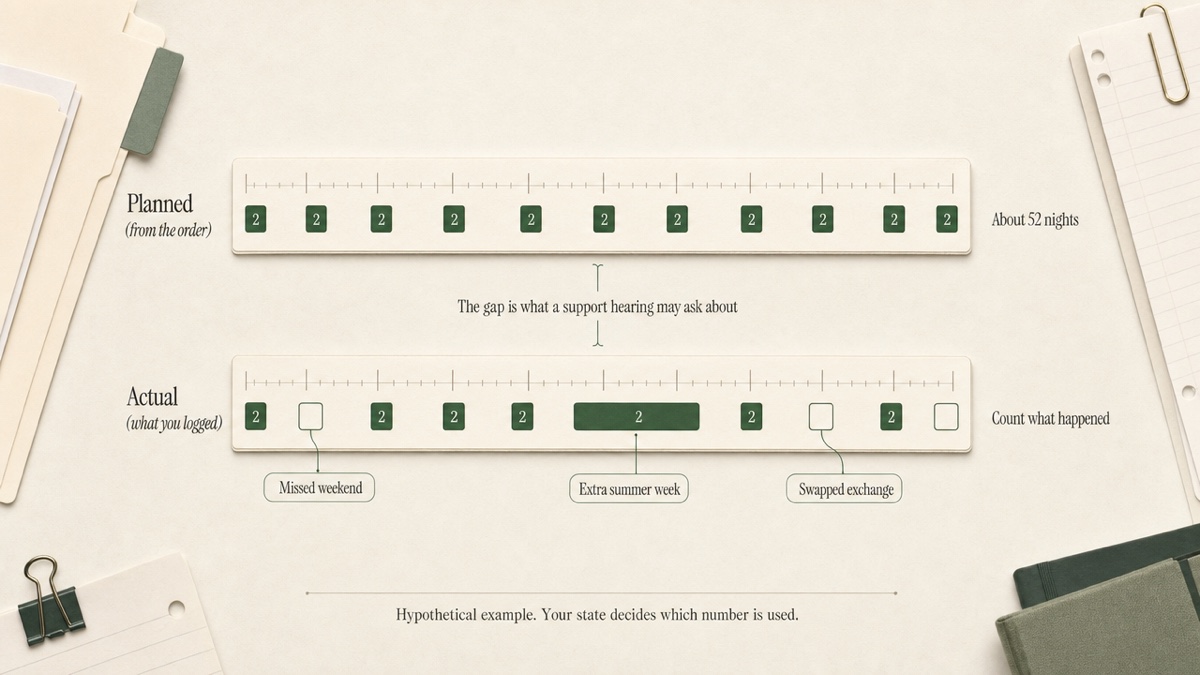
Your order describes a plan. Real life drifts. A parent stops exercising alternate weekends. Holidays get swapped. A summer block shrinks. After a year, the overnights in the order and the overnights that happened can be noticeably different.
A simple illustration, with hypothetical numbers: an order for every other weekend is two nights, about 26 times a year, so roughly 52 overnights. Miss four of those weekends and the actual figure is about 44. Add an extra week in summer that the order did not provide and it moves again. Neither number is a guess, but only one describes what happened.
States differ on which number they use. A key question in setting support is whether to rely on the time written in the decree, the time actually exercised, or both. Some states credit overnights actually and lawfully spent with a parent, even outside the order, when credible evidence supports them, and presume the order's number otherwise. Some states may not credit time taken in violation of a court order, so check how your state treats it.
Whichever rule applies, the parent with a dated, consistent record of actual nights is in a better position than the parent with a recollection. "They hardly ever take their weekends" is a claim. A calendar showing which weekends were missed, by date, is a record.
Holidays, swaps and partial days
- Holidays and school breaks. Log them as the order sets them and as they happened. If the holiday follows a rotation, record which year you had it.
- Swapped exchanges. Log the night where the child actually slept. Do not leave the original plan in place and add a note.
- Late returns and early pickups. In an overnight state these often do not change the night count, but log the times anyway. They may matter under a different counting rule, or as a pattern.
- Disputed nights. Mark them as disputed in your notes rather than quietly counting them. A record that admits a gray area holds up better than one that claims every edge case.
Multiple children and night counting
If two children sleep at your home on the same Tuesday, that is one Tuesday. A custody percentage measures your time, so one calendar night counts once no matter how many children were there.
Per-child detail still matters, especially when siblings are on different schedules. Some guidelines handle children with different overnight counts by averaging or by calculating each child separately. To make that possible, your record needs both views, clearly labeled:
- Nights: unique calendar nights with at least one child.
- Child-nights: each child's nights added together. One night with two children is 2 child-nights and still 1 night.
Unlabeled, those two numbers look like inflation. Labeled, they answer two different questions.
What support usually covers, and what it often does not
Basic support is generally meant for the child's ordinary living costs: food, housing, clothing, everyday needs. Many orders treat certain costs separately and divide them between the parents, commonly uninsured medical and dental costs, childcare, and sometimes school or activity costs. Those shared costs can create an obligation even when the basic support figure is small or zero. Which costs are shared, in what proportion, and what notice is required are set by your order and state guidelines.
That means two records, kept apart: overnights for the parenting-time side, and a dated expense ledger with receipts for the add-ons. The system for the second is in how to track unreimbursed child expenses.
Preparing your records for a support hearing
Ask your attorney what they want and in what form. If they have not said, these are the pieces that usually help:
- An overnight total for a defined period, such as the last 12 months or year to date, counted as nights.
- A calendar showing where each night was spent, so the total can be checked date by date.
- Planned versus actual, if adherence is disputed: nights kept as ordered, missed, and extra.
- Timed visits, kept separate, with counts and hours.
- Exchange notes and messages that explain deviations: the cancellation text, the swap agreement.
- The expense ledger with receipts, filtered to what is actually at issue.
Consistency is the credibility test. The total on your summary should match the calendar, and the calendar should match the exchange notes. If you discover a mistake, fix it in the record before you hand it over, not at the hearing.
Your attorney will also know which official worksheet or calculator your state uses. State courts and child support agencies typically publish their guidelines and worksheet online. Your job is an accurate input. The calculation belongs to the guideline and the people applying it.
Where Custody Proof fits
Custody Proof is a private record kept by one parent. The other parent is never invited and never notified. It does not calculate child support. It keeps the input honest.
- Overnights are counted as nights, with the end date as the return morning. Timed visits are tracked separately as a count and hours and never enter the overnight percentage. Details: how custody time is counted.
- Upload your order or describe your schedule in plain words, and the app compares the planned schedule against what you logged. Reports can include a planned-versus-actual section and a "Confirmed through" date showing you reviewed the record.
- One night with several children counts once, with a By Child view and labeled child-nights on reports.
- The expense ledger tracks receipts, reimbursable shares, and what has been received.
- Exports include a one-page stats summary, a detailed PDF, a CSV your attorney can work from, and an expense report with receipts as labeled exhibits.
Documentation is $14.75/month or $144/year. Case Builder, at $29/month or $278/year, adds Vero, who turns voice notes, pasted texts, and photos into draft entries you review. Vero never guesses dates.
If support may depend on your overnights, start counting the real ones now. Start your record.
Frequently asked questions
If we have 50/50 custody, does anyone pay child support?
Possibly. Under many guidelines, equal time reduces the effect of the time adjustment, but differences in income can still produce support. Shared costs like childcare or uninsured medical bills can also create an obligation. Your state's guideline decides.
Do daytime visits count toward the support calculation?
It depends on how your state measures parenting time. Most use overnights, and a few count hours or portions of days. Keep visits recorded separately with their hours so the right number is available either way.
Will logging more overnights lower my support?
No record guarantees a change. How overnights affect support depends on your state's model, its thresholds, whether it uses ordered or actual time, and the incomes involved. An accurate count helps your attorney work with the right number.
Does Custody Proof calculate child support?
No. It counts overnights, visits, and expenses and exports them in a form your attorney can enter into your state's official worksheet or calculator.
Will the other parent know I'm tracking overnights?
No. There is no shared account, no invitation, and no notification. If you share a record, you export a file and hand it over yourself.
Keep reading
- How to Modify a Custody Agreement: Documenting the Change
- What to Include in a Parenting Plan: Checklist
- How to Prepare for Custody Mediation: Records to Bring
- Which custody app fits your situation
Custody Proof is a documentation tool, not a law firm. Nothing on this page is legal advice. Whether and how a record is used in a case is a question for your attorney.