How to Prepare for Custody Mediation: The Records to Bring
By EJ Archuleta, Licensed attorney · Updated
To prepare for custody mediation, know three things before you walk in: the schedule you want, your realistic outcome if no deal is reached, and a short set of records that settle the facts. Those records are overnight counts, planned versus actual parenting time, a dated list of missed or late exchanges, and an expense ledger with receipts.
Decide with your attorney which records to share and when. Then plan how you will track the agreement once it is signed.
This guide is for one parent preparing on their own. It does not depend on the other parent agreeing to anything before the session. It is general information, not legal advice. Mediation rules vary by state and by court, so ask a family law attorney where you live about your case.
What custody mediation is, and what it covers
Mediation is a negotiation run by a neutral third party. The mediator helps both parents talk, test options, and draft terms. The mediator does not decide who is right and cannot impose a result. Any agreement is yours to accept or refuse.
Custody mediation usually covers:
- Legal custody: who makes major decisions about health care, education, and similar matters.
- Physical custody: where the children live most of the time.
- Parenting time: the calendar, including weekdays, weekends, holidays, summer, and exchanges.
- Logistics: exchange locations, transportation, notice for schedule changes, and how parents communicate.
Some court programs limit the topics. In California's court-connected mediation, for example, child support and evidence against the other parent are not discussed. Private mediators often handle a wider range of issues, including finances, though some court programs also cover child support or property in the same or a separate session. Ask what is in scope before you prepare, so your binder matches the session you are actually attending.
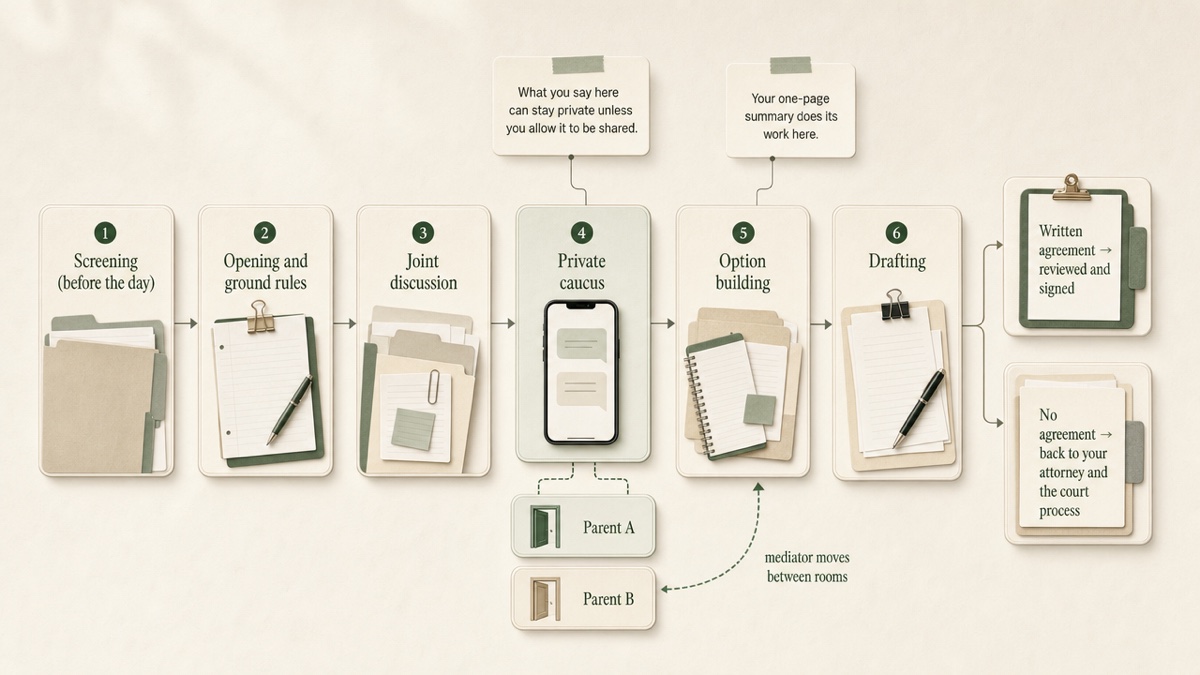
How a session usually runs
Formats vary, but most sessions follow a similar shape.
- Intake and screening. Many programs screen each parent beforehand for domestic violence, power imbalance, or other issues that affect whether mediation is safe or fair.
- Opening. The mediator explains the ground rules, confidentiality, and how the day will run.
- Joint discussion. Each parent describes the issues and what they want.
- Private caucuses. The mediator meets with each parent separately. What you say in caucus generally stays private unless you allow the mediator to share it. It is normal for the mediator to spend more time with one side.
- Option building. The mediator moves between parents testing proposals, often working directly on a draft calendar.
- Drafting. If you reach terms, someone writes them up. In court programs, a judge or other judicial officer typically reviews and signs the agreement before it becomes an enforceable order.
Finding and vetting a mediator
Even when a court orders mediation, you may get some say in who mediates. In family cases, look for formal family mediation training and real experience with custody disputes. Some states offer a special certification for family mediators.
Questions to ask before you agree
- What family mediation training do you have, and how many custody cases do you handle in a year?
- How do you screen for domestic violence or coercive control? Can sessions run in separate rooms or by video?
- Do you expect a pre-session memo? Is it confidential, or shared with the other parent?
- Will I sign an agreement to mediate? Can I read it in advance?
- Who writes up any agreement we reach, and in what form?
- What do you charge, how is the cost split, and what happens if we run late?
- Have you worked with either parent, either attorney, or either family before?
That last question is about neutrality. A good mediator answers it plainly and discloses any connection without being pressed.
Mediation vs. litigation
Where mediation tends to win: it usually costs less and moves faster. Sessions are private. Parents can shape details, such as an exchange time that fits a work shift, that a judge might never consider.
Where it tends to lose: nobody can compel the other parent to agree. A parent who stalls can use sessions to delay. A parent who intimidates can use them to pressure. Unclear terms written in a hurry can seed the next dispute.
When mediation is a poor fit
Mediation assumes both people can negotiate freely. That assumption breaks down when there is abuse, threats, stalking, or a large imbalance of power or information. Some courts limit or prohibit mediation in custody cases where a court has found domestic violence or a protective order exists.
If safety is a concern, tell the screener and your attorney before the session, not during it. Options may include:
- Separate rooms with the mediator moving between them.
- Video sessions.
- Staggered arrival and departure times.
- Asking to be excused from mediation entirely.
Mediators are mandatory reporters of child abuse in most states. Keep that in mind when deciding what to raise and how.
The records to bring
Court guides tell you to "bring documents." That instruction is too vague to help. These are the records that answer the questions that come up in custody negotiations.
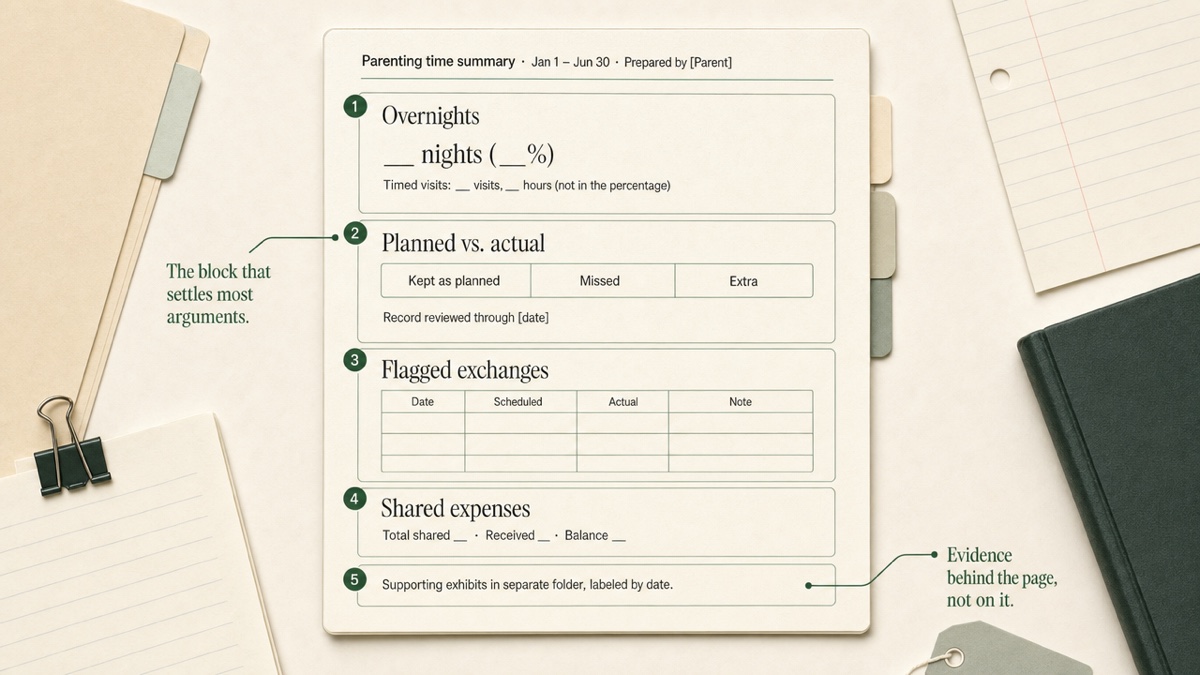
1. A one-page parenting-time summary
Bring one page that shows the period covered, your overnight count, and your overnight percentage. Count nights, not calendar days. A Friday-to-Sunday weekend is two nights. Keep timed day visits as their own line, with a count of visits and total hours, so dinners do not inflate the overnight number. How courts count parenting time explains the math.
If you have more than one child, show nights and child-nights separately, each clearly labeled. Unlabeled totals invite the accusation that you inflated your numbers.
2. Planned vs. actual
This is the record that most often ends an argument. It compares what the current order or informal arrangement scheduled with what actually happened: nights kept as planned, nights missed, and extra nights.
A comparison you reviewed as you went is stronger than one rebuilt from memory the week before. Note the date through which you checked your record.
3. A dated log of flagged violations
List each missed exchange or late pickup with the date, the scheduled time, the actual time, and one line of description. Group entries by type so a pattern is visible at a glance.
Bring the supporting texts or screenshots in a separate folder, labeled by date. Do not lead with them.
4. An expense ledger
If your session covers money, bring a ledger of child expenses. Each row should show the date, amount, category, and receipt, plus whether the cost is shared under your current arrangement and what has been reimbursed. Filter it to what is in dispute, such as medical costs this year, rather than your entire history.
5. Supporting documents the mediator may ask for
Depending on scope, these can include:
- Pay stubs, tax records, health insurance costs, and day care costs.
- School attendance records or report cards, if they are at issue.
- A draft parenting plan or proposed calendar.
- Case numbers for any police reports.
Some courts ask for multiple copies of everything. Check your program's instructions.
Write facts, not feelings
Your summary will be read by someone trained to hear both sides. Adjectives cost you credibility. Dates, times, and counts earn it.
| Instead of | Write |
|---|---|
| "He is always late and doesn't care." | "Pickups scheduled 6:00 p.m.: 9 of 14 started after 6:30 p.m. (Jan–Jun)." |
| "She keeps the kids whenever she wants." | "4 scheduled weekends not exchanged: Feb 9, Mar 8, Apr 12, May 24." |
| "I pay for everything." | "Shared medical costs since Jan 1: $___. Received: $___." |
Keep your feelings for the caucus or for your attorney. They are real, and they matter. They are not the summary.
How confidentiality changes what you bring
In most states, what is said during mediation generally cannot be used later in court, whether or not you reach agreement. There are exceptions, and the rules vary by state.
Records you kept before the session usually exist independently of it. Showing a log you kept in the ordinary course to a mediator generally does not make the log itself off-limits later, but summaries or notes you prepare specifically for the mediation may be treated as confidential.
The reverse also matters. A pre-session memo may be shared with the other parent. Before you write one, ask whether it is confidential, and decide with your attorney what goes in it.
Coordinate with your attorney
Agree on roles in advance. Will your attorney attend the session, or only help you prepare and debrief afterward?
Ask for a reality check: what is the likely outcome if this goes to a judge? Your best and worst realistic outcomes without a deal set the floor for what you accept.
Send your records early, in the format your attorney prefers. Organized exports also reduce the hours spent sorting a pile of screenshots; see what attorney time costs. For how to structure the full record, see how to document custody for court.
After the session: make the agreement trackable
A signed agreement is a plan. Once it is approved or signed, you need a way to show whether the plan is followed. Do this the week it takes effect:
- Build the new schedule into a calendar. Include rotations, holidays that alternate by year, summer blocks, and any dates "to be designated."
- Record notice deadlines as reminders. Examples include "designate summer weeks in writing by April 1."
- Log actual time against the plan. Confirm the weeks that went as scheduled, not just the exceptions.
- Keep the expense ledger running under the new cost-sharing terms.
If the agreement breaks down later, you will return to your attorney with a record that starts on day one.
If you use Custody Proof for this
Custody Proof is a private documentation app for one parent. The other parent is never invited or notified.
You can upload your agreement or describe the schedule in plain words. It becomes a recurring calendar that you review week by week before anything saves. Deadlines found in your order are offered as in-app reminders.
From there, you log overnights and timed visits separately, flag violations, attach evidence, and keep an expense ledger with receipts. The Reports page exports:
- A one-page Stats Summary.
- A Detailed PDF with an optional Planned vs. Actual section that cites the date you confirmed your record through.
- An expense report with receipts as labeled exhibits.
See Reports and exports for how to export them.
Documentation is $14.75/month or $144/year. Case Builder is $29/month or $278/year and adds Vero, the AI assistant. Your first charge has a 30-day money-back guarantee.
Start your record before the session.
Frequently asked questions
What should I bring to custody mediation?
Bring a one-page parenting-time summary with overnight counts and a planned-vs.-actual comparison. Add a dated log of missed or late exchanges, and an expense ledger with receipts if money is in scope. Also bring any documents your program requests, such as financial or school records. Ask in advance how many copies you need.
Can I prepare if the other parent won't cooperate with anything?
Yes. Everything on this list comes from your own records: your calendar, your receipts, and the messages you received. None of it requires the other parent to sign up for, share, or approve anything.
Will the records I bring be confidential?
What is said in mediation is generally confidential in most states, with exceptions. Documents you created before the session are usually treated differently. Ask your attorney, or your court's self-help center if you do not have one, how your state handles both.
Should I bring every screenshot I have?
Bring a summary up front and organized exhibits behind it, labeled by date. A mediator has limited time. A pattern shown in one table usually lands better than forty images passed across the table.
What if I feel unsafe being in the room?
Tell the screener and your attorney before the session. Depending on your court, options may include separate rooms, video sessions, staggered arrival, or asking to be excused from mediation.
Does Custody Proof provide mediators or a place for both parents to work?
No. It is a documentation tool for one parent. You keep your record privately and export files to share with your attorney or bring to a session yourself.
Keep reading
- Gaslighting in Co-Parenting: Signs and How to Document It
- Can a Judge Order a Co-Parenting App?
- Are Co-Parenting Records Admissible in Court? Plain Terms
- Which custody app fits your situation
Custody Proof is a documentation tool, not a law firm. Nothing on this page is legal advice. Whether and how a record is used in a case is a question for your attorney.