Gaslighting in Co-Parenting: A Same-Day Record Is Your Best Defense
By EJ Archuleta, Licensed attorney · Updated
Gaslighting in co-parenting happens when the other parent repeatedly denies, rewrites or minimizes what happened (an agreement, an exchange time, a message) until you start doubting your own memory. It works because memory fades and certainty sounds convincing. The strongest counter is a record written the same day, with the original texts and photos attached, that a third party can read without having to take your word for anything.
This page covers what gaslighting looks like between co-parents, what it costs you and your children, and what a credible record contains. It is general information, not legal or mental-health advice. Talk to a qualified attorney or counselor about your own situation.
What gaslighting looks like between co-parents
Gaslighting is a form of psychological abuse. One person uses manipulation and deception to make another question their memory, their perception and sometimes their sanity. The name comes from an old stage play and film in which a husband manipulates his wife into believing she is losing her mind.
Between co-parents, it usually centers on logistics. Logistics are where the facts live, so that is where the rewriting happens.
Common tactics
- Denying agreements. "We never agreed to switch weekends," days after you agreed by phone.
- Moving the goalposts. The pickup time "was always 6," even though it was 5.
- Small distortions. A history that sounds right but has one date, time or detail changed. These are the hardest errors to disprove from memory.
- Certainty and indignation. A flat denial delivered with offense, so that questioning it feels rude.
- Blame reversal. Their late arrival becomes your fault for "confusing them."
- Guilt and warmth. Affection or hurt feelings used to make you drop the subject.
Lawyers recognize these patterns in litigation too. Intense conviction, righteous denial and slightly altered history work best when combined with shame.
Phrases you may hear
- "You never remember things correctly."
- "You're overreacting."
- "I was only joking."
- "You're trying to confuse me."
- "It's all your fault."
- "You know I would never hurt you on purpose."
One phrase alone means little. A steady pattern of them, aimed at things you can check, is the warning sign.
Signs it is working on you
You may notice that you apologize for things you didn't do. You may reread old texts to confirm what you already knew, avoid raising problems because the argument isn't worth it, or second-guess dates you used to be sure of. The more often the tactics repeat, the more likely a person is to doubt their own reality. That effect is the whole point of the tactic.
What it does to you, and to the kids
Being gaslit can lead to anxiety, depression and other mental health problems. The risk is higher for people with a history of trauma, low self-esteem or depression. If you notice these effects, treat them as a health issue and not a character flaw.
Children feel it too. They may hear two incompatible versions of the same weekend, or sense that one parent's account always "wins." Some practical guardrails:
- Don't use the children as messengers or fact-checkers.
- Don't question them after exchanges to build your case.
- Acknowledge their feelings ("that sounds confusing") without criticizing the other parent.
- If a child tells you something on their own, write down what they said, in their words, with the date.
A child therapist can help with age-appropriate ways to support a child's sense of what is real.
Why a same-day record beats memory
Gaslighting needs your account to be vague. "I'm pretty sure it was Friday" loses to "It was never Friday." A note you wrote Friday night, with the text thread attached, doesn't depend on how sure you sound.
It also changes who has to do the work. Without a record, you have to convince someone. With one, the other side has to explain the gap between their story and a dated entry.
A consistent log also shows a pattern, and patterns are what judges and evaluators look for. Scattered, undated complaints can be harder for a judge or evaluator to weigh than a consistent, dated record. For more on why this matters, see records, not memories.
What a credible entry looks like
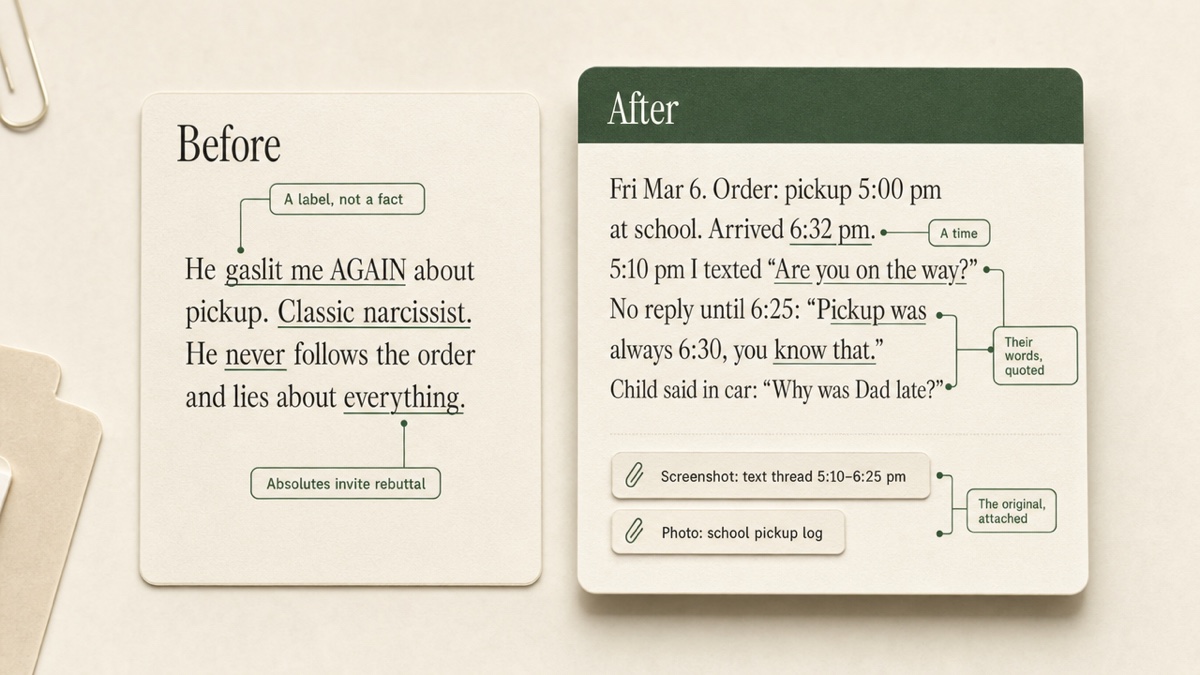
Facts, not diagnoses
Write what a camera would have recorded: date, time, place, who was there, what was said (quoted where you can), and what happened next. Leave out "gaslighter," "narcissist," "manipulative" and "as usual." Those words don't add evidence. They make the writer look like the problem, and they give the other side an easy way to dismiss the whole log.
If something affected the children, record the observable part, such as "missed the first 40 minutes of the game," not "he's damaging them."
Attach the original
A summary is your account. The text itself is their words. Screenshot the message, keep the original thread on your phone, and attach the screenshot to the entry it belongs to. Photograph physical evidence such as a damaged item or a sign-in sheet.
Screenshots alone sometimes don't meet a court's evidence rules. Ask your attorney whether a fuller message export is needed. Keep audio and video files unedited on the original device. Copying, converting or trimming can strip the date and device information embedded in the file.
Recording conversations is a separate question. Consent rules differ by state, and a recording made the wrong way may be unusable or worse. Before you record a conversation, ask an attorney about your state's rules. Some states let you record if you are part of the conversation, while others require everyone in it to agree.
Same day, real dates
Write the entry the day it happens. If you're entering something late, use the real event date and say in the entry when you wrote it. Never backdate. An honest "written March 9 about March 6" is worth more than a perfect-looking entry that falls apart under questioning.
Plan vs. actual: where the schedule fight gets settled
Many gaslighting disputes come down to the calendar: "You've had them every weekend," or "I've never missed a visit." The answer is two columns, what the order planned and what actually happened, compared night by night.
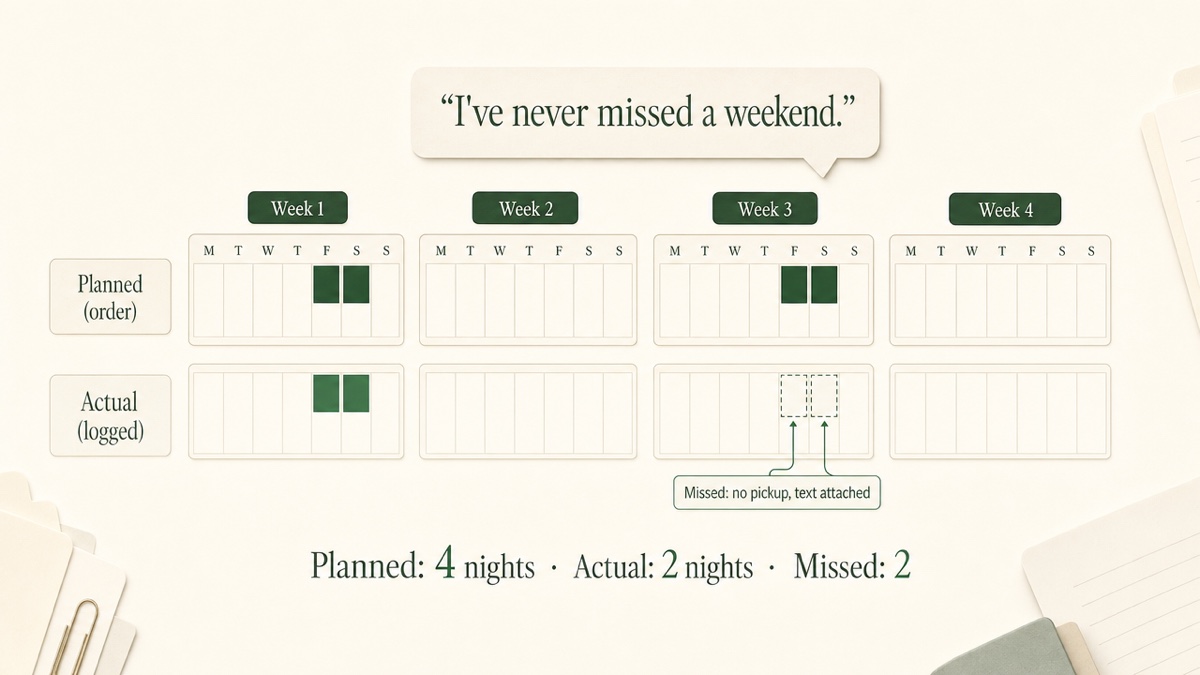
Log missed and late exchanges as they happen. This guide on missed visitation and late pickups walks through it. Also confirm the weeks that went as planned, so the record shows the whole picture and not only the bad days.
Shrink the surface area: communication and boundaries
You can't stop someone from rewriting events, but you can give them less to rewrite.
- Keep logistics in writing. Answer phone calls with a text that confirms what was said: "Confirming: you'll pick up Saturday at 10."
- Stay short and factual. You don't have to defend every point. "That's not my recollection. My notes show 5:00 pm" is enough.
- Follow your order. If it specifies a communication method or response window, use it exactly.
- Bring a neutral observer to exchanges if they're contentious. A neighbor is better than a new partner, and an observer isn't there to take sides.
- Don't argue history in real time. Write it down, and let the record do the arguing later.
Get help: therapist, support, attorney
A therapist or counselor is a good first step. They can help you trust your own perception again, and they can help with safety planning if you need it. Trusted friends who simply witness what happens make it harder for one person's story to override yours.
Bring your attorney the record, not a speech. They can tell you what matters under your state's law and what form it needs to be in.
Where Custody Proof fits
Custody Proof is a private documentation app for one parent. The other parent is never invited and never notified.
- Calendar: log overnights and timed visits, flag violations, and compare your planned schedule against what you actually logged.
- Evidence vault: store dated entries in seven categories, including Communications and Incidents, with screenshots, photos and files attached to the entry they belong to. Files are encrypted with AES-256 before storage. See how the evidence vault works.
- Exports: produce PDF reports and the Court Packet to hand your attorney.
- Vero (Case Builder plan): turns a voice note or pasted thread into a draft in neutral language. Vero never guesses a date, and you review every draft before it saves.
Pricing: Documentation is $14.75/month or $144/year. Case Builder is $29/month or $278/year.
Start your private record. Your first charge has a 30-day money-back guarantee.
Frequently asked questions
Should I write "gaslighting" in my notes?
No. Describe what happened and quote what was said. Let the reader draw conclusions. Labels make a log look like a grievance file.
Is gaslighting a legal claim?
It describes behavior, not a cause of action. In custody matters, courts generally look at conduct and how it affects the children. Your attorney can tell you what's relevant where you live.
Are screenshots enough?
Screenshots are a good start. Keep the original messages on your device too, and ask your attorney whether a fuller export is needed.
Can I record our conversations?
It depends on your state's consent rules and how the recording is made. Ask an attorney before recording anything.
Will the other parent know I'm documenting?
Not through Custody Proof. There's no shared account and no notification. If you share a record, you do it by exporting a file yourself.
Keep reading
- Can a Judge Order a Co-Parenting App?
- Are Co-Parenting Records Admissible in Court? Plain Terms
- Domestic Violence Custody Case Evidence: Document Safely
- Which custody app fits your situation
Custody Proof is a documentation tool, not a law firm. Nothing on this page is legal advice. Whether and how a record is used in a case is a question for your attorney.