Are Co-Parenting Records Admissible in Court? A Plain-Terms Guide
By EJ Archuleta, Licensed attorney · Updated
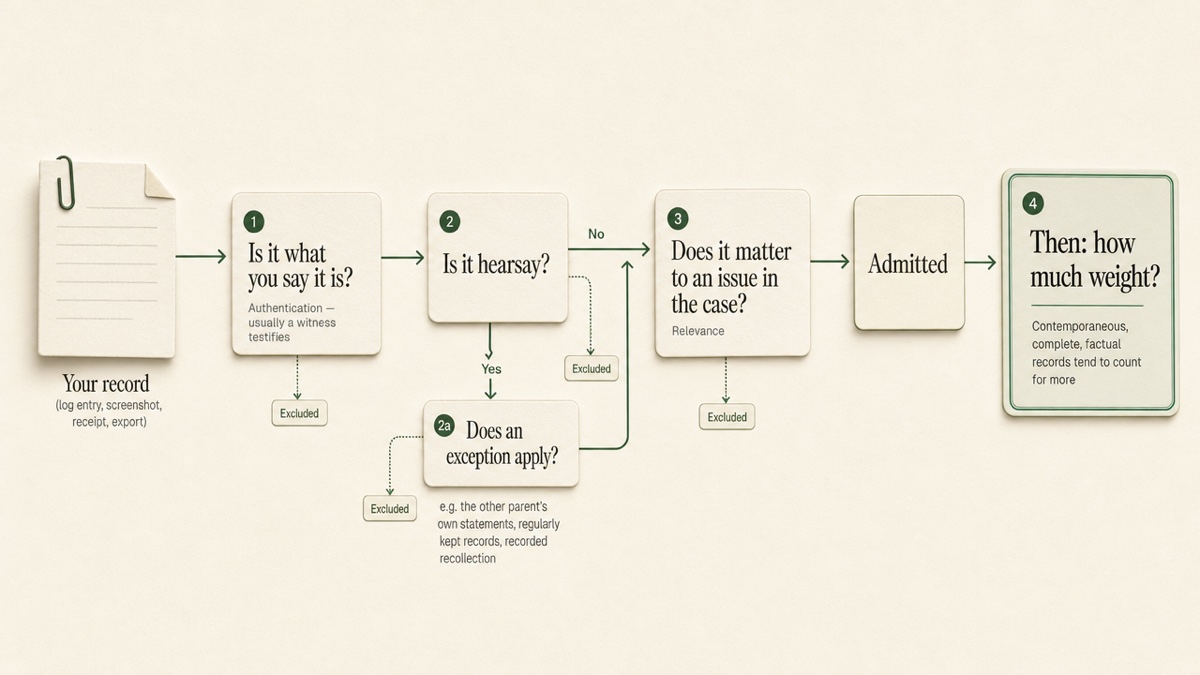
Co-parenting records can be admissible in court, but no app makes them admissible. A judge decides, applying your state's rules of evidence to the specific record, the specific case, and whoever is offering it. Whether the record came from a shared co-parenting platform or from your own private log, it generally has to get past the same questions: is it what you say it is, is it hearsay, and does it matter to an issue the court is deciding.
You control a different set of things. You decide whether the record was written when events happened, whether it is complete, whether it sticks to facts, and whether the originals behind it still exist. Those are the qualities that give a record weight.
This page is general information from a family-law perspective, not legal advice about your case. Evidence rules vary by state, so take questions about your own case to a family law attorney licensed where it is pending.
Why "court-admissible" is a loaded word
"Admissible" describes a ruling, not a product feature. A record is admitted when a judge, at a hearing, decides it can come in. That ruling depends on who is testifying, what the record is offered to prove, whether the other side objects, and the local rules.
So when software calls its output "court-admissible," it is describing a hope. A tamper-resistant PDF can make authentication easier. It cannot guarantee that a judge admits the exhibit, and it cannot guarantee the judge believes it.
The better question is whether your record will be easy for your attorney to use and hard for the other side to pick apart.
Two separate questions: is it real, and is it hearsay
People often merge these. Courts usually don't.
Authentication: someone has to vouch for it
To authenticate evidence is to show it is what it appears to be, or what the person offering it says it is. Most evidence is authenticated through a witness. In a custody case, that witness is often you.
The questions tend to be simple. Do you recognize this exhibit? What is it? Who made it, and when? Is it in the same condition as when you made it or first saw it? Has anything been changed?
If you kept the log yourself, you are the person best positioned to answer those questions. That is one reason your own records can be useful. It is also why you need to be able to explain them under cross-examination.
Hearsay: authentic is not the same as admissible
A record can be exactly what you say it is and still be excluded as hearsay, an out-of-court statement offered to prove that what it says is true. Your journal entry saying "pickup was 90 minutes late" is your out-of-court statement.
Several exceptions commonly come up with custody records. The other parent's own texts or emails, offered against them, are often treated differently from third-party statements. Records kept as a regular practice may fit a business-records exception. Personal notes may be used to refresh your memory on the stand, or in some situations read in as a recorded recollection. If you use notes to refresh your memory, the other side is usually entitled to see them.
Which exception fits, if any, is a call for your attorney. The point to remember is that authenticity alone is not the whole test.
Certified business records, and where shared apps fit
A business record, in the general evidence sense, is one made at or near the time of an event by someone with knowledge, kept in the course of a regularly conducted activity, where making that kind of record is routine. Those conditions are usually shown by a custodian's testimony or by a qualifying affidavit or declaration. Even then, the record can be kept out if its source or preparation looks untrustworthy.
Some evidence rules also let certain certified records authenticate themselves, without a live witness, when they come with the right certification. Requirements differ by state, so attorneys check their own state and local rules.
This is the service some shared co-parenting platforms sell. Because both parents' messages pass through the company's servers, the company can act as custodian and provide a certified export or a business records affidavit, often for a fee.
A private, one-parent log is a different kind of record. You are the author, so you are generally the witness. There is no third-party custodian certifying it. That is not a defect. It is a different evidentiary route, and your attorney will know which one fits your situation. For the structural difference between the two kinds of tools, see Custody Proof vs. co-parenting apps.
How subpoenas of app data generally work
Shared platforms generally will not hand one parent's data to the other just because they ask. Getting it usually takes formal legal process. That usually means a subpoena issued under civil procedure rules, through an attorney or in some courts the court clerk, sometimes with retrieval or witness fees paid in advance. Discovery requests to the other parent can also reach data in their control.
Discovery also runs the other way. In many cases, each side can be asked to produce documents and data in its possession, custody, or control. A private log is not off-limits just because the other parent never saw it, though privilege and relevance limits can apply. If you do not produce it when properly asked, you may not be able to use it later. If you are asked to produce your records, or a subpoena mentions them, talk to your attorney before you hand anything over.
Contemporaneous notes vs. reconstructed memories
An entry written the evening of a late exchange and an entry written eight months later about the same exchange are not equal, even if the words match.
The first was made while the details were fresh, before anyone knew there would be a hearing. The second is a reconstruction, and cross-examination is built for reconstructions. "When did you write this? What did you look at? Why that date?"
Most states let personal notes be used to refresh your memory and, in limited situations, read in as a recorded recollection, but the details differ, including what foundation is required and when the other side may see or introduce the notes. In every version, timing matters. There is a longer case for this in records, not memories.
How attorneys actually use a client's log
Most attorneys do not drop a parent's journal on the bench and rest. In practice, a client-kept record tends to do quieter work:
- Building the timeline. The attorney reads it to learn what happened and when.
- Finding the real exhibits. A dated entry points to the text, receipt, or school email that proves the point.
- Preparing testimony. You review your own entries before you testify.
- Summaries and calculations. Overnight counts, expense totals, and patterns of missed time often reach the court as a summary built from your underlying records, which usually must be made available to the other side.
- Discovery and settlement. An organized record shows the other side what you can prove.
If the log is organized, the attorney spends time on strategy. If it is a camera roll, they spend it sorting.
Facts, not conclusions
Evaluators and judges know that the material a parent submits is what that parent thinks proves a point. A neutral entry survives that skepticism better than an argumentative one.
Argumentative: "She's sabotaging my time again, like always. She doesn't care about the kids."
Factual: "Saturday 3/8. Scheduled exchange 10:00 a.m. at the school lot. Arrived 9:55. Other parent arrived 11:32 with both children. Text at 10:40 said 'running late.' Screenshot attached."
The second version gives a reader a date, a time, a place, and a document. It lets the judge reach the conclusion. The first asks the judge to adopt yours.
Complete beats curated
Evaluators report finding out later that a parent left out parts of a conversation, sometimes on purpose and sometimes not. Once that surfaces, everything else that parent submitted looks thinner.
Keep the whole thread, not just the worst message. Log the weekends that went fine along with the ones that didn't. A record showing 40 exchanges on time and 6 late is more believable than one showing only the 6.
Preserve the originals
Electronic evidence can be faked, and the other side knows it. If authenticity is seriously disputed, a forensic examiner may need the original device or file, not a copy of a copy. Protect that ability:
- Keep the phone. Don't trade in or wipe a device that holds key messages without asking your attorney first.
- Keep the original files. Store the photo itself, not only a cropped or edited version. Edits and re-saves can strip metadata.
- Screenshot with context. Capture the contact name, the date, and the surrounding messages. Know that screenshots alone sometimes fall short, and ask your attorney whether a fuller export is needed.
- Keep paper receipts until you are told you no longer need them.
- Never delete. Destroying electronic evidence during a dispute can carry serious consequences, and in some jurisdictions it can be treated as a crime.
- Only collect what you lawfully have access to. Ask before recording anyone or accessing another person's accounts.
Where Custody Proof fits, and where it doesn't
Custody Proof is a private documentation tool for one parent. It does not produce certified records, and you are the person who stands behind what you export.
What it does is help you keep the kind of record described above:
- Entries are dated and timestamped as you log them.
- Files attach to the incident or expense they belong to.
- Evidence files are encrypted (AES-256) in a vault only your account can see. See the evidence vault.
- A planned-vs-actual comparison and a "Confirmed through" date show that you reviewed the whole record, not just the bad days.
- Exports include PDFs with receipts and photos labeled as exhibits, CSVs for attorneys who work in spreadsheets, and a ZIP with every original attachment. See reports and exports.
An export won't win an evidentiary ruling. It gives your attorney something dated, filtered, and labeled to work from. The other parent is never invited or notified.
Finding your state's version
Every state has its own evidence code and procedural rules. That includes its own form, or lack of one, for a business records affidavit and for self-authenticating records. Most are modeled on the federal rules, some closely and some loosely, and a few states follow their own codes; either way the details differ. Your attorney, or the court's self-help center, can point you to the version that applies.
If you want a record that is ready when your attorney asks for it, start one with Custody Proof. Plans start at $14.75/month, with a 30-day money-back guarantee on your first charge.
Frequently asked questions
Are screenshots of texts enough for court?
Sometimes, sometimes not. Screenshots are easy to dispute and often lack context. Keep the original messages on the device, capture full threads with names and dates, and ask your attorney whether a more complete export is needed for your case.
Can Custody Proof provide a business records affidavit or certified copy?
No. Custody Proof exports files you create and control, such as PDFs, CSVs, and evidence archives. You authenticate them, usually through your own testimony, with your attorney deciding how to present them. If you receive a subpoena involving your records, contact your attorney and Custody Proof support.
Is a private log less credible than a shared co-parenting app?
Not automatically. A shared app may offer a custodian's certification. A private log relies on you as the witness. Credibility comes mostly from timing, completeness, and factual tone, whichever tool you use.
I started documenting late. Are my older entries useless?
No, but be honest about them. Enter past events with their real dates and attach the original evidence you have, such as texts, receipts, and emails. Don't present a reconstruction as if it were written at the time. Your attorney can decide how to use it.
Should I send my log to the other parent's lawyer?
Not on your own. Whether, when, and how your records are produced is a discovery question for your attorney.
Keep reading
- Domestic Violence Custody Case Evidence: Document Safely
- High-Conflict Custody Exchanges: Handle and Document Them
- How to Prepare for Child Custody Court: A Checklist
- Which custody app fits your situation
Custody Proof is a documentation tool, not a law firm. Nothing on this page is legal advice. Whether and how a record is used in a case is a question for your attorney.