High-Conflict Custody Exchanges: Keep Them Short, Keep Records Exact
By EJ Archuleta, Licensed attorney · Updated
Two things help most with high-conflict custody exchanges: make the handoff short, public, and predictable for your children, and write a factual record of every exchange right after it ends. The first protects the kids today, and the second gives your attorney something better than "it's always a fight."

This page covers both: where and how to hand off, what to say when the other parent starts something, and what to write down afterward, including late, missed, and refused exchanges. It is general information, not legal advice. Exchange rules come from your order, and custody law varies by state, so take questions about your case to your own family law attorney.
Pick a place that lowers the temperature
Exchanges tend to go better where other people are around. Common choices are the child's school or daycare, a busy parking lot, or a spot near a police station. Watchers change behavior, and a school pickup can remove the face-to-face meeting entirely: one parent drops off in the morning, the other picks up after class.
Your order may already name the exchange location. If it does, use that location, even when you'd prefer another. If the current location isn't working, ask your attorney how a change would be made. Don't change it on your own.
Keep the handoff short and about the child
The exchange is not the time to settle anything. Talk only about what the child needs in the next few days: medicine, a school form, a sleep problem. Anything else can wait for writing.
Make it routine:
- Arrive on time. Lateness, even by a few minutes, is one of the most common sparks for an argument at a handoff.
- Have the bag packed and in hand before you get out of the car.
- Say a warm, quick goodbye. Long goodbyes make leaving harder for the child.
- Leave once the child is across.
Prepare the kids before the car door opens
Exchanges are hard on children. They can feel caught between parents and have no control over the schedule. Young children may cry, hide, or say they don't want to go. Older children may get angry or shut down.
Things that help:
- Tell them the plan ahead of time. "After school Friday, Dad picks you up. You'll be back Sunday after dinner."
- Keep the schedule predictable, with as few exceptions as you can manage.
- Let them bring a comfort object (a blanket, a stuffed animal, a book) that travels both ways.
- Use the same small ritual every time, like a song in the car or a hand squeeze at the door. Repetition tells a child this is normal.
- Don't ask them to report back on the other home. A child is not a witness for your file.
What to say when it starts
You can't control the other parent. You can control how long you stay and how much you say. Keep a few lines ready:
- "I'm here for the exchange. Let's keep this about the kids."
- "I hear you. Please send that to me in writing."
- "We can agree to disagree. I'm going to go now."
- To the child: "Have a great weekend. I love you. See you Sunday."
Asking for things in writing does two jobs. It ends the argument in the parking lot, and people tend to be less hostile when they write something a court might read later. Then leave. Raising your voice or answering an accusation in front of the child hurts the child, and conflict at exchanges can be held against either parent.
If you feel unsafe, leave and contact law enforcement. Then tell your attorney.
What to log after every exchange
Professional supervised exchange providers use a standard form so the same facts are captured every time. Their observation notes typically include each parent's arrival time, who brought the child, how long the exchange took, departure time, and how the child and the adults behaved on arrival and departure. They also keep the notes objective and correct mistakes visibly instead of erasing them. You can hold your own notes to the same standard.
Write the entry the same day, ideally before you leave the parking lot:
- Date.
- Scheduled time, as the order sets it.
- Actual time each person arrived, and when the child was handed over.
- Location.
- Who was present: the other parent, a new partner, a relative, bystanders.
- What happened, in plain facts. Quote direct statements word for word when you can.
- The child's behavior at arrival and departure.
- Corroboration: the "running late" text, a timestamped photo of the empty lot, a witness's name.
A later pickup is a clock reading. "She was being impossible" is a conclusion, and conclusions weaken a log. Write "arrived 6:47 p.m. for a 6:00 p.m. exchange; said 'you'll never see them on my weekends' in front of the children."
If you get something wrong, correct it openly ("Correction: arrival was 6:52, not 6:47") rather than quietly rewriting the entry.
A note on recording: consent laws vary by state, and some states require every person's permission before audio is recorded. Ask your attorney, or a legal aid office or lawyer referral service if you don't have one, before you record anyone at an exchange.
For a starter routine you can begin today, see how to document tonight.
Late, missed, and refused exchanges
These three incidents make up most exchange records. Each needs slightly different notes.
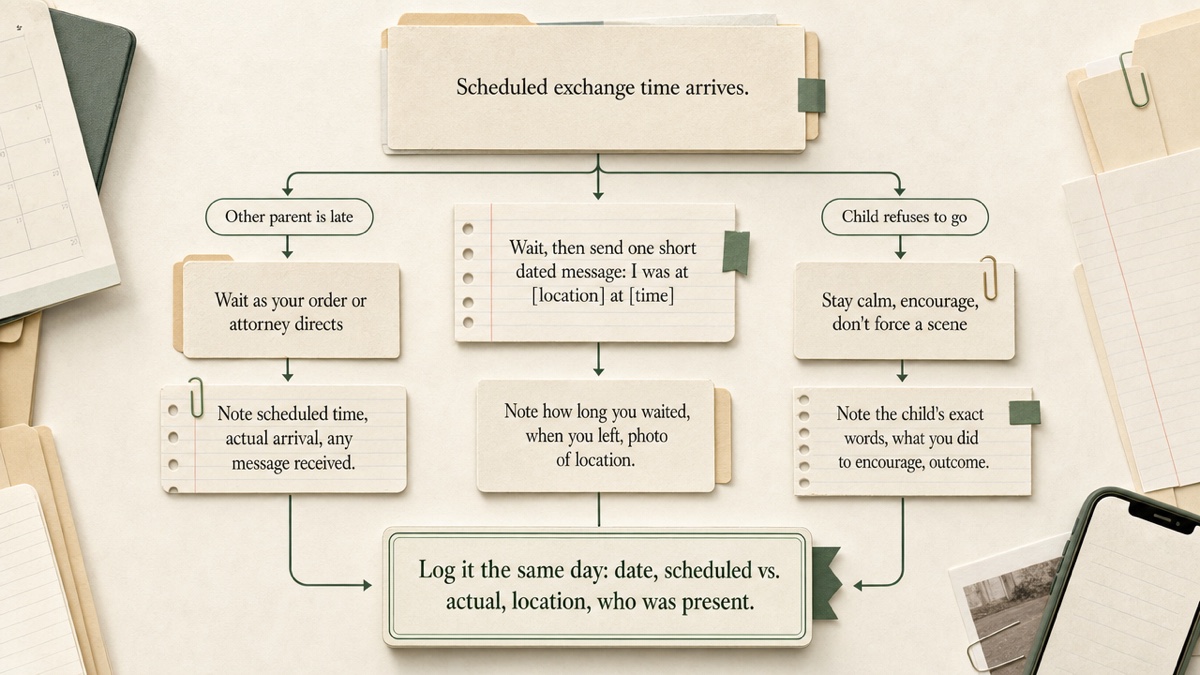
Late arrivals. Wait. Record the scheduled time, the actual arrival, and any message you received. One late pickup is a bad day. Lateness at most exchanges for months is a pattern. How long you have to wait, and whether a long delay forfeits the period, depends on your order and your state. Read your order first, then ask your attorney, or a legal aid office or court self-help center if you don't have one, so you know the answer before it happens.
No-shows. Stay for the time your attorney recommends. Before you leave, send one short, dated message: "I was at the school lot with the kids at 6:00 as scheduled and waited until 6:45." Take a photo with a timestamp. Keep the message to facts, with no commentary. More on handling these: missed visitation and late pickups.
A child who refuses to go. This is the hardest one, and the rules depend on your state and the child's age. In general, stay calm, encourage the child warmly, and avoid a physical struggle. Then write down the child's exact words, what you did to encourage the exchange, how long it lasted, and how it ended. A careful note protects you whichever parent is on the receiving end. Ask your attorney, or a legal aid office or court self-help center if you don't have one, what is expected of you before it happens again.
Long-distance and travel exchanges
When parents live far apart, exchanges often happen at a midpoint, such as a busy restaurant or gas station off the highway, or at an airport. The same logging rules apply. Add the details travel creates:
- departure and arrival times
- flight numbers and gate changes
- traffic or weather delays
- receipts for gas or fares
An airline delay notice is strong corroboration of why someone was two hours late. Save it.
Supervised and third-party exchanges
When direct contact keeps going badly, there are a few general options.
A third party handles the handoff. A grandparent or friend does the exchange in your place. Whether that's allowed usually depends on your order, so check before you send someone.
Supervised exchange programs. Often court-connected, these let the child move between households without the parents meeting. Typically one parent drops off and leaves before the other arrives. Programs keep their own records and may report attendance and violations to the court or attorneys. Many have strict rules about arrival times, and repeated cancellations or late arrivals can end services.
Asking for changes through your attorney. If exchanges keep failing, your attorney can tell you whether to ask the court to change the location, the method, or add supervision.
Even with a supervised provider, keep your own notes. Some programs record only significant events, so your entry may be the only record of a quiet but late Friday. How much weight a court gives a parent's notes compared with a neutral provider's records is a question for your attorney. Corroboration helps either way: texts, photo timestamps, receipts, witnesses.
Turning entries into a pattern your attorney can use
A stack of notes is raw material. A summary is what your attorney or a guardian ad litem can read in a few minutes. Every few months, count:
- scheduled exchanges in the period
- exchanges that happened on time
- late arrivals, and the typical delay
- no-shows
- refusals
- incidents in front of the children
"Late to 9 of 14 exchanges between March and June, average delay 40 minutes, two no-shows" tells your attorney more than pages of frustration. Bring the dated entries behind every number.
Where Custody Proof fits
Custody Proof is private documentation software for one parent. The other parent is never invited or notified.
Logging the time. Log each period on the calendar as an overnight stay or a timed visit with real hours. See adding custody time.
Logging the incident. Flag a late pickup or missed exchange as a violation using the preset categories. Then attach the screenshot, photo, or note to that event, so the evidence sits next to the date it belongs to.
Seeing the pattern. Plan vs. Actual compares your saved schedule with what you logged, day by day. The Patterns view shows when violations happen and how often.
Handing it to your attorney. Reports export as dated, chronological PDFs.
On the Case Builder plan, you can tell Vero what happened by voice note right after the exchange. She drafts the entry for you to review, and she never guesses a date.
Documentation is $14.75/month or $144/year. Case Builder, which adds Vero, is $29/month or $278/year. Start your record.
Frequently asked questions
Can I change the exchange location myself?
If your order names a location, follow it. Changing it usually takes a written agreement or a court order. Ask your attorney how that works where you live.
Should I bring someone with me to exchanges?
A calm adult can lower tension and can be a witness if something goes wrong. Check whether your order limits who can attend. Choose someone who will stay quiet and stay back.
Does Custody Proof track exchanges by location or GPS?
No. You log the time on the calendar and write the location and details yourself. You can attach photos, screenshots, and files to the entry.
Will the other parent see what I log?
No. There is no shared account, invitation, or notification. If you share a record, you do it yourself by exporting a file.
I didn't write anything down for past exchanges. Is it too late?
No. Enter past exchanges with their real dates, use texts and photos you already have to pin down times, and mark which details come from memory.
Keep reading
- How to Prepare for Child Custody Court: A Checklist
- Co-Parent Lying About You in Court? Answer With Records
- Contempt of Court for Custody Violations: What to Document
- Which custody app fits your situation
Custody Proof is a documentation tool, not a law firm. Nothing on this page is legal advice. Whether and how a record is used in a case is a question for your attorney.