Contempt of Court for Custody Violations: Meaning and What to Document
By EJ Archuleta, Licensed attorney · Updated
Contempt of court for a custody violation is a request asking a judge to find that the other parent knew about a specific term in a court order and disobeyed it. Whether a violation qualifies usually turns on three things: a clear written term, proof the parent knew about it, and conduct that looks deliberate rather than accidental. Judges generally decide this from the order's wording, dates, and a pattern. How angry the situation has made you is not part of the test.
This page explains those principles in plain language and shows how to keep a violation log your attorney can use. It is general information, not legal advice for your case. Contempt rules and procedures differ by state, so talk to a family law attorney licensed where your order was entered.
What contempt means in a custody case
A custody order is a court command. When a parent disobeys it, the other parent can ask the court to enforce it. Contempt is one enforcement tool. It is not a ruling on who is the better parent, and it is not a way to punish rude texts. It can generally rest only on a specific provision of a written order, not on bad behavior in general.
Civil vs. criminal contempt
In broad terms:
- Civil contempt aims to get someone to comply. The court usually gives the person a way to "purge" the contempt by doing what the order requires: following a set schedule, paying an amount, or providing makeup time. In many places, using contempt to enforce a parenting time order is generally treated as civil, though courts can use criminal contempt when the goal is purely to punish, and the rules vary by state.
- Criminal contempt aims to punish a past violation that can't be undone. It usually carries stronger procedural protections for the accused parent and is less common in ordinary parenting-time disputes.
Depending on the state and the type of contempt, consequences can include fines, payment of the other side's attorney's fees, makeup parenting time, or jail. A judge may also skip contempt and use other remedies to get the order followed. Your attorney can tell you what is realistic where you live.
Why clear terms and willfulness usually matter
Two questions sit under most contempt requests.
Is the term clear? "Exchanges at 6:00 p.m. Sunday at the school parking lot" can be shown to have been broken. "The parents shall cooperate" is much harder to enforce. Courts generally also expect the order to be valid and clear, and the other parent to have known about it, often through formal service, though service and notice rules vary by state.
Was it willful? Courts commonly separate a parent trying to get around the order from a parent who misunderstood it or genuinely couldn't comply. Where the filing parent shows noncompliance, the other parent may get the chance to show inability to comply. A one-time late return after a highway closure reads differently from eight Sundays in a row.
The second question is where documentation earns its keep. One incident is a story. A dated series measured against the order starts to look like a choice.
Violations that commonly come up
Most contempt requests in custody cases involve a small set of facts:
- Missed exchanges. The other parent doesn't show, or doesn't bring the child.
- Late returns. The child comes back hours or a day after the order's return time.
- Withheld time. Whole weekends, holidays, or summer weeks are denied.
- Unpaid shared expenses. Medical, school, or activity costs the order splits but the other parent doesn't pay.
- Other written provisions. Notice deadlines, right-of-first-refusal clauses, or communication terms, where the order actually spells them out.
For timing problems specifically, see missed visitation and late pickups.
Show the pattern against the schedule
Attorneys generally want to see three things side by side: what the order says should happen, what actually happened, and how often the two differ. That is a planned-vs.-actual timeline, and most parents don't have one. They have a camera roll and a memory.
To build one:
- Start from the order's schedule, including holidays and summer blocks, not the schedule you wish you had.
- Mark every scheduled exchange, including the ones that went fine. A record that only shows problems invites the question of what you left out.
- Note each deviation by date: missed, late (with times), or extra.
- Review the record regularly and note how far it has been checked, so it reads as a kept record and not a reconstruction.
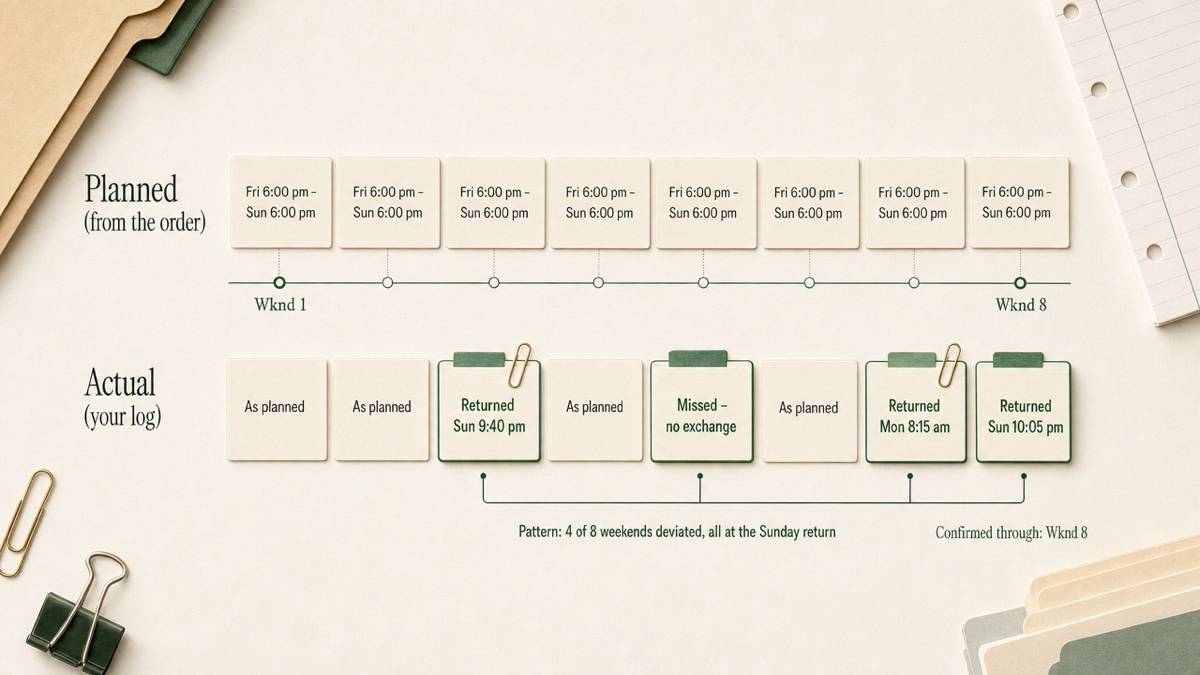
The pattern matters beyond contempt itself. Makeup time is a common remedy for missed parenting time, but a pattern of repeated denials can lead courts to consider stronger remedies, such as contempt sanctions or changes to the schedule. In some states, repeated contempt findings can themselves support modifying custody or parenting time. Your attorney can only argue "recurring" if the record shows it.
Write each entry as a fact
A contempt hearing is usually a full evidentiary hearing with sworn testimony. Hearsay and written statements from people who aren't present to be questioned are often excluded, though there are exceptions and practice varies by court. Your log won't speak for you, but it helps you and your attorney testify precisely.
Compare these two entries:
- "He kept the kids AGAIN because he doesn't care about the order."
- "Sun 3/9. Order: return 6:00 p.m. at Lincoln Elementary lot. Arrived 6:00. Children returned 9:40 p.m. at my home. Text at 5:52 p.m. attached: 'running late.' No reason given."
The second entry has a date, the order's term, times, a place, and an attachment. It can be checked. The first one only invites a fight.
A few habits help:
- Write it the same day, while the times are still exact.
- Quote or cite the order provision the event relates to.
- Record what you did too. "I waited until 6:45 and left" is part of the fact pattern.
- Leave out motives, diagnoses, and adjectives.
Your flag is not a finding
When you mark a day as a violation in your own log, that label is yours. It means "I believe this departed from the order." It does not mean a court agrees. Only a judge decides whether conduct was contempt. Keep that line visible. Label entries in your notes as alleged or flagged, and let your attorney decide which ones support a motion. For a broader overview of keeping records, see custody documentation.
Attach what backs it up
An entry is stronger with the source attached: the screenshot of the "running late" text, the email declining a holiday exchange, the photo of an empty parking lot with its timestamp. Attach each file to the entry it supports so nobody has to match a loose image to a date later. Only save material you lawfully have access to. Whether any item is admissible is your attorney's call.
Keep expenses in their own ledger
Unpaid shared expenses are a different kind of claim from parenting-time violations. They involve amounts, receipts, and whether you asked for payment. Keep them in a separate ledger: date incurred, amount, category, receipt, the share the order assigns, when you sent the request, and payment status (unpaid, partial, paid, disputed).
Mixing a $340 copay into a log of missed weekends muddies both. The full method is in how to track unreimbursed child expenses.
Contempt is not the only tool
Before anyone files, it's worth knowing the alternatives. Many violations come from vague wording or changed circumstances, and some court guidance suggests modification or mediation can resolve those more effectively than contempt.
- An attorney letter putting the other side on notice of specific dates and terms.
- Mediation, which tends to work best when the parents have resolved things before and only small adjustments are needed. It is often a poor fit in high-conflict cases.
- Modification, when the schedule no longer fits real life or the wording keeps causing the same dispute.
- Contempt, generally better suited to a parent who appears to be deliberately getting around the order.
The same timeline supports every one of these options, so the documentation work is not wasted if your attorney picks a different route.
Don't hand the other side a contempt claim
The parent who files is usually under the same order. Common ways people expose themselves:
- Withholding time over unpaid support or expenses. Parenting time and money obligations are generally enforced separately. Withholding one over the other can itself violate the order.
- Self-help makeup time. Keeping the child an extra weekend to "even it out" without an agreement or order.
- Ignoring the order's own terms. Missing a notice deadline, skipping a designated exchange location, or changing times on your own.
- Messages that read as threats. Your texts can become exhibits too.
Follow the order as written, even when the other parent doesn't, and document your own compliance alongside their deviations.
What to bring your attorney before they decide whether to file
Your attorney will weigh cost, odds, and remedy. Make that decision easier by bringing:
- The signed, filed order, plus any later modifications.
- Proof the other parent was served or knew of it, if you have it.
- A planned-vs.-actual timeline for the period in question, with each deviation dated.
- Attachments linked to entries: texts, emails, photos.
- The expense ledger, filtered to shared costs, with receipts and request dates.
- Witnesses: names, what they saw, and whether they could appear.
- What you want: makeup time, reimbursement, clearer terms, or changes to the order.
Ask what format they prefer. If they haven't said, a short summary first and supporting detail behind it is a sensible order. See reports and exports.
Keeping this record in Custody Proof
Custody Proof is private documentation software for one parent. The other parent is never invited or notified. You can set your schedule from your order or a plain-words description, log overnights and timed visits, and flag violations on your own calendar using preset categories. Flagged days are kept as evidence, and flagging notifies no one. Plan vs. Actual compares your saved schedule with what you logged, and reports can carry a "Confirmed through" date. Texts, photos, and files attach to the event they belong to in an encrypted vault. Expenses live in their own ledger with receipts and reimbursement status. When your attorney asks, you export PDFs or CSVs and hand them over yourself.
The software keeps the record. It doesn't decide what counts as a violation and it doesn't file anything. That stays with you and your attorney.
Start your record. Documentation is $14.75/month or $144/year, with a 30-day money-back guarantee on your first charge.
Frequently asked questions
Can I file for contempt over a single late pickup?
You can usually ask. Whether it's worth it is another question. A single, explained incident often looks unintentional, and a court may prefer a lighter remedy. A dated pattern against clear order terms is generally what makes contempt persuasive. Ask your attorney about your facts.
Does marking something a violation in my log mean the court will agree?
No. Your flag records your view that the event departed from the order. Only a judge decides whether conduct was contempt.
Will the other parent see my violation log?
Not in Custody Proof. There is no shared account and no notification. A record leaves the app only when you export a file and hand it to someone. Your attorney can explain what may have to be disclosed during a case.
Should unpaid expenses go in the same log as missed visits?
Keep them separate. Expense claims depend on amounts, receipts, request dates, and payment status. Parenting-time claims depend on the schedule. Two clean records are easier for an attorney to use than one mixed one.
Can I keep the child longer to make up for time I lost?
Not on your own. Self-help makeup time can itself depart from the order. Raise the lost time with your attorney, who can pursue makeup time or another remedy through the proper channel.
Keep reading
- Legal Abuse in Family Court: Document the Pattern
- What to Do Before Separation With Kids
- What Is a Guardian ad Litem? Role, Interview, Records
- Which custody app fits your situation
Custody Proof is a documentation tool, not a law firm. Nothing on this page is legal advice. Whether and how a record is used in a case is a question for your attorney.