What to do before separation with kids or filing for custody
By EJ Archuleta, Licensed attorney · Updated
What to do before separation with kids comes down to four things: start a private, dated record of who does the parenting right now, and gather the children's documents and the financial records you are entitled to. Then lock down your own devices and accounts, and bring a short list of questions to a family law attorney.
If you are not safe at home, safety planning comes before all of it. None of these steps requires a conversation with the other parent.
This page is general information, not legal advice. Custody law varies by state. Take questions about your own case to a family law attorney licensed where you live.
Start with the baseline: who does the parenting now
Most pre-divorce checklists start with bank accounts. For custody, the more fragile record is the ordinary week, and it is often the one nobody kept.
Once a case is filed, both parents tend to remember being the one who did everything. A record made week by week, before anyone had a reason to write it, is harder to argue with.
What to log
Log the routine, not only the bad days:
- School runs. Who dropped off, who picked up, and what time.
- Appointments. Pediatric, dental and therapy visits: who scheduled them and who went.
- Bedtime and mornings. Who did baths, homework and getting everyone out the door.
- Sick days. Who stayed home, and who answered the school's call.
- Activities. Who signed the child up, who drove, and who stayed to watch.
- Overnights. Where the children slept each night, once living arrangements start to change.
How to write an entry
Write it the same day. Use dates, times and what happened. Leave out adjectives and conclusions.
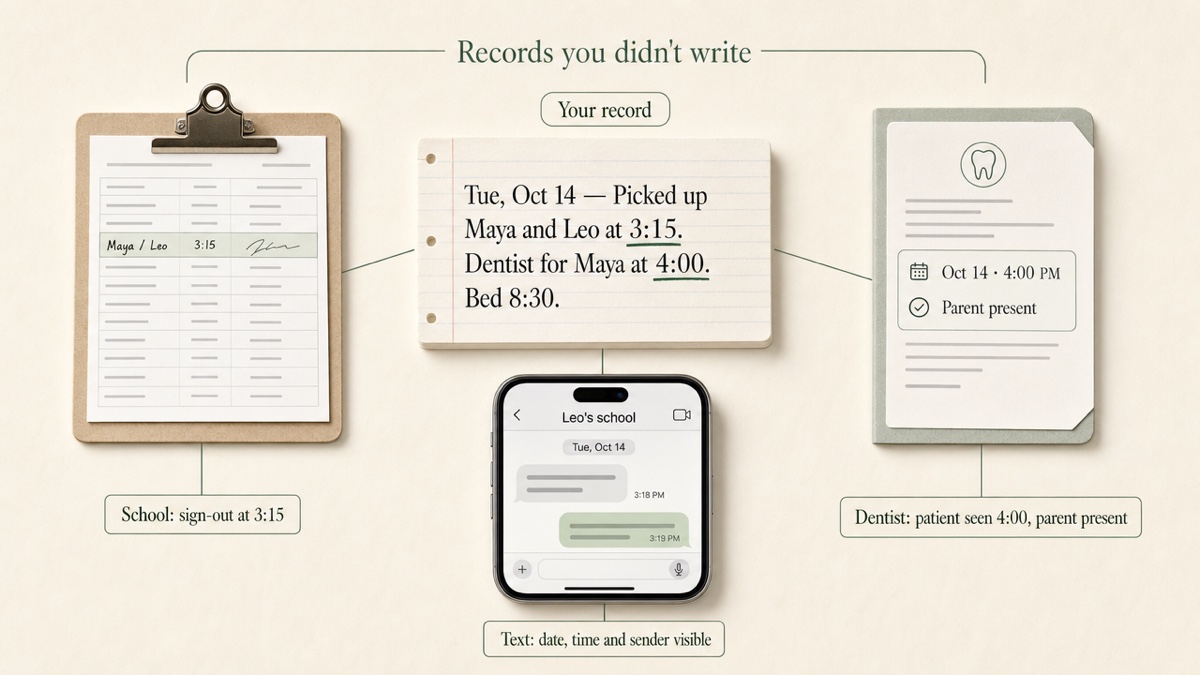
"Picked up both kids at 3:15. Took Maya to the dentist at 4:00. Dinner, homework, bed at 8:30" is a record. "I do literally everything" is a complaint.
Keep the log separate from your personal journal. Keep it about the children's care and nothing else.
Courts in some states have protected a parenting log kept at a lawyer's direction, or written to be given to a lawyer, while a personal diary kept for your own use can often be obtained by the other side. The rules vary by state and depend on how the log is created.. Ask your attorney how they want yours kept. Either way, write every entry as if a judge will read it.
Back it up with records you did not write
Your log is your account of events. Records kept by schools, doctors and daycares show the same facts from the outside:
- pickup sign-out sheets
- the name on the enrollment form
- who signed in at conferences
- which parent the pediatrician's office calls
Some court self-help materials suggest that parents who disagree about custody try to get statements from schools and medical offices. Request copies through ordinary channels, as the parent you are.
Gather the children's documents
Make copies. Keep the originals where they normally live unless your attorney says otherwise.
- Identity: birth certificates, Social Security cards, passports and health insurance cards.
- Medical: pediatric, dental, therapy, prescription and vaccination records, plus a list of providers with phone numbers.
- School and childcare: report cards, attendance reports, IEP or 504 plans, daycare contracts, and anything showing who handles enrollment and conferences.
- Prior orders: any earlier custody, support or protective order, ideally as certified copies. Earlier orders generally stay in effect until a court changes them, can affect what you can ask for now, and some contain limits on moving or travel..
Financial records and child expenses
For your attorney, gather what you can of roughly the last five years:
- tax returns
- bank and credit card statements
- canceled checks
- loan documents, deeds and vehicle titles
- insurance policies
- online payment records
- any prenuptial or postnuptial agreement
- estate planning documents
You do not have to find everything yourself. You do not have to find everything yourself. Once a case is filed, many missing records can usually be obtained through discovery or a subpoena, though the rules vary by state and some records may be protected..
Start a child-expense ledger now, separate from household spending. Record:
- the date
- the amount
- what it was for
- the receipt
- which child
For medical costs, keep the bill and proof of payment. A dated ledger with receipts attached settles more arguments than a camera roll.
Only take what you are entitled to
This is where people hurt their own cases. Copying a joint tax return from the family filing cabinet is one thing. Logging into the other parent's email, reading their phone, installing tracking software, or opening mail addressed only to them is something else entirely. That can create legal problems for you and give the other side something to talk about besides the children..
Recording conversations is the same kind of question. States differ on whether one person's consent is enough or everyone on the call must agree.. Do not record anyone until you have asked a lawyer where you live.
When in doubt, write down what the document is and where it sits. Then ask your attorney how to get it properly.
Secure your own devices and accounts
Assume anything the other parent could reach in the past, they can still reach.
- Change the passwords on your email, phone and cloud accounts. Do not reuse old ones.
- Turn on two-factor authentication, and send the codes to a phone only you hold.
- Use "sign out of all devices" where the option exists.
- Check family-sharing plans, shared photo libraries and location sharing.
- Check whether photos back up to a cloud account someone else can open.
- Review which devices are signed into your accounts, and which apps have access to them.
- Consider a separate email address used only for documentation.
If you keep your record in an app, sign in from a device the other parent cannot open. Your account, data, and privacy explains how Custody Proof stores and protects what you enter.
If there is abuse: document safely
Safety comes before evidence. If you are in danger, call 911. The National Domestic Violence Hotline (1-800-799-7233, thehotline.org) can help you build a safety plan, including how to leave and what to take.
When it is safe to document, advocates recommend:
- An incident journal. Note the date, time, what happened, what was said by anyone present, and how it affected you.
- Photos. Photograph injuries, however minor, and any damage to the home.
- Texts. Preserve them so the image shows the message, the contact, the date and the time.
- Emails, call logs and voicemails. Keep them with sender, recipient, date and time visible. Check social media posts from both profiles. Digital evidence disappears easily.
- Official records. Keep police reports, and records from courts, child welfare agencies or health care providers.
If your phone or accounts may be monitored:
- Memorize your passwords.
- Do not discuss your plans by text or social media.
- Store copies somewhere separate, such as a backup drive or a trusted relative.
- Use a public library computer if your own devices are not safe.
Some courts offer safety tools. Examples include forms that let a parent withhold an address or the children's school from filings, and parenting plan guides written for families with safety concerns. What exists depends on your state.. Ask a local advocate or the court's self-help center.
Questions to bring to your first consultation
Bring your log, your document list and these questions:
- How should I keep my parenting log so it is most useful, and should I address it to you?
- Does moving out before filing affect custody in this state?
- Should I change the children's routine now, or keep it as it is?
- What can I lawfully copy from shared files and accounts?
- Are there temporary orders I should ask for, and when?
- Does any prior order limit what I can request?
- What should I stop putting in writing to the other parent?
- Is a separate therapist for the children a good idea?
- What will this likely cost, and how can I keep that cost down?
A first meeting goes further when your attorney is reviewing an organized record instead of building one from your memory. For how that record usually comes together, see How to document custody for court.
Where Custody Proof fits
Custody Proof is a private documentation app for one parent. The other parent is never invited or notified.
- Time: log overnights and timed visits as separate things, and add past entries with their real dates.
- Incidents: flag violations on your own timeline. Flagging one notifies no one.
- Evidence: keep screenshots, photos and documents in an encrypted vault.
- Expenses: track child expenses with receipts attached.
- Reports: when your attorney asks, export dated PDF reports, including the Court Packet.
The Documentation plan is $14.75/month or $144/year. Case Builder ($29/month or $278/year) adds Vero, the AI assistant, which drafts records from voice notes, pasted texts and photos for you to review.
Getting started walks through setup. When you are ready to start your baseline, create your account.
Frequently asked questions
Do I need to tell the other parent I am keeping a record?
A personal record does not depend on their involvement. Custody Proof never contacts them. Whether, when and how to say anything about your plans is a question for your attorney.
Can my notes be used against me?
Possibly. A personal diary may be discoverable, and an inflammatory entry reads badly in front of a judge.. Keep entries factual, and ask your attorney how to keep the log.
I have already moved out. Is it too late to start?
No. Start today, and add earlier events with their real dates as best you can document them. Gather school and medical records for the period before you left.
Should I move out with the children before filing?
That decision can shape the status quo, and how courts treat it depends on your state and your facts.. Talk to a local family law attorney first unless you are leaving for safety.
Can I record my conversations with the other parent?
It depends on your state's consent rules and on how the recording is made.. Get an attorney's answer before you record anything.
Keep reading
- What Is a Guardian ad Litem? Role, Interview, Records
- Digital Safety During Divorce: Protect Accounts and Records
- Co-Parent Harassing You? How to Document It
- Which custody app fits your situation
Custody Proof is a documentation tool, not a law firm. Nothing on this page is legal advice. Whether and how a record is used in a case is a question for your attorney.