Guardian ad Litem: What They Do and How to Prepare Your Records
By EJ Archuleta, Licensed attorney · Updated
A guardian ad litem (GAL) is a neutral person a court appoints to look into a custody case and report on what serves the child's best interests. A GAL interviews people, visits homes, reads records, and reports to the judge, often with a recommendation. The GAL does not represent you or the other parent. In many states the GAL is not the child's lawyer either.

That last part matters most. A GAL has limited hours and a lot to read. A parent who hands over a short, dated, organized record makes the GAL's job easier. A phone full of screenshots and a long account of everything the other parent did wrong makes it harder.
This page is general information, not legal advice. GAL rules differ by state and sometimes by county. Your own family law attorney can tell you how they work in your case.
What a guardian ad litem is
"Ad litem" means "for the suit." The GAL serves in this case only, for the purpose the court sets.
Who can serve depends on the state. Some states require GALs to be licensed attorneys. Others also allow mental health professionals or trained volunteers from court-approved programs, such as CASA. Training requirements, fees, and how fees are split between the parents also vary. The appointment order usually spells out the GAL's duties, who pays, and how long the appointment lasts.
When courts appoint one
Judges tend to appoint a GAL when they need someone independent to gather facts. Common triggers include:
- Serious claims about abuse, neglect, domestic violence, or substance use
- High conflict, where each parent's account contradicts the other's
- A proposed relocation
- A child old enough to have opinions the court wants heard, without putting the child on the stand
- Third-party custody, guardianship, or grandparent visitation cases
A parent or attorney can usually ask for an appointment. The judge can also order one without a request. In some situations, such as cases involving allegations of child abuse or neglect, the law requires the court to appoint one.
GAL vs. the child's attorney vs. other child advocates
These roles are easy to confuse, and the differences change what you should expect from each one.
| Role | Works for | Goal |
|---|---|---|
| Guardian ad litem | The court | Investigate and report on the child's best interests |
| Child's attorney | The child | Advocate for what the child wants, within legal ethics |
| Your attorney | You | Advocate for your position |
| CASA or other volunteer advocate | The court or program | Gather information and support the child; role varies by state |
The key difference is between best interests and wishes. A child's attorney generally argues for what the child says they want. A GAL weighs what the child wants as one factor, and that wish can conflict with what is actually good for the child. In some states one person can hold both roles. The court's appointment order, along with state law and court rules, determines which role applies.
A GAL also does not give legal advice to either parent. Ask your own attorney your legal questions.
What a GAL investigates
Some GALs have a general appointment covering custody and parenting time as a whole. Others have a limited-purpose appointment covering a single question, such as a proposed move, a specific safety concern, or whether supervised visits are still needed.
The scope matters. In many courts a GAL looks only at the areas the order names. Expanding or narrowing that scope usually takes a request to the court and a new or amended order, though the exact procedure varies. If you think the GAL is looking at too little or too much, raise it with your attorney rather than with the GAL.
Within the scope, a GAL typically:
- Interviews each parent, usually separately
- Talks with the child, depending on age
- Visits each home
- Contacts teachers, doctors, therapists, and childcare providers
- Requests school, medical, and other records
- Reviews documents the parents provide
Interviews and home visits: what to expect
Nothing you say to a GAL is confidential. Assume every sentence can appear in the report or be repeated in court. Many GALs say this at the start of the first meeting. Believe it.
This applies to children too. What a child tells the GAL may reach the judge and, in time, the parents. Coaching a child before an interview is easy for a GAL to spot, and it tends to hurt the parent who did it.
At a home visit, a GAL is not grading your decorating. Expect them to look at basic safety, where the child sleeps, food in the house, and whether the child seems settled. Ordinary mess is fine. Hazards and missing basics are not.
GALs generally keep their contact with each parent even-handed. If you represent yourself, you should get the same fair process as a parent with a lawyer, but you are also expected to follow the same court rules and deadlines.
How to prepare for the interview
- Answer requests promptly. A GAL can only weigh the information they receive. Missed calls and late paperwork leave your side of the story thin.
- Know your child's daily life cold. Teachers' names, the pediatrician, medications, bedtime, friends, the hard parts of the week. Specifics show involvement better than claims do.
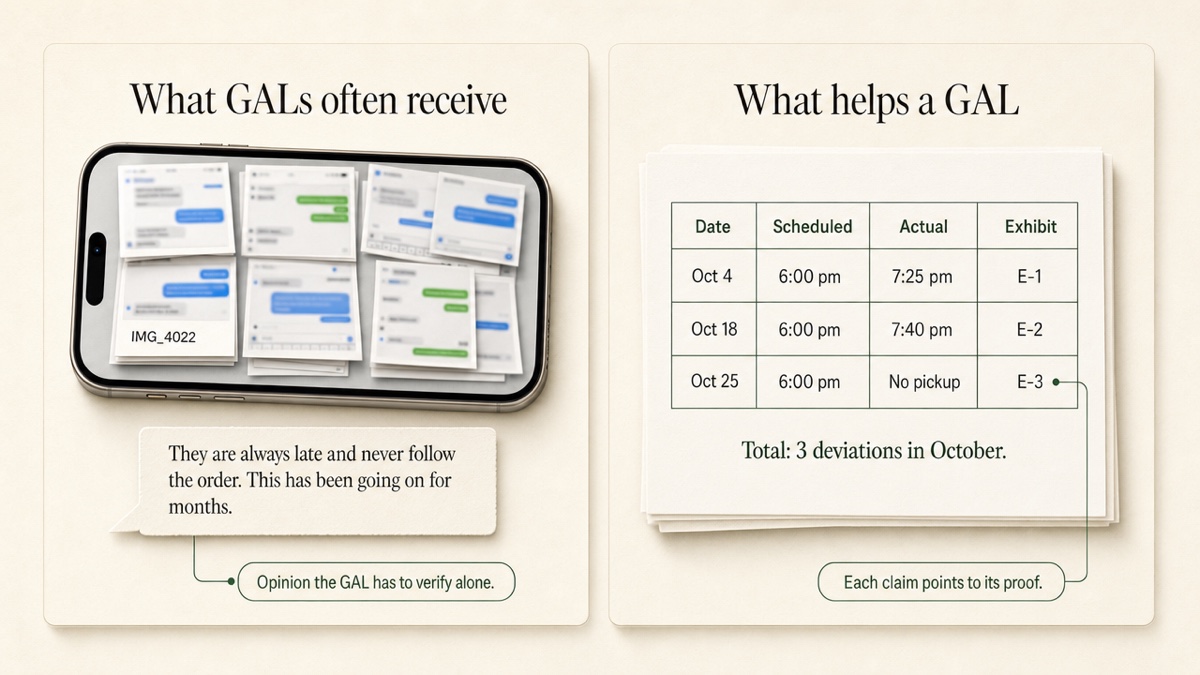
- Bring your concerns as examples, not labels. "Three late pickups in October, each over an hour" gives the GAL something to check. "They're irresponsible" does not.
- Say what the other parent does well. It is credible, and it shows you can put the child first.
- Ask how the GAL wants records delivered: format, length, and whether through your attorney.
- If you have an attorney, talk to them before you send anything. What you hand a GAL is effectively handed to the court.
What records to give a GAL, and how to organize them
Give the GAL a short, organized record, not everything you have. Build it in three layers.
1. A one-page summary
Cover the period at issue, the schedule the order sets, and the headline numbers: overnights, missed exchanges, outstanding expenses. Present the totals plainly and let the GAL draw conclusions.
2. A chronology
List events in date order. Give each entry a date, a time if you have it, what happened, and a reference to any exhibit. A late exchange is a timestamp. A canceled weekend has a date. A general complaint is not evidence.
3. Exhibits, labeled
Number each screenshot, photo, or receipt, and tie it to the chronology entry it supports. A GAL should never have to work out which file goes with which claim.
Records from neutral sources
Teachers, doctors, therapists, and coaches carry weight because they have no stake in the outcome. Useful records include report cards, attendance records, medical visits, therapy summaries, and any police reports. Give the GAL contact information for these professionals and let the GAL decide whom to call.
What to leave out
Leave out commentary on the other parent's character, other people's social media, and anything you were not lawfully entitled to access. Leave out long message threads with no summary, and duplicate screenshots of the same event.
For a fuller walkthrough of building this kind of record, see How to document custody for court and why records beat memories.
Tone: facts, not a case against the other parent
GALs meet parents at their worst moments. They are used to accusations. What they see less often is a parent who describes problems calmly, admits their own mistakes, and keeps the focus on the child.
Write every entry as if the other parent will read it, because they may. Use neutral verbs: "arrived at 7:40," not "showed up whenever they felt like it." Report what the child said in the child's words, without interpretation. If you were short-tempered in an exchange, say so. A record that only ever faults one person reads as advocacy. A record that includes your own lapses reads as honest.
The GAL report and recommendation
At the end, the GAL usually files a written report, sometimes with recommendations. Depending on the order and the state, these can cover:
- Legal and physical custody
- The parenting-time schedule
- Conditions such as counseling or substance testing
- Sometimes related issues like child support
In some courts a GAL may recommend only if the order allows it. The judge decides the case. The GAL does not. Still, judges often give the report real weight, because the GAL is the one neutral person who has spoken with everyone.
Some states, and many appointment orders, set a deadline for the report to reach the parties before a hearing. You can usually challenge a report you disagree with, for example by questioning the GAL at the hearing or presenting contrary evidence. In some places, an agreement between the parents also needs the GAL's approval. Ask your attorney early what the options and deadlines are in your court.
No record guarantees a recommendation. A clear record makes it more likely the GAL works from facts instead of from whoever sounded most convincing.
Preparing a GAL packet with Custody Proof
Custody Proof is private documentation software for one parent. The other parent is never invited or notified. You can:
- Log overnights and timed visits separately
- Flag missed or late exchanges on your own timeline
- Compare your court-ordered schedule with what actually happened, and confirm the record as you go
- Store screenshots, photos, and documents in an encrypted evidence vault with seven categories
- Track child expenses with receipts attached
When the GAL asks for records, set the time period and child filter, then export. Options include:
- A one-page stats summary
- A detailed PDF, with an optional planned-vs-actual section
- An expense report with receipts as labeled exhibits
- An evidence report tied to dates
- The Court Packet, which combines a plain-English summary, color-coded calendars, flagged deviations, and evidence grouped under best-interests factors
Export details are in Reports and exports.
Plans start at $14.75/month or $144/year. Case Builder, at $29/month or $278/year, adds Vero, an AI assistant that turns voice notes and screenshots into dated drafts you review before saving. Your first charge has a 30-day money-back guarantee.
Start your record before the GAL's first request arrives.
Frequently asked questions
Is a guardian ad litem on my side?
No. A GAL works for the court and investigates the child's best interests. They are not your advocate or the other parent's. Your own attorney is the one who represents you.
Can I talk to the GAL off the record?
Assume not. Statements to a GAL are generally not confidential and can appear in the report or in court. This includes what your child says.
Can the GAL see my Custody Proof account?
No. Custody Proof has no outside logins. If you want the GAL to see your records, you export the files and deliver them yourself, ideally after checking with your attorney.
How much should I give the GAL?
Less than you think. A one-page summary, a dated chronology, and labeled exhibits tied to it will get read. Then ask whether the GAL wants anything more.
What if I disagree with the GAL's recommendation?
The judge, not the GAL, makes the decision. Most courts allow a parent to challenge a report, but the procedure and timing vary by state. Talk to your attorney as soon as you receive the report.
Keep reading
- Digital Safety During Divorce: Protect Accounts and Records
- Co-Parent Harassing You? How to Document It
- How to Co-Parent With an Abuser: Keep a Private Record
- Which custody app fits your situation
Custody Proof is a documentation tool, not a law firm. Nothing on this page is legal advice. Whether and how a record is used in a case is a question for your attorney.