How to co-parent with an abuser and keep your life private
By EJ Archuleta, Licensed attorney · Updated
To co-parent with an abuser, keep contact minimal and in writing, rely on a custody order that is as specific as possible, and make exchanges as safe and as witnessed as you can. Keep a private, factual record of what happens, one the other parent cannot see, search, or get notified about. You are not aiming for a friendly co-parenting relationship. You are aiming for a predictable one, with a paper trail.
This page covers the practical side: why shared tools can expose you, how to lock down your devices, how to log incidents and your child's words without coaching them, and who should be on your side. It is general information, not legal advice. Custody law and protective-order practice vary by state, so take specific questions to your own attorney and a domestic violence advocate.
If you are in immediate danger, call 911. Physical safety comes before paperwork.
Why a shared app can work against you
Many co-parenting tools are built around one account that both parents use. Both parents see the calendar, both get notifications, and messages land in one shared inbox. That design suits two parents who will both take part in good faith. For a survivor, it can mean:
- The other parent sees your plans. A shared calendar can show where you will be and when.
- They see what you document. Your notes, flags and attachments can become something to react to, argue with, or punish you for.
- They know when you are active. Read receipts, "last seen" markers and notification timing can become another way to monitor you.
Researchers who interviewed separated mothers found that the record-keeping features of post-separation parenting apps can be used both to continue coercive control and to resist it. The same feature can help or harm depending on who controls it.
If your order requires a specific communication platform, follow the order. Use it for what the order says, keep your messages short and factual, and keep your own documentation somewhere else. Your private notes should never live in a space the other parent can read.
A device and account security audit
Before you document anything, check whether your phone, accounts, and the child's devices are already open to the other parent. An advocate can help you decide what to change and when, especially if abrupt changes might raise suspicion or escalate things.
Go through this list:
- Shared cloud accounts. Check family-sharing plans, shared photo albums, and any shared cloud storage. Photos you take as evidence can sync to an account the other parent still uses.
- Location sharing. Look at phone settings, map apps, and any family-locator service you once set up together. Do the same on the children's phones and tablets.
- Old passwords and recovery options. Change any password the other parent might know or guess. Check recovery email addresses and phone numbers. An old shared address can be used to reset your account.
- Saved logins. Sign out of your accounts on any device you no longer control, including old laptops, tablets, and smart TVs.
- Notification previews. Turn off lock-screen previews so a glance at your phone does not reveal a message, an email subject, or an app alert.
- Email and statements. If the other parent can see your inbox or a shared card statement, they can see which services you use.
- Your digital footprint. Search your own name online to see what is public.
The National Domestic Violence Hotline suggests keeping documentation where an abuser cannot find it. Options include a separate email address used only for documentation, a backup copy, or copies held by a trusted person. If you have no safe device of your own, a public library computer is an option.
Logging incidents factually
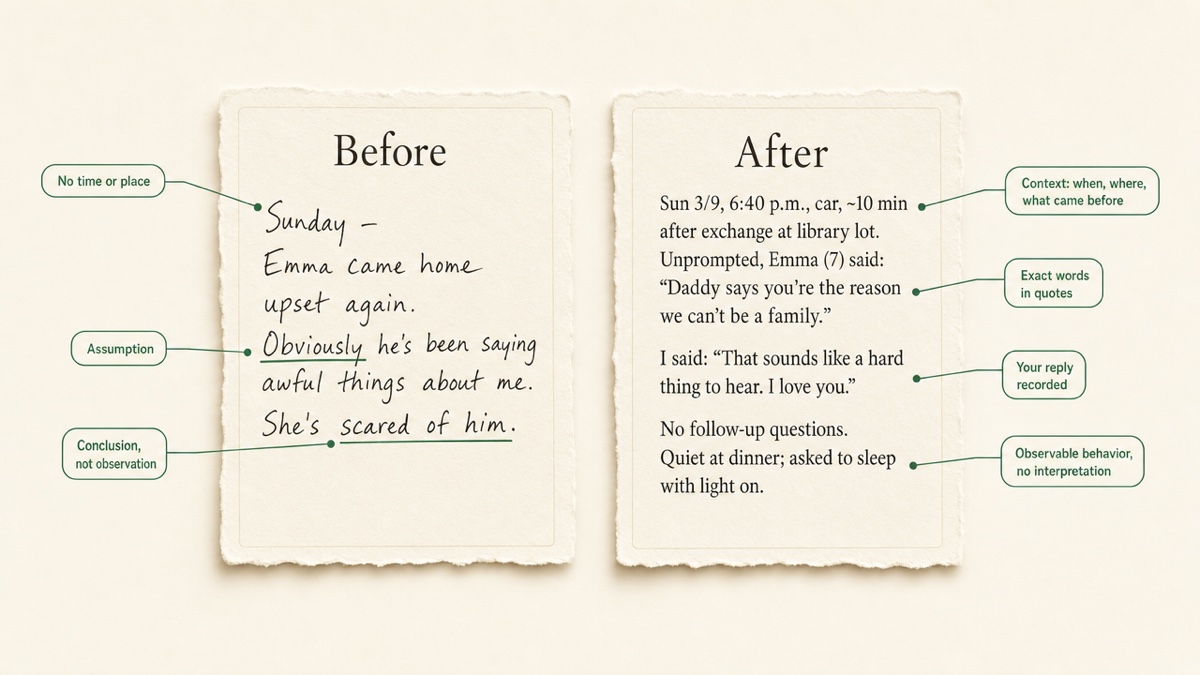
A record helps you most when it holds facts instead of conclusions. "He was abusive at pickup" is a conclusion. "At 6:10 p.m. at the school lot he stood at my driver's window, shouted, and blocked the door from closing for about two minutes. Ms. R., the crossing guard, was present" is a record.
For each incident, write down:
- Date and time, and when you wrote the note if it was later.
- Location.
- What happened, in order, in plain words.
- Exact words, in quotation marks, where you remember them.
- Who was present, including the children.
- What you did in response.
- Attachments: screenshots, photos, voicemails, or emails. Each one should show the sender, recipient, date and time where possible.
Write it the same day if you can. Gaslighting works by making you doubt your memory, and a dated note pushes back on that. The Hotline points out that documentation can help a survivor trust their own account of what happened, separate from any use it has in court.
Keep the tone flat. Leave out adjectives you cannot defend. A neutral record is harder to wave away than an angry one.
What your child says: write it down, don't draw it out
Children sometimes say things after time with the other parent. How you handle those moments matters, for the child and for your credibility.
Do:
- Write the child's words exactly as they said them, in quotation marks, even if the grammar is off.
- Note the date, the time, where you were, and what was happening just before. For example: "in the car, unprompted, about ten minutes after the exchange."
- Write down your own reply, word for word if you can.
- Note observable changes: sleep, appetite, bedwetting, clinginess, refusing to go, anger after exchanges.
Don't:
- Quiz the child after visits, or ask the same question more than once.
- Ask leading questions ("Did Dad yell at you?"). An open "How was your weekend?" is enough, and you can let the answer be short.
- Promise to keep secrets, or show strong reactions that teach the child what you want to hear.
- Ask the child to report on the other parent's home.
Repeated questioning can change what a child says and how a court sees it. Concerns about abuse belong with professionals trained to talk with children, and your attorney can tell you who that is where you live.
Exchanges: where, who, and when
Exchanges are where many incidents happen, so they need the most structure. Options to raise with your attorney include:
- Supervised exchange centers, where staff manage the handoff and the parents may never meet.
- Public places with people and cameras, such as a busy store entrance or a police station lobby.
- School or daycare handoffs, where one parent drops off and the other picks up, so you never cross paths.
- A neutral third party, such as a relative or friend both sides accept under the order.
Some state court guidance for domestic violence cases recommends that parenting orders spell out schedules, exchange locations and communication methods specifically, so there is less room for confrontation. Guidance for custody evaluators in another state favors detailed plans with as little left to negotiation as possible. If your order is vague, raise it with your attorney. In some states, custody orders in domestic violence cases are required to be specific about days, times and exchange arrangements, partly because vague orders are hard to enforce.
For every exchange, log the scheduled time and the actual time, the location, who was present, and anything said or done. A late pickup is a timestamp. A pattern of 40-minute delays over three months is something you can show. For more on recording these, see missed visitation and late pickups.
Keep communication limited and in writing
You do not owe the other parent a conversation. Some state court guidance for abuse cases lists options such as written-only communication, a designated parenting app, and phone calls limited to emergencies. Your order may already set the method. Your order may already say how you and the other parent communicate. If it does, follow it. If it doesn't, ask your attorney whether the order should set a method.
A few habits help:
- Keep messages about the children: logistics, schedule, health, school.
- Answer only what needs an answer. Ignore bait.
- Write as though a judge will read it, because one might.
- Save what you receive. Don't delete messages, even cruel ones. Deleting evidence relevant to a case can be unlawful in many places.
- Vent offline to a therapist, attorney, or trusted friend, never on social media. Posts are not private and can be obtained in a case.
Follow any protective order to the letter, including its rules on contact.
Where documentation ends and surveillance begins
Protective documentation records what happens to you and what you lawfully see and receive. It does not include:
- Tracking the child's phone location during the other parent's time. Courts can view this badly, and in some places it may be unlawful.
- Logging into the other parent's email, social media, or cloud accounts, even if you know the password.
- Recording conversations without checking your state's recording laws first.
- Coaching the child to report back, or hiding devices in their belongings.
Crossing these lines can undercut the very record you are building. When in doubt, ask your attorney before you act.
Supporting your child
Children in these situations often need an adult outside the conflict. A child therapist gives them a place to talk that is not you and not the other parent. Ask your attorney whether your order says anything about who consents to therapy before you schedule it.
Watch for distress in the forms your child usually shows it, because it looks different in every child. Keep routines steady at your home. Don't put the child in the middle by asking them to carry messages or keep score. Let them love the other parent without guilt, even while you document what you see.
Your attorney and your advocate
You need two kinds of help. A family law attorney handles the custody case, the order, and what evidence matters where you live. A domestic violence advocate helps with safety planning, protective-order preparation, and local resources, often at no cost.
An organized, dated record saves both of them time. Instead of piecing together months from a camera roll, they can read a timeline, check the pattern, and decide what to use. Ask what format they want before you export anything. For a fuller walkthrough, see how to document custody for court.
Hotlines and safety planning
- National Domestic Violence Hotline: thehotline.org, 1-800-799-7233. Advocates there can help you build a safety plan.
- Local domestic violence programs: many offer court advocacy and supervised exchange referrals.
- Victim notification services: some states offer alerts about custody status, arrests, or hearings in a partner's case.
- 911 whenever you or your children are in danger.
Keeping the record private with Custody Proof
Custody Proof is documentation software for one parent. The other parent is never invited, never has an account, and is never notified. Flagging a violation notifies no one. If you want to share a record, you export a file and hand it over yourself.
- Evidence vault: files are encrypted (AES-256) before they are stored, and only your account can see them. Categories include Incidents, Communications, Emotional, Health and Witness.
- Calendar: log overnights and exchanges, flag late or missed handoffs, and compare the plan against what actually happened.
- Access: it is a web app with email and password sign-in. Changing your password signs out your other devices. Reminders stay in the app. The optional emails about open possession dates can be turned off in Settings. Charges appear as CUSTODYPROOF.COM, which matters if someone else can see your statement. Details are on the account and privacy page.
- Exports: filtered PDF reports and an evidence archive for your attorney or advocate.
Plans are Documentation at $14.75/month or $144/year, and Case Builder at $29/month or $278/year. Case Builder adds Vero, an assistant that drafts records from voice notes, pasted texts, or photos. You review every draft before it is saved.
Frequently asked questions
Will the other parent find out I'm using Custody Proof?
Not through the product. There is no shared account, no invitation, and no notification. They could still learn of it through your own devices or statements, which is why the security audit above matters.
Does Custody Proof keep me physically safe?
No. It keeps a private record. Physical safety comes from safety planning, protective orders where appropriate, safer exchanges, and emergency services. An advocate can help with all of those.
My order requires a shared co-parenting app. What do I do?
Use it as the order requires, keep messages brief and factual, and keep your own notes and evidence in a separate private record. If the required platform raises safety concerns, talk to your attorney.
Will my records be admitted in court?
That depends on your state's evidence rules and your case, and your attorney is the one to judge it. A clear, dated, labeled record is easier for them to evaluate and use.
Should I record my child talking about the other parent?
Write down what they say on their own, word for word, with the date and context. Don't question them to get statements, and check with your attorney before making any audio or video recording.
Keep reading
- How to Track Custody Schedule Swaps
- How to Respond to Hostile Texts From Your Ex
- Court-Ready Custody Report: What to Include
- Which custody app fits your situation
Custody Proof is a documentation tool, not a law firm. Nothing on this page is legal advice. Whether and how a record is used in a case is a question for your attorney.