How to respond to hostile texts from your ex and keep the record
By EJ Archuleta, Licensed attorney · Updated
To respond to hostile texts from your ex, don't answer right away: find the one practical question in the message, if there is one, and answer only that, in a sentence or two. If there is no question, you usually don't need to reply. Either way, save the whole thread with dates before you do anything else.
Everything below explains how to do that with the phone you already have. You don't need a new app, and the other parent doesn't need to agree to anything.
This page is general information, not legal advice. Custody and evidence rules vary by state, so take questions about your own case to your attorney.
Before you reply: separate the question from the accusation
Hostile messages usually mix two things. One is a logistics question: a time, a place, a form, a prescription. The other is commentary meant to get a reaction.
Read the message once. Then rewrite it in your head as if a calm stranger had sent it. "You're a selfish parent who can't even keep track of soccer, is practice still at 5 or did you forget that too" turns into "Is practice at 5?"
That stripped-down question is the only part you owe an answer. The rest is a speech. Speeches don't need replies.
If you feel your pulse in your ears, wait. Most custody logistics can sit for an hour. Put the phone face down, do something else, and come back. A reply written angry is often the one that ends up in someone else's exhibit.
Reply patterns that keep the record clean
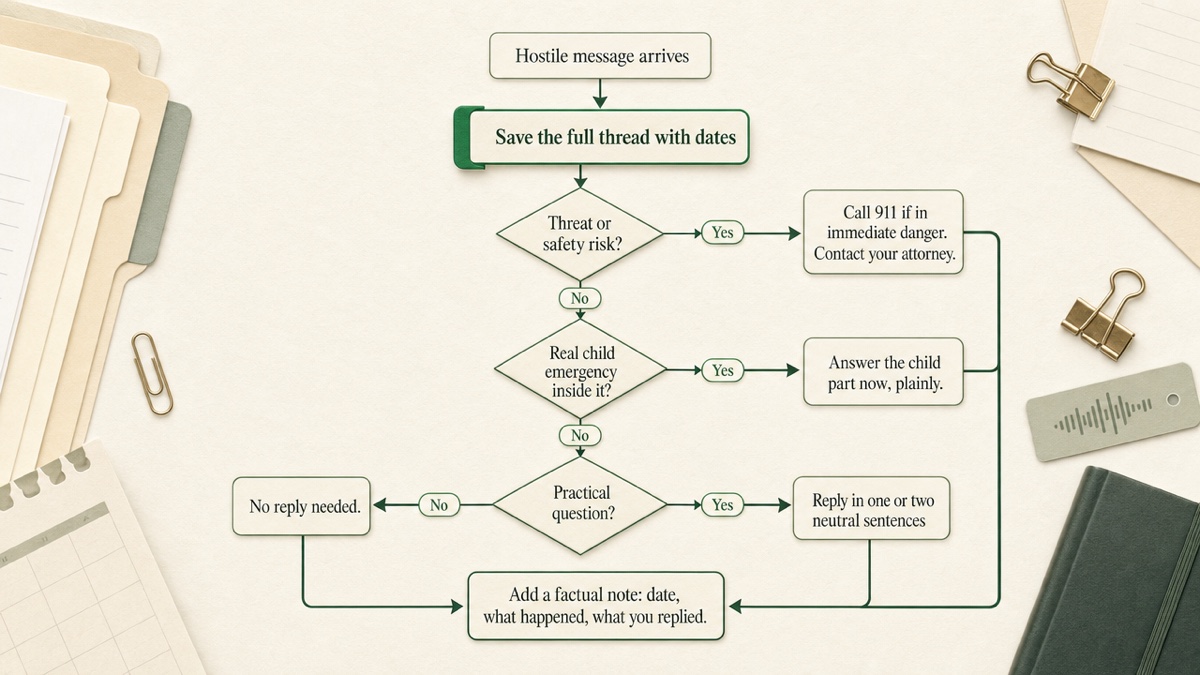
When a reply is one or two sentences
A good reply answers the question, states the fact, and stops. Some patterns:
- Confirm: "Yes, practice is at 5. I'll have her there."
- Restate the schedule: "Pickup is Friday at 6 at the school, as scheduled."
- Give information: "The pediatrician appointment is Tuesday at 3:15. The office number is on the school form."
- Decline politely: "I can't swap this weekend. The regular schedule stands."
Leave out apologies for things you didn't do. Leave out defenses, sarcasm, "as I've told you before," and any reaction to the insults. Don't argue with the accusation even when it's false. Answering it gives it a place in the conversation.
Read your draft as a judge would, cold, months from now. If any line would make you wince, cut it.
When not to reply
Some messages contain no question at all: a rant, a list of grievances, an insult at 2 a.m. Silence is a complete response to those.
If the volume becomes harassment and you feel safe doing it, one short written request to stop can make sense, such as "Please keep messages to the children's schedule and needs." After that, stop engaging with messages that only harass. Domestic violence advocates commonly recommend this approach. If you're unsure whether even that message is wise in your situation, ask your attorney first.
If your ex starts messaging your friends or family, ask them not to respond and to save what they receive.
Real urgency vs. manufactured urgency
Some messages are built to feel urgent: "ANSWER ME NOW," ten messages in five minutes, threats to "take this to the judge tonight." That kind of pressure is not an emergency.
A real child emergency looks different. A hospital visit, an injury, a missed pickup with the child waiting, a medication question. Sometimes it's buried in the middle of an angry message. Read the whole thing before you decide it's just noise.
When it's real, answer the child part fast and plainly: "On my way to the ER now. Which hospital?" Deal with the tone later, or never.
Setting a predictable rhythm helps. Answer routine logistics within a reasonable window, such as the same day, instead of instantly. You aren't required to be on call for provocation.
When a message suggests a safety concern
If a message threatens you or the child, describes a danger the child is in, or suggests someone is about to show up and hurt someone, treat it as a safety issue, not a texting issue.
- Immediate danger: call 911.
- Threats, stalking, or escalating harassment: contact your attorney. A legal advocate can explain protective orders where you live. The National Domestic Violence Hotline can connect you with one.
Save the message either way, but don't let documenting it delay getting help. A record is useful later. Safety comes first.
The screenshot trap
A single screenshot is easy to misread, and easy to weaponize. Picture a thread where the other parent sends six baiting messages and you finally snap back once. A screenshot of only your reply looks like you started it. A screenshot of only their worst line can look like you edited out your own provocation.
Custody evaluators who review texts weigh whether messages may have been edited or shown out of context. A cropped image invites that question. The fix is the same for both sides: keep the whole conversation, not the highlight.
How to capture a whole thread with dates
- Capture before anything gets deleted. Messages disappear, by accident or on purpose. Save them the day they arrive.
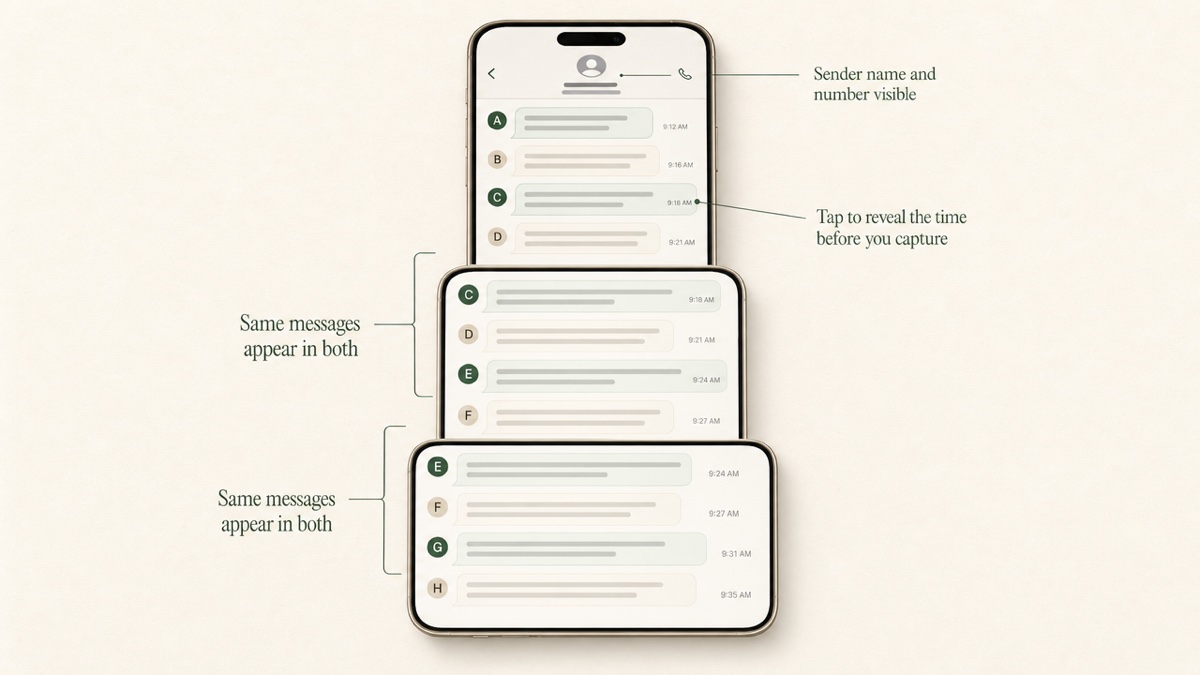
- Overlap your screenshots. Scroll only halfway each time, so the bottom of one screenshot is the top of the next. That shows the images form one continuous conversation.
- Reveal the timestamps. Many phones hide the time until you tap or swipe on a message. Capture the times, not just the words.
- Show who sent it. If the thread doesn't show the sender's name and number, also screenshot the contact entry for that number.
- Note when you captured it. One line is enough: "Captured March 4, 9:10 p.m."
- Ask about a full export. Screenshots often fall short of what a court needs. Evidence rules vary by state, and screenshots are not always enough. Ask your attorney whether software that exports your phone's complete message history would give a more usable record. Ask your attorney what format they want before you rely on screenshots alone.
Before you post anything about your case online, talk to your attorney. Sharing case facts or documents on social media can put privilege at risk.
Save the original next to a factual note
A screenshot shows what was said. It doesn't show what happened around it. Pair each saved thread with a short note written the same day:
- The date and time it arrived
- What it was about, in one plain line
- What actually happened, if it connects to a parenting-time event ("Exchange was set for 6 p.m. Child was handed over at 7:40 p.m.")
- What you replied, or that you didn't
Leave out adjectives, guesses about motive, and your diagnosis of your ex. "Received 14 messages between 11 p.m. and 1 a.m. about the school form" is a record. "She was unhinged again" is an opinion.
Store all of it somewhere the other parent can't reach and is unlikely to look. A camera roll on a phone they once had access to doesn't qualify.
One message is an incident. Fifty is a pattern.
A single nasty text rarely changes much. What can matter is repetition: the same accusations every exchange weekend, messages that spike before a hearing, late-night bursts, threats that escalate over weeks.
You only see a pattern if every message is dated and kept in one place. Log the dull ones too. "Six messages Tuesday, all about pickup, no insults" is also part of the record, and it makes the bad weeks stand out.
What your attorney needs from a message record
Ask your attorney what they want. In general, a useful message record is:
- Complete. Whole threads, including your own replies.
- Dated. Every message has a visible date and time.
- Attributed. It's clear who sent each message.
- Organized. Sorted by date, not by how angry each one made you.
- Annotated. A short factual note ties each thread to what happened that day.
- Original. You keep the source files and never edit or crop the copies you share.
An attorney can work with that. A folder of 400 unlabeled images named IMG_ is mostly sorting work. For the wider picture, see how to document custody for court.
Before you record a phone call with your ex, ask your attorney. Some states allow recording with one person's consent, while others require everyone on the call to agree.
Keeping the record in Custody Proof
Custody Proof doesn't touch your messages. They stay on your phone, in the channel you already use. What it gives you is a private place to keep the record. The other parent has no account, gets no notification, and can't see anything you save. That's the difference from the shared apps described in why co-parenting apps fail.
In the evidence vault, screenshots go under Communications with the date attached, next to your written details. Each file can be up to 25 MB and is encrypted (AES-256) before it's stored. If a thread relates to a late exchange or a missed visit, attach it to that calendar event so the context stays together.
On the Case Builder plan, you can paste a thread or add screenshots and Vero, the AI assistant, drafts dated entries for you to review. Vero never guesses a date. If a draft has no date, you add one before it can save. You can also enter months of older messages with their real dates.
When your attorney asks, you can export a PDF Evidence Report with exhibits, or a ZIP with every original file.
Start your private record. Documentation is $14.75/month, and your first charge has a 30-day money-back guarantee.
Frequently asked questions
Should I screenshot texts from my ex for court?
Yes, save them. But capture whole threads with overlapping screenshots and visible timestamps, not single cropped messages. Screenshots often aren't enough on their own, so ask your attorney whether they also want a full export from your phone.
Is it okay to just not reply?
Often, yes. If a message has no practical question about the children, silence is a reasonable response. Do answer genuine child logistics and emergencies, briefly.
Should I block my ex?
That depends on your order and your situation. Blocking can cut you off from real messages about the child, and some orders require a way to communicate. Ask your attorney before blocking. Keep saving everything until you do.
Can Custody Proof read or filter my ex's messages?
No. It doesn't send, receive, or filter messages. You save screenshots, files, and notes into your own encrypted vault, and you export them when your attorney asks.
Will my screenshots be admitted as evidence?
No tool can promise that. Whether a court accepts a message, and in what form, depends on your state's rules and your case. A complete, dated, unedited record gives your attorney the most to work with.
Keep reading
- Court-Ready Custody Report: What to Include
- 60/40 Custody Schedule Examples and the Overnight Math
- Co-Parent Keeps Changing Custody Schedule?
- Which custody app fits your situation
Custody Proof is a documentation tool, not a law firm. Nothing on this page is legal advice. Whether and how a record is used in a case is a question for your attorney.