60/40 custody schedule examples, the 4-3 rotation and overnight math
By EJ Archuleta, Licensed attorney · Updated
The most common 60/40 custody schedule examples are the 4-3 rotation, the 9-5 two-week split, and an extended-weekend pattern. A true 60/40 split is about 219 overnights a year for one parent and 146 for the other, and most named "60/40" patterns land a few points off that number. An extended weekend gives one parent alternate weekends stretched to five nights, sometimes with a midweek overnight added.

Below are the patterns, how they compare with 50/50 rotations, and how to count what each one gives you. Then comes the step most calendars skip: checking whether the split you actually lived matches the one on paper.
This is general information, not legal advice. Custody law and support rules vary by state, so take questions about your own order to your own attorney.
What 60/40 means in overnights
Parenting time is usually counted in nights the child slept at a home, not calendar days touched. A Friday-after-school to Sunday-evening weekend is two nights. The full explanation is in how courts count parenting time.
In a 365-night year:
- 60% is 219 nights. 40% is 146.
- 50/50 is about 182 or 183 nights each.
- One percentage point is roughly 3.65 nights.
That last figure matters. A schedule that someone calls "basically 60/40" can be 10 or 15 nights a year away from it. When an overnight count feeds a support calculation, that gap can matter.
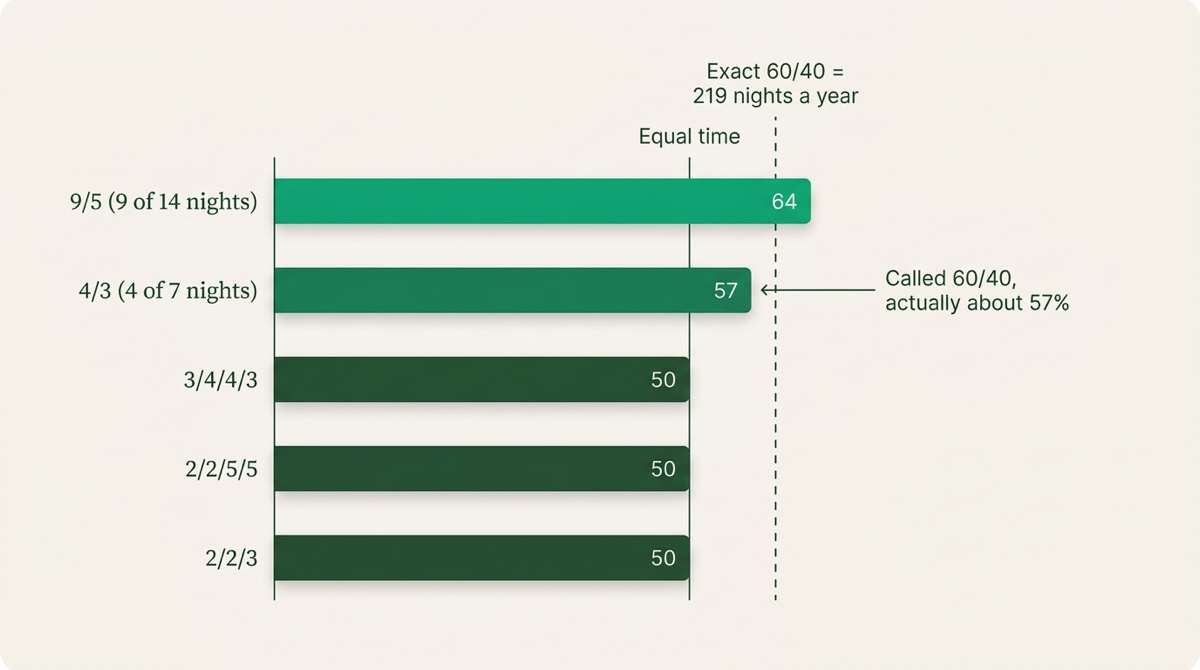
60/40 schedule examples
The 4-3 rotation
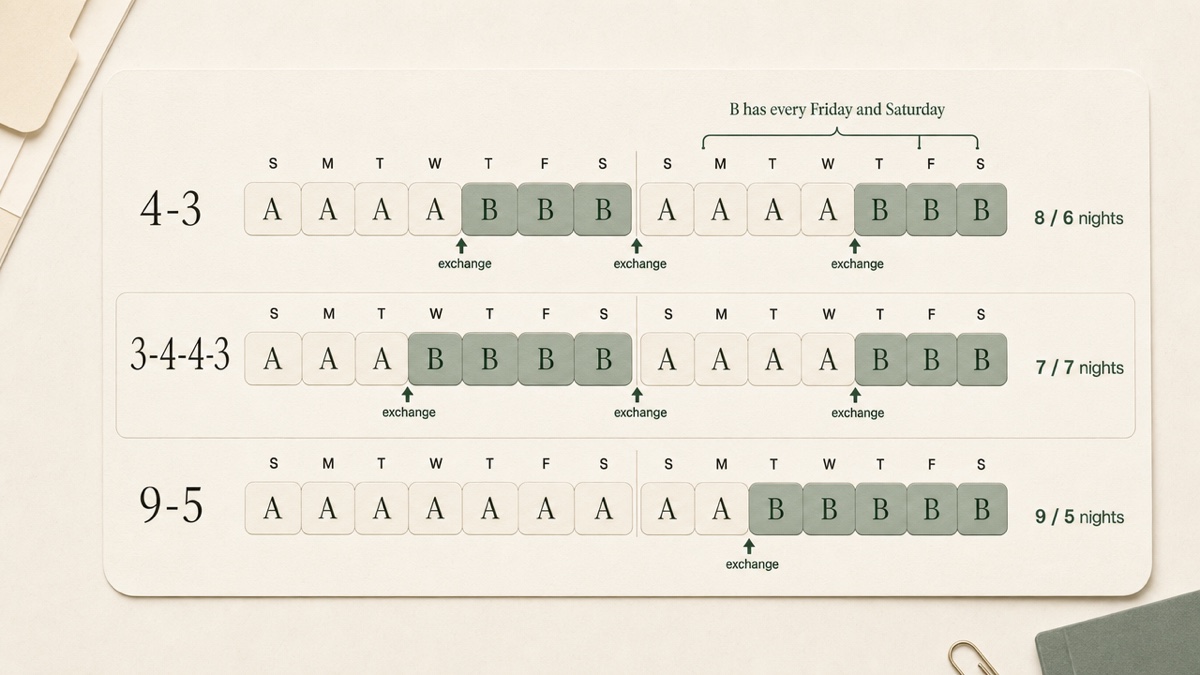
The child spends the same four nights every week with one parent and the same three with the other. A typical version gives Parent A Sunday through Wednesday nights and Parent B Thursday through Saturday nights.
- Math: 4 of 7 nights is about 57%, or 208 to 209 nights a year. That is 10 to 11 nights short of an exact 60%.
- Exchanges: two a week. If one exchange happens at school pickup, the parents may rarely meet.
- Strength: the week is predictable, which suits steady work schedules. Court guides note that fewer exchanges can help when conflict is high.
- Weak spot: depending on how the days are assigned, one parent may end up with every weekend. The other parent may also go four days without seeing the child. A midweek dinner visit is a common fix.
The 3-4 variant
"3-4" usually names the same rotation from the other parent's side. The version that changes your life is the one that moves days around. For example, the three-night parent might get Friday and Saturday nights in alternate weeks instead of every Thursday through Saturday. The counts stay the same and the weekends get shared. Before you agree to anything, check which version the written schedule actually describes.
Do not confuse it with 3-4-4-3. That is a 50/50 schedule in which the fourth day alternates each week.
Extended weekends
One parent has alternate weekends stretched at both ends. One court model plan runs from Wednesday after school to Monday morning every other week. That is 5 of 14 nights, about 36%. Adding a midweek overnight in the off week moves the split closer to 40%. Plans in this family differ mostly in when the weekend starts and ends, so read the start and end times carefully.
9-5 and 8-6 two-week splits
In a 9-5 split, one parent has nine straight nights and the other five in each 14-night cycle. That works out to about 64%. The exchange can fall on a weekday so each parent still gets a weekend. An 8-6 split is about 57%, the same as 4-3, but with fewer exchanges and longer stretches.
How 60/40 compares with 50/50 rotations
| Schedule | Larger share | Exchanges per 2 weeks | What stands out |
|---|---|---|---|
| 4-3 | ~57% | 4 | Same days every week |
| 9-5 | ~64% | 2 | Long stretches, weekends can alternate |
| 2-2-3 | 50% | 6 | Short gaps, days shift week to week |
| 3-4-4-3 | 50% | 4 | Fixed three days plus a rotating fourth |
| 2-2-5-5 | 50% | 4 | Same weekdays each week, weekends rotate |
Fewer exchanges mean fewer handoffs. More exchanges mean shorter gaps between seeing each parent. Court guides suggest short gaps often suit younger children.
Factors that push toward one pattern
Court worksheets keep returning to the same questions:
- Distance. How far apart the homes are, and who drives to school, child care, appointments and activities. Long drives favor fewer exchanges.
- Work schedules. A fixed four-day block suits a parent who works the same days each week. It can also suit a parent who travels out of town.
- Child age. Younger children often do better with shorter gaps. Older children bring more school, sports, social and job commitments that the schedule has to absorb.
- Conflict level. Exchanges at school, where one parent drops off and the other picks up, reduce face-to-face handoffs.
None of these makes one schedule legally better than another. Which pattern fits your family, and how your state treats it, is a conversation for your attorney.
How the percentage is actually calculated
The formula is simple:
> unique overnights with you in the period ÷ total days in the period
Count each night once, even if two children slept at your home that night. A few edge cases trip people up:
- School exchanges. The parent who picks up after school usually has that night. The parent who drops off in the morning does not.
- Mid-day exchanges. Ask whose home the child sleeps in. When you log a multi-night stay, the end date is the return morning, and that morning is not a night.
- Timed visits don't move the number. A Wednesday 4–7 p.m. dinner is real parenting time. It is not an overnight, so it belongs in a separate count of visits and hours.
- Holidays and summer. Holiday and summer blocks override the weekly pattern. For example, if the 4-3 parent gives up two summer weeks, their year falls from about 209 nights toward 195, which is roughly 53%. The weekly pattern and the annual percentage are different numbers. Know which one your order and your support discussion refer to.
- Third-party care. Nights a child spends with a grandparent or a sitter are generally counted toward the parent whose scheduled time it was. A right-of-first-refusal clause in your order can shift those nights to the other parent, and some states count overnights based on where the child actually sleeps or on the order's exact wording.
Many states use overnight counts in child support calculations, and some use thresholds where the formula changes. This page will not run that math for you. Your attorney will.
Planned vs. actual: when the split drifts
A 4-3 schedule on paper is 57%. A year of late returns, skipped Thursdays and "just this once" swaps can turn it into something else. Drift is easy to miss week to week and hard to rebuild from memory months later.
A record that can show drift has three parts:
- The plan, set up as a recurring calendar.
- What actually happened, logged as it happens: missed overnights, extra nights, changed exchange times.
- Confirmation of the normal weeks. If you only log exceptions, nobody can tell whether the other 40 weeks went as planned.
The comparison works only if you keep the record yourself. It never depends on the other parent logging anything.
Setting it up in a tracking tool
Two decisions matter most.
Pick the anchor. A two-week pattern needs a fixed starting point: "week 1 begins Friday, January 2, with Parent A." Model plans sometimes fix this by year, such as one parent starting in odd-numbered years. If the anchor is wrong, every alternating weekend for the rest of the year lands on the wrong side. Use the date your order names. If it names none, use the first exchange you can document.
Add the overrides. Enter holidays, summer and alternating-year blocks separately so they replace the weekly pattern on those dates instead of stacking on top of it.
In Custody Proof, you upload your agreement or type the schedule in plain words, such as "4-3, I have Sunday through Wednesday nights." You then review it week by week on a grid before anything saves. Biweekly rotations, summer possession and holidays that alternate by year are supported (setup guide).
From there, the Plan vs Actual view lists the kept, missed and extra nights. Reports can carry a "Confirmed through" date. Timed visits stay out of the overnight percentage. The statistics page shows the split for any period you pick. It is private to you, and the other parent is never invited or notified.
Start your record. Schedule setup and planned-vs-actual tracking are on the Documentation plan, $14.75/month, with a 30-day money-back guarantee on your first charge.
Frequently asked questions
Is a 4-3 schedule really 60/40?
Not exactly. Four of seven nights is about 57%, or roughly 208 to 209 nights a year, against 219 for an exact 60%. People call it 60/40 because it is the closest common weekly pattern.
How many overnights is 60/40?
About 219 nights for one parent and 146 for the other in a 365-night year. In a leap year, add one night to the total.
Do dinner visits count toward my percentage?
Not toward an overnight percentage. Visits are parenting time and worth recording as a count of visits and hours. They don't add nights.
Why don't my percentage and the other parent's add up to 100%?
A one-parent record counts only the nights you logged. Unlogged nights are not automatically assigned to anyone. Confirm the weeks that went as planned so your record is complete.
What if my order doesn't say which week the rotation starts?
Then the anchor is ambiguous, and that is worth raising with your attorney. For tracking purposes, pick the first exchange you can document and keep it consistent.
Keep reading
- Co-Parent Keeps Changing Custody Schedule?
- How to Document Restraining Order Violations
- Google Calendar for a Custody Schedule: Setup and Limits
- Which custody app fits your situation
Custody Proof is a documentation tool, not a law firm. Nothing on this page is legal advice. Whether and how a record is used in a case is a question for your attorney.