How to Document Restraining Order Violations for Court
By EJ Archuleta, Licensed attorney · Updated
To document restraining order violations, write down each contact or approach as soon as you are safe. Record the date, the exact time, the place, what was said or done, and who saw it. Save the proof that goes with it: screenshots that show the sender and timestamp, voicemails, photos, and a police report number. Keep all of it in one chronological record that the restrained person cannot see or reach.
The record supports a police report and your attorney's work. It does not replace either one. This page explains what to capture, including the violations that leave no text message behind, and how to keep the record private. It is general information, not legal advice. Protective order law differs a great deal from state to state, so take questions about your own order to your attorney or a local advocate.
Know which order you have
Protective orders go by different names: restraining order, protective order, order of protection, no-contact order. The types and their rules vary by state. Many states follow a broadly similar pattern, though the names and details differ::
- Emergency orders are short. They are sometimes issued outside court hours and last only days, until a hearing can be held.
- Temporary or preliminary orders cover the period until a full hearing.
- Longer-term or final orders are issued after a hearing. Some last a year or more and can be extended.
Criminal courts can also issue no-contact orders as a condition of bail or probation. Those orders can exist alongside a family court order.
The terms on your copy are what matter. Read them for four things:
- Who is protected. Some orders also cover children or other household members.
- How far away the restrained person must stay.
- Which places are named, such as home, work, or school.
- Whether any contact is allowed, for example about the children or through a named third party.
Some orders also set temporary custody or visitation..
Keep a copy of the order, stored securely
Keep a copy of the current, unexpired order where you can reach it quickly. Photograph every page. If the restrained person was not at the hearing, also keep the proof of service, because it shows they were told about the order.
Check device safety before you store anything. If the restrained person has ever had access to your phone, email, or cloud photo backup, photos and notes there may not be private. Some advocates suggest waiting until the order has been served before photographing it. A library computer, a trusted friend, or an advocate's office can be safer places to keep copies.
What to log for every violation
A useful log is specific. Compare these two entries:
- "He keeps showing up." This is a complaint.
- "Tuesday, 7:42 a.m., silver truck parked across from the school drop-off line for about ten minutes, seen by the crossing guard." This is an entry.
For each incident, capture the following:
- Date and time. Use the time it happened, not the time you wrote it down. If you are unsure, say so ("about 9 p.m.").
- Place. Give the address or a precise description, and how close they came if distance is in the order.
- What happened. Record words as close to verbatim as you can, in quotation marks. Describe actions plainly. Write what you saw and heard, not what you concluded.
- How it was contact. Record the channel: in person, call, text, email, social media, a gift left on the porch, or a message through someone else.
- Witnesses. Note names and how to reach them. Include people who saw you shortly afterward, not only people who saw the incident.
- Proof. Screenshots should show the sender, number or handle, date, and time. Save voicemails with their dates. Photograph any property damage. Digital evidence can disappear quickly, so capture it the same day.
- What you did next. Record whether you called police, the report number, and the officer's name.
Write factually. "She said 'you'll regret this' and slammed the car door" will hold up better than "she threatened me" with no words attached.
Violations that leave no message behind
Many violations involve no text message, so there is no message log to rely on. These are the incidents most likely to go unrecorded.
Showing up
This includes appearing at your home, work, the children's school, church, or a friend's house. It also includes driving past repeatedly or waiting in a parking lot. Log the vehicle, the time, how long they stayed, and whether anyone else noticed. A coworker or front-office staff member who saw them is a witness worth naming.
Contact through other people
Messages can arrive through relatives, a new partner, mutual friends, or the children. Examples include "Tell your mom she'd better drop the case," a friend forwarding a message, or a new account following you online. Whether contact through others violates your order depends on its wording.. Log it either way. Record who delivered it, their exact words, when, and how you know where it came from.
When the children carry messages
If a child repeats something, write down what the child said, when, and in what words. Do not question the child to build the record. A short note made at the time is more useful than a conversation that looks coached.
Don't answer, even when they start it
In some states only the restrained person can be cited for violating the order.. A reply from you can still blur the record. It also gives the other side a story that the contact was mutual or invited.
If a message arrives, screenshot it, log it, and do not respond. If the order allows limited communication about the children, use only the method and topics the order names. If you are not sure what is allowed, ask your attorney before anything goes out.
Child exchanges under a protective order
When a protective order and a custody order both apply, exchanges carry the most risk. Some orders set a location, such as a police station lobby or a supervised exchange center. Others require a third person to handle the handoff, or a curbside exchange with no conversation. Follow the terms exactly.
If the protective order and the custody order seem to conflict, do not guess which one controls. Call your attorney before the next exchange. If you don't have one, contact your court's self-help center or a legal aid office..
At each exchange, record:
- The scheduled time and the actual arrival time.
- The location, and whether it matched the order.
- Who was present.
- Any words or actions beyond the handoff itself.
- Whether the children were returned on time.
Routine exchanges are worth a short line too. A record of exchanges that went as ordered makes the ones that didn't stand out.
A pattern versus isolated incidents
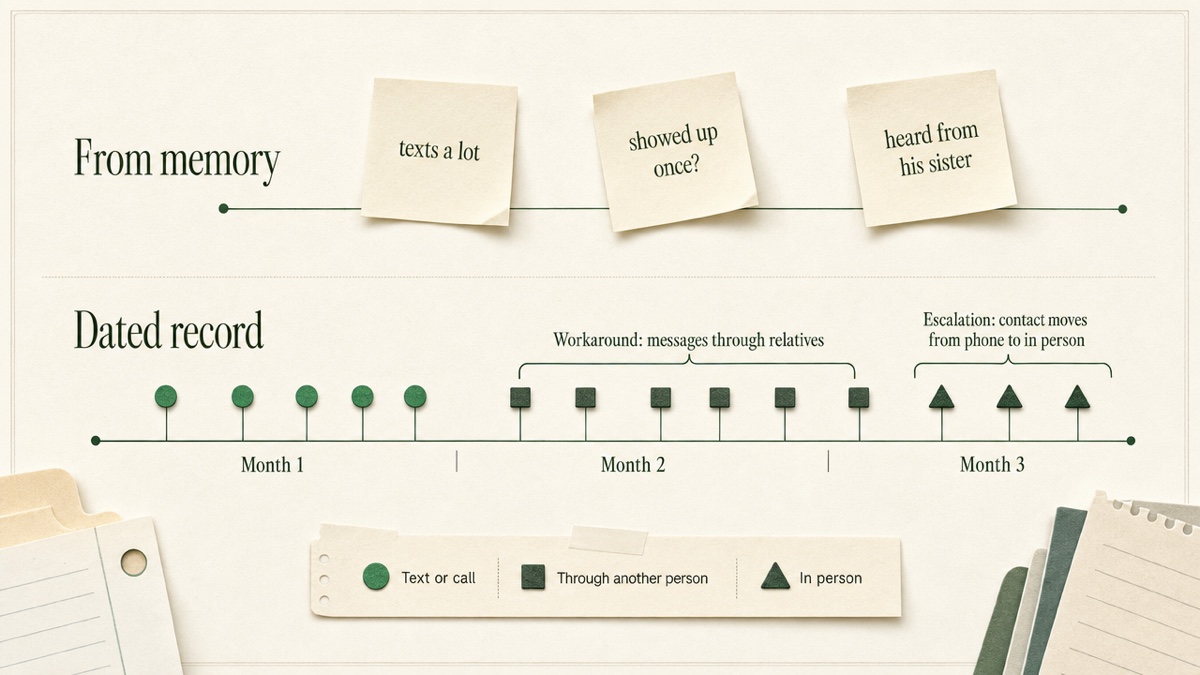
One drive-by can be explained away. Twelve drive-bys, each with a date, time, and place, are harder to explain. Courts may look at the overall course of conduct, so a complete chronological record can show a pattern that single entries cannot. A single serious violation can still matter on its own.. No fixed number of incidents makes a pattern. Your attorney can tell you what your court tends to look for.
A dated record makes three things visible:
- Frequency. How often contact happens.
- Escalation. Whether it is moving from texts to showing up.
- Workarounds. For example, direct messages stop and messages through relatives begin.
For a fuller treatment of turning entries into something your attorney can use, see how to document custody for court. On why a note written the same day beats recollection months later, see records, not memories.
When to call police, and when to call your attorney
Call 911 if you are in danger. Documentation can wait. In many states, enforcing a protective order starts with reporting the violation to police.. Tell the dispatcher about any weapons the restrained person has. Ask for the report number and put it in your log.
Call your attorney after any violation, even one police did not act on. A violation can matter in your custody case, and your attorney decides what to file and when. Violations can also bring criminal charges or contempt proceedings, with consequences set by state law..
Safety resources
- National Domestic Violence Hotline: 1-800-799-7233, or thehotline.org. The hotline is free and confidential.
- Local domestic violence advocates. Many can help with safety planning and organizing an evidence binder.
- Your court's self-help center. It can explain the local forms and hearing process.
Keeping the record in Custody Proof
Custody Proof is a private documentation tool for one parent. The restrained person never gets an account, an invitation, or a notification. Flagging an incident notifies no one.
The evidence vault holds dated entries in categories that fit this work:
- Incidents for the event itself.
- Communications for screenshots and messages.
- Witness for statements from third parties.
You can attach photos, screenshots, PDFs, audio, and video to each entry. Files are encrypted (AES-256) before they are stored, and only your account can see the vault. Exchanges go on the custody calendar, where a missed or late handoff can be flagged as a violation.
When your attorney or advocate needs the file, export a PDF evidence report with a cover page and exhibits tied to dates. On the Case Builder plan, Vero can turn a voice note or pasted thread into a draft entry for you to review. Vero never guesses dates.
If the restrained person may know your email or password, change both in Settings. Changing your password signs out your other devices.
Plans start at $14.75/month or $144/year, with a 30-day money-back guarantee on your first charge. Start your private record.
Frequently asked questions
Will the restrained person know I'm keeping a record?
Not through Custody Proof. There is no shared account, no invitation, and no notification. A record leaves the app only when you export a file and hand it to someone yourself.
Does a Custody Proof log prove a violation in court?
No tool can promise that. Entries keep their dates and attachments organized, and you can edit them to fix mistakes. Whether a record is admitted, and how much weight it carries, depends on your court and your case. Ask your attorney.
Can I add incidents that happened before I started?
Yes. Enter each one with its real date, and say plainly in the entry when you wrote it. Attach any screenshots or photos you already have.
What if they contact me about the children?
Check what your order allows. If it permits child-related communication through a specific method, use only that method. Otherwise, log the message, do not reply, and ask your attorney how to handle child matters.
Should I record calls or in-person encounters?
Recording laws differ by state. Some require everyone's consent.. Ask your attorney before recording, and only save material you lawfully have access to.
Keep reading
- Google Calendar for a Custody Schedule: Setup and Limits
- Representing Yourself in Custody Court
- What Is a Child Custody Evaluation? How to Prepare
- Which custody app fits your situation
Custody Proof is a documentation tool, not a law firm. Nothing on this page is legal advice. Whether and how a record is used in a case is a question for your attorney.