Representing Yourself in Custody Court: Organizing Your Records
By EJ Archuleta, Licensed attorney · Updated
Representing yourself in custody court is generally allowed, but the court will usually hold you to the same rules of evidence and procedure as a licensed attorney. Judges and clerks cannot tell you what to argue or what evidence to bring, so the part you control most is preparation: a short, dated, readable record instead of months of screenshots. Nobody will build your case for you.

This page covers that preparation. It explains the difference between going fully alone and hiring a lawyer for pieces of the case, where to find free help, how to build a chronology, how to count parenting time and expenses, and how to carry yourself in the courtroom. It is general information, not legal advice. Procedure varies by state and county, so take questions about your own case to a qualified family law attorney or your court's self-help center.
Pro se vs. limited-scope representation
Pro se (self-represented) means you handle everything. You choose and file the forms, serve papers, meet deadlines, pick witnesses and present the evidence. Courts generally do not appoint lawyers for parents in private custody disputes. For example, North Carolina's court system says it does not.
Limited-scope representation, often called unbundled services, sits between full representation and doing it all yourself. You hire a lawyer for specific tasks and handle the rest. Common tasks include:
- Reviewing your forms before you file them
- Coaching you before a hearing
- Appearing for one contested hearing
- Drafting or reviewing a proposed order
States regulate limited-scope arrangements differently. Some require a written agreement that defines the scope or a notice filed with the court.. Ask any lawyer you consult exactly what they will and will not do, and get that in writing.
Limited-scope help is one of the better ways to stretch a small budget. Your money buys a lawyer's judgment at the points where it matters most. For a sense of what full representation costs, see what custody attorneys charge.
Free and low-cost starting points
Before you file anything, check what your court already offers.
- Court self-help centers. Many courthouses have one. Staff can explain forms and procedure, but they cannot advise you on strategy. In California, every court has Family Law Facilitators, attorneys who give free help with support issues but do not represent either side.
- Legal aid organizations. They often have income limits and waitlists. Apply early.
- Public law libraries. Librarians can point you to your state's custody statutes and local rules. They cannot interpret them for you.
- Bar association referral services and law school clinics. Some offer reduced-fee consultations.
- Mediation. It can resolve some disputes without a hearing. Whether it is required, offered or appropriate depends on your court and your case. That is especially true where there is a history of abuse or intimidation. Many courts offer exemptions, separate sessions or other safety measures, so tell the court or mediator about any safety concerns before mediation is scheduled..
Ask the clerk's office whether your court charges filing fees and whether fee waivers exist. Ask too whether interpreters are available. Courts commonly provide spoken-language and sign-language interpreters at no cost if you request one ahead of time.
Build a chronology, not a pile
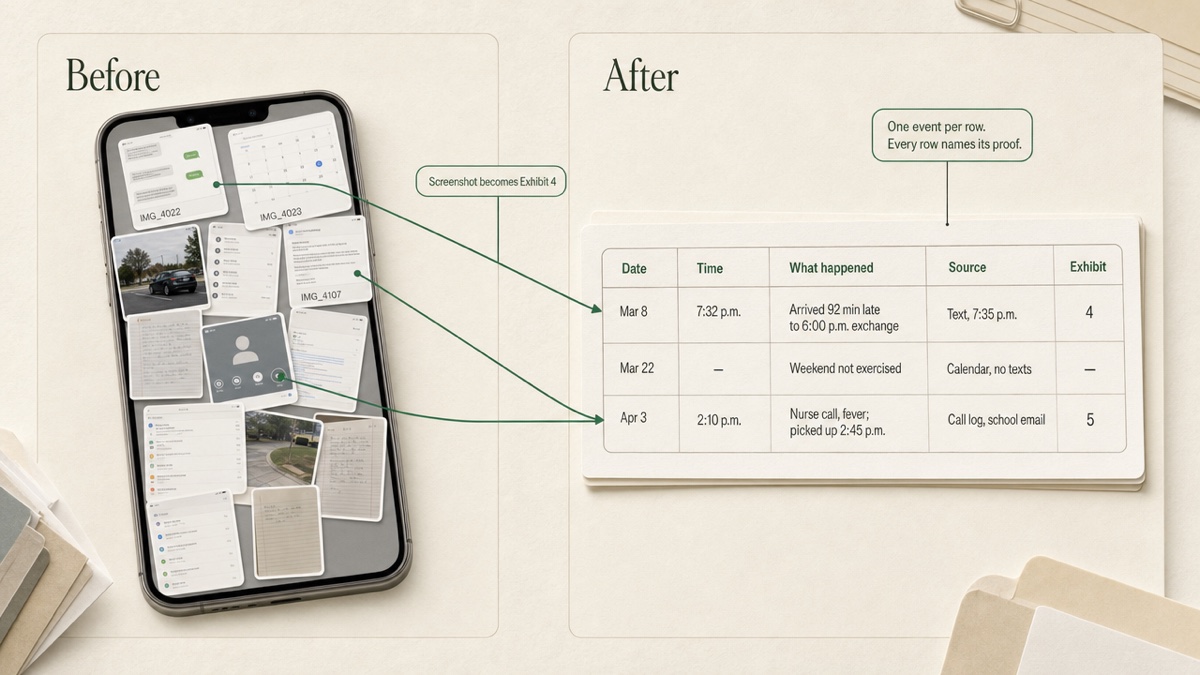
Most self-represented parents arrive with evidence. Fewer arrive with evidence a judge can follow. A camera roll of 400 screenshots shows that a lot happened. It does not show what happened, when, or how often.
A chronology is a table with one event per row, in date order. Each row points to its proof. A workable format:
| Date | Time | What happened (facts only) | Source | Exhibit |
|---|---|---|---|---|
| Mar 8 | 7:32 p.m. | Scheduled exchange was 6:00 p.m. Other parent arrived at 7:32 p.m. | Text received 7:35 p.m. | 4 |
| Mar 22 | none | Weekend not exercised. No message received. | Calendar entry, no texts that day | — |
| Apr 3 | 2:10 p.m. | School nurse called about fever. Picked child up at 2:45 p.m. | Call log, school email | 5 |
Some rules that keep the table useful:
- One event per row. A row that bundles "late again, rude, ignored my texts" is three rows or none.
- Real dates, not reconstructed ones. If you are entering past events, use the date the event happened. Mark anything you are unsure of.
- Write the source. "Text received 7:35 p.m." lets anyone check the row against the screenshot.
- Cut what does not matter. Court guidance commonly tells self-represented parties to leave out issues that do not support their case. A two-page chronology of the events that matter beats twenty pages of everything.
For a fuller walkthrough of the documentation itself, see how to document custody for court.
Count parenting time two ways: overnights and day visits
Parenting time disputes often come down to a number, and the other side will check how you got it.
Two units are commonly used:
- Overnights. Count the nights the child slept at your home. A Friday-afternoon-to-Sunday-evening weekend is two nights, not three days, because the return day is not a night.
- Day visits. A Wednesday dinner from 3:30 to 7:30 p.m. is real parenting time, but it is not an overnight. Track it as a count of visits and a total of hours.
Keep these as two separate totals. If dinner hours get folded into an overnight count, the number stops meaning one thing, and it becomes easy to attack.
Some courts or support worksheets use an hour-based method instead. In one version of that method, the hours the child spends with each parent across the year are added up and divided by 8,760, the number of hours in a non-leap year. Worksheets differ on what time counts, including whether holidays and vacations are included.. If your court uses hours, overnight and visit records are still the raw material. Ask the self-help center which method your court uses, and do not guess.

Organize expenses and reimbursements
If your order or agreement splits certain child costs, keep a ledger, not a shoebox. For each expense, record:
- The date it was incurred and the amount
- What it was for and the category (medical, school, activities)
- The receipt
- Whether it is shared under the order, and the share
- When you asked for reimbursement and what you have received
The total owed minus the amount received is your balance. A one-page summary with each receipt labeled as an exhibit answers "they never pay their half" better than any argument does. Which costs are shared, and what counts as notice, depend on your order. If either is unclear, ask a lawyer before you put the expense in front of a judge.
Package your exhibits
Court guidance on exhibits tends to agree on a few points:
- Label every exhibit (Exhibit 1, Exhibit 2, and so on) and organize them before the hearing.
- Put your notes on top. Follow them with the chronology, then the evidence it cites, then copies of anything the other side filed.
- Bring enough copies. Some courts recommend at least three: one for you, one for the judge and one for the other side. Bring extra if a witness will need to look at an exhibit, and check your local rules..
- Ask about deadlines. Missing a filing or service deadline can sink a case. Some courts also require exhibits to be exchanged or filed before the hearing.
- Keep your address current with the court. Courts generally assume you received anything mailed to the address on your forms.
Clean organization does not make anything admissible. That is decided under your state's evidence rules. It does make your exhibits dated, labeled and easy to find when the judge asks.
In the courtroom: composure and factual language
What you say carries as much weight as what you bring.
Use facts, not conclusions. "They are an unfit parent" is a conclusion the judge has to reach, not one you can announce. "On March 8 the exchange was scheduled for 6:00 p.m. and the other parent arrived at 7:32 p.m., see Exhibit 4" is a fact the judge can weigh. Let the chronology do the persuading.
Be brief. Explain your side clearly, stick to the issues that matter to the children, and never attack the other parent personally.
Etiquette basics:
- Dress. Wear business clothes if you have them. If you don't, clean and neat casual clothes are fine. Remove hats.
- Timing. Arrive early. Lateness can lead to dismissal, a ruling without you, or a postponement.
- Addressing the judge. Say "Your Honor" or "Judge." Do not interrupt or react while the other side or the judge is speaking. Wait your turn.
- Rehearse by watching. If you can, sit in on other hearings beforehand. You will see where the parties sit, how they explain their cases and how much time each side gets.
- Your witnesses are your job. Court staff will not contact or subpoena witnesses for you.
When to get an attorney, even for one hearing
Some moments justify limited-scope help even on a tight budget:
- The other parent has a lawyer. The gap in procedural knowledge is real.
- A contested evidentiary hearing or trial. Objections, witness questioning and admitting exhibits are technical skills.
- Relocation, protective orders, or allegations of abuse or substance use. The stakes and the procedure both go up.
- Drafting the final order. Vague wording becomes the next dispute.
- Anything you do not understand in papers you were served.
An organized record also makes a short engagement go further. A lawyer handed a clean chronology, parenting-time totals and an expense summary spends less time sorting and more time on the hearing.
Where Custody Proof fits
Custody Proof is a private documentation tool for one parent. It is not a law firm, and it does not provide legal services or court forms. The other parent is never invited or notified.
It keeps the record described above:
- Parenting time. Overnights and timed visits are counted separately.
- Plan vs. actual. Your scheduled time is compared against what you logged.
- Incidents. Violations are flagged on your own timeline.
- Evidence. Files are stored in an encrypted vault with seven categories.
- Expenses. A child-expense ledger tracks receipts and a running reimbursement balance.
- Exports. PDF reports include a one-page stats summary, an expense report with receipts labeled as exhibits, and the Court Packet. See reports and exports for what each one contains.
Plans start at $14.75/month, with a 30-day money-back guarantee on your first charge. Start your record.
Frequently asked questions
Can I represent myself in a custody case?
Generally, yes. Expect to be held to the same procedural and evidence rules as a lawyer. Court staff can explain processes but cannot advise you. Your court's self-help center can tell you what applies where you live.
What is the difference between pro se and unbundled legal services?
Pro se means you handle the entire case yourself. With unbundled, or limited-scope, services, you hire a lawyer for defined tasks such as one hearing or a form review, and you do the rest. Rules on how limited-scope arrangements work vary by state..
Will the judge help me if I make a mistake?
Judges are generally expected to be fair to self-represented parties. They will not tell you what evidence to present, which witnesses to call or how to argue. That is why preparing your exhibits before the hearing matters.
Should I count parenting time in days or nights?
Many courts talk about parenting time in overnights. Many courts talk about parenting time in overnights. Some use hours or a percentage of the year for certain purposes, such as child support worksheets.. Keep overnights and day-visit hours as separate totals so you can present either, and ask your court which method it uses.
Does Custody Proof provide legal advice or court forms?
No. It is a documentation tool. It organizes your records and exports reports you can give a lawyer or use to prepare. Forms come from your court or its self-help center. Legal advice comes from an attorney.
Is it too late to start organizing if my hearing is soon?
No. Start with the events most relevant to the hearing, use their real dates, and attach the proof you already have. A short, accurate chronology is more useful than a long, rushed one.
Keep reading
- What Is a Child Custody Evaluation? How to Prepare
- Parallel Parenting Plan Template for High-Conflict Cases
- Custody Log Template: The Fields Every Entry Needs
- Which custody app fits your situation
Custody Proof is a documentation tool, not a law firm. Nothing on this page is legal advice. Whether and how a record is used in a case is a question for your attorney.