Parallel parenting plan template: the sections and how to track it
By EJ Archuleta, Licensed attorney · Updated
A parallel parenting plan template has the same sections as most detailed parenting plans, written much more tightly. Those sections are an exact schedule, exchange times and places, holidays and vacations, decision-making authority, communication rules, expenses, household independence, and dispute resolution. Every clause should answer who, what, when, where, and by what deadline. Nothing should need a conversation to work.
That last point is what makes it a parallel plan. Below is the outline, the questions each section should settle, and the part most templates skip: how one parent can keep an independent record of whether the plan is being followed.
This page is general information, not legal advice or a ready-to-file form. Parenting plan rules and formats vary by state, so have a family law attorney in your jurisdiction draft or review your final plan.
Parallel parenting vs. co-parenting
A parenting plan sets out when the children are with each parent and how major decisions get made. What changes between the two models is how much the parents have to deal with each other.
- Cooperative co-parenting relies on frequent, open conversation. Schedules shift with a quick call, and the plan can be loose because the parents fill gaps together.
- Parallel parenting keeps contact minimal, written, and businesslike. Schedules are rigid and spelled out. Each parent runs their own time independently. The parents still share basic expectations for the children and still communicate about important issues, but only through set channels.
A loose plan works when two people can settle the details between them. When every detail turns into an argument, the plan has to settle those details ahead of time.
The template, section by section
Treat the bracketed blanks as decisions to make with your attorney, not defaults.
1. Regular schedule
- The rotation pattern, such as alternating weeks or every other weekend plus a midweek visit.
- The anchor date. Which parent has the first weekend, and starting when? Without an anchor, "every other weekend" can be read two ways.
- Exact start and end times for each period: "[day] at [time] to [day] at [time]."
- Whether midweek time is overnight or a timed visit with set hours.
- How the schedule changes with age, if it does. A plan for a toddler and a plan for a teenager rarely look the same. Some court model plans also use different structures when the homes are far apart, such as longer alternating blocks instead of midweek visits.
2. Exchanges
- Time. Exact, not "after school" or "evening."
- Location. Often a neutral public place, such as the school, so the parents don't have to meet at a front door. If school is the exchange point, say what happens on non-school days.
- Transportation. Who drives, and whether a named third party may do the exchange.
- Lateness. Whether there is a waiting period, and what happens after it passes.
- Holiday and summer exchanges. Say whether they follow the same rules or their own.
3. Holidays, vacations, and to-be-designated dates
Holidays override the regular rotation, so the plan should say so and say how.
- List each holiday, which parent has it, and in odd or even years.
- Give start and end times, not just dates. "Thanksgiving" could mean Thursday, or Wednesday at 6:00 p.m. through Sunday.
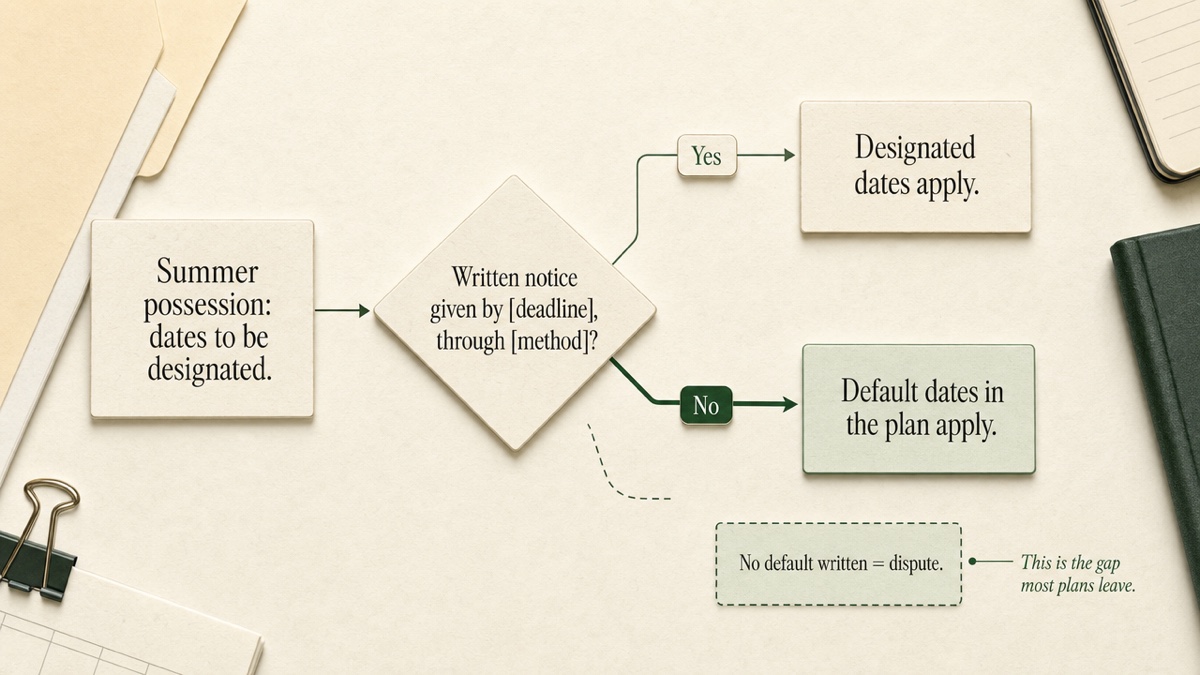
- For vacations and summer time chosen later, write the notice deadline, the method (in writing, through which channel), and the default that applies if no one gives notice.
That default is the clause most often left out. Without it, a missed deadline turns into a dispute about the whole summer. With it, a missed deadline simply means the fallback dates apply.
4. Decision-making authority
Day-to-day decisions, like meals, bedtime, homework routines, and chores, usually belong to the parent who has the children at the time. Emergency decisions usually do too. Major decisions need a structure. The common options are:
- Joint. Both parents must agree. This needs a dispute mechanism, or it becomes a permanent stalemate.
- One parent decides. In some high-conflict cases a court gives one parent the exclusive right to make certain decisions for exactly this reason.
- Divided by domain. One parent has final say on health care, the other on education, for example. A variation requires the parents to consult first, with a named parent holding final say.
Whatever you choose, say whether consultation is required, how it happens, how long the other parent has to respond, and that once a decision is made, both parents carry it out during their own time. That includes medication schedules and school attendance.
5. Communication rules
- Channel. The one method the parents use, named in the plan.
- Scope. Business only: schedule, exchanges, transportation, school, activities, health, safety, and the children's financial needs. Not the relationship.
- Frequency and length. For example, one scheduled update per week plus urgent matters only.
- Response window. Replies within [__] hours for routine items and [__] hours for time-sensitive ones.
- Emergencies. What counts as one, and how to notify the other parent immediately.
- Information sharing. Which school and medical information each parent must forward, and whether each parent may contact providers directly.
6. Expenses and reimbursement
- Which costs are shared (medical, childcare, activities, school) and in what proportion.
- Process. The paying parent sends the bill or receipt within [__] days, the other parent reimburses within [__] days of receiving it, and the plan names the method.
- Whether shared costs above a set amount need agreement before they're incurred.
- Activities. One parallel approach lets each parent choose and pay for one activity. Each parent then takes the child to scheduled sessions during their own time.
7. Household rules: each home runs independently
State plainly that each parent sets their own household routines and neither will try to control the other home. Then list the narrow shared standards that do apply, such as medication, safety rules, or a school bedtime. Keeping that list short keeps it enforceable.
8. Dispute resolution and review
- What the parents must try before going to court: mediation, a parenting coordinator, or another process, and who pays for it.
- A review point, either a date or a condition, for loosening the plan.
Why vague clauses create disputes
Words like "reasonable," "liberal," "as agreed," and "flexible" all assume the parents will negotiate. In a high-conflict case each one leaves a question open, and each open question becomes something to argue about.
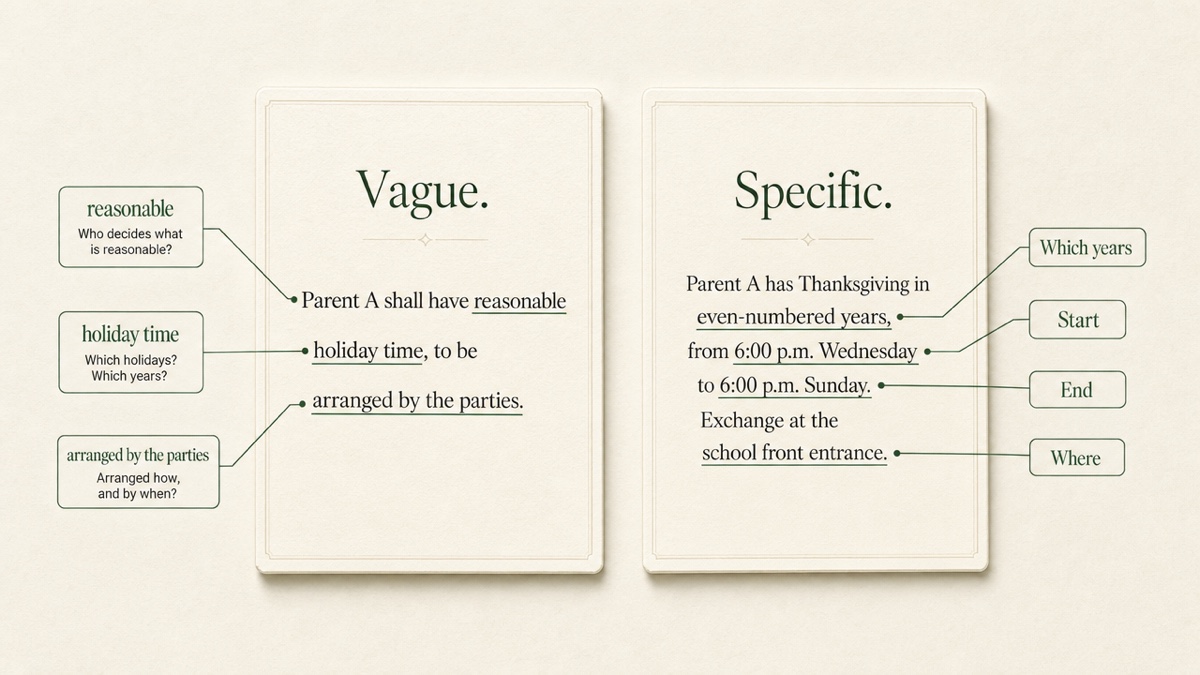
Specific clauses also make the plan measurable. You can't show that someone failed to follow "reasonable time." You can show that a 6:00 p.m. exchange happened at 7:40.
Tracking adherence on your own
Parallel parenting minimizes contact. Your record shouldn't depend on the other parent either. If the only record lives in a shared system, you have no independent account of what was planned, what happened, and what you did about it. Why co-parenting apps fall short in high-conflict cases goes into this further.
Keep a record that tracks the plan section by section:
- Planned vs. actual time. Load the plan's schedule, then record what actually happened: nights kept, missed, and extra. Counting the weeks that went right matters as much as the exceptions, because it shows the full picture rather than a list of complaints.
- Exchanges. For every late, missed, or relocated exchange, record the date, the scheduled time, the actual time, and the place. Write the facts and leave out the commentary. A practical guide: documenting missed visitation and late pickups.
- Response windows. When the plan sets a reply deadline, save the message with its date, and note the date of the reply or that none came.
- Deadlines. Track notice dates for vacations and designated periods, including your own. A record that shows you met every deadline is worth having.
- Expenses. For each shared cost, keep the date incurred, the receipt, the date you sent it, the amount owed, and the amount received. The balance is what you spent minus what came back, with a status on each item.
Over a few months this gives you a summary an attorney can use: how many exchanges went as scheduled, how many were late or missed, which notice deadlines were met, and what is still unreimbursed.
How Custody Proof handles this
Custody Proof is private documentation software for one parent. The other parent is never invited or notified. It doesn't draft parenting plans. It reads the plan you already have.
- Schedule from your order. Upload the agreement or describe the schedule in plain words, then review the calendar week by week before it saves. See set up your custody schedule.
- Holidays and to-be-designated blocks. Odd- and even-year holidays, summer blocks, and periods with dates still to be set are handled as holiday and vacation blocks. Notice deadlines found in your order are offered as in-app reminders.
- Plan vs. actual. Planned and logged time are compared day by day. You fix any differences and confirm the record through a date, and reports state that "Confirmed through" date.
- Violations and evidence. Flag late pickups and missed visits on the calendar. Attach screenshots and messages in an encrypted evidence vault, and see when violations happen and how often.
- Expenses. A ledger with receipts, each other parent's share, and a status: not requested, unpaid, partially paid, paid, or disputed.
- Exports. PDF reports, CSVs, and the Court Packet, which you export and hand to your attorney yourself.
The Documentation plan is $14.75/month or $144/year. Case Builder, at $29/month or $278/year, adds Vero, an AI assistant that turns voice notes, texts, and photos into drafts you review before saving.
When the plan isn't followed
A record helps your attorney decide what to do next. It doesn't decide anything by itself. Depending on the state, the options after repeated violations can include a motion to enforce the order, a contempt proceeding, a request for make-up time, or a request to modify the plan.
The right path depends on the pattern and on your state's law, so bring your attorney the dated record rather than a summary from memory.
Moving back toward co-parenting
Parallel parenting can be a stage rather than a permanent arrangement. If exchanges have run on time for months, messages stay on topic, and expenses get paid, that history is the evidence that loosening the plan is justified. The same record that would support enforcement can also show that conflict has gone down.
Keeping that record doesn't depend on anyone's cooperation but yours. Start your record with Custody Proof.
Frequently asked questions
Is this template a court form I can file?
No. It's an outline of what detailed plans usually address. Courts often have their own required forms and rules, which differ by state. Your attorney should draft or review the final version.
What's the main difference between a parallel parenting plan and a standard parenting plan?
The level of detail. A parallel plan leaves nothing to be worked out between the parents. That means exact times, exact places, named decision-makers, written deadlines, and a default for every to-be-designated date.
Will the other parent know I'm tracking whether the plan is followed?
Not through Custody Proof. There is no shared account, no invitation, and no notification. If you share anything, you export the file and hand it over yourself.
Can Custody Proof write my parenting plan?
No. It turns an existing order or agreement, or your plain-words description of the schedule, into a calendar you review. Drafting the plan is your attorney's job.
Does parallel parenting require a shared messaging app?
Your plan or your court may name a communication channel, and you should follow whatever it says. Your own record of schedules, exchanges, deadlines, and expenses doesn't have to live there. Keeping copies of your messages in your own record means you aren't relying on a single system you don't control.
Keep reading
- Custody Log Template: The Fields Every Entry Needs
- How to Prove Custodial Interference
- How to Win Custody as a Father: The Records That Matter
- Which custody app fits your situation
Custody Proof is a documentation tool, not a law firm. Nothing on this page is legal advice. Whether and how a record is used in a case is a question for your attorney.