How to Win Custody as a Father: The Records That Show Involvement
By EJ Archuleta, Licensed attorney · Updated
If you want to know how to win custody as a father, start here: no single move does it, because courts generally decide on the child's best interests, not on which parent is the mother or the father. What a judge can weigh is evidence of involvement: the nights your child slept at your home, the school and medical appointments you handled, the costs you paid, and how reliably you showed up for exchanges. If you keep that evidence dated, factual and organized, your attorney has something concrete to work with instead of a list of claims.

This page is an inventory of those records and how to keep them so they hold up. It applies to any parent seeking more time, including mothers. It is general information, not legal advice for your case. Custody law varies by state, so take state-specific questions to your own family law attorney.
The standard is the child's best interests
Every state uses some version of a best-interests test, and the factors look similar across many of them. Courts commonly ask questions like these:
- Which parent has been the main caregiver, before and after separation?
- What are the emotional ties between each parent and the child?
- How connected is the child to school, home and community?
- Can each parent meet the child's daily and special needs?
- Will each parent support the child's relationship with the other parent, when that is safe?
- Is there any history of family violence or substance abuse?
Notice what is missing: the parent's gender. Several state court systems say directly that neither parent is favored. Look at what remains. Most of those questions are answered by history, which means they are answered by records.
What changes from state to state
Some states start from a presumption that a strong relationship with both parents, or a shared schedule, serves the child. Others apply the best-interests factors without a starting presumption, and a few list shared custody as a preference rather than a presumption. Where a presumption exists, it can be overcome with evidence. The difference matters because it shifts what your evidence has to do: support a shared plan, or show why a different allocation fits your child.
If you were not married to the other parent, you may need to legally establish paternity before a court will address custody or parenting time. How that happens depends on your state. In most states, a voluntary acknowledgment signed at birth can make you a legal parent, but you may still need a court order before custody or parenting time is set. Ask your attorney about this first. It can control the timeline of everything else.
The involvement inventory: four kinds of records
1. Overnights and parenting time totals
Start with time. Most custody arguments eventually come down to how much time each parent actually had, and family courts commonly count it in overnights, not calendar days. A Friday-to-Sunday weekend is two nights. The full math is in how courts count parenting time.
Keep two separate tallies:
- Overnights: each night the child slept at your home, counted once no matter how many children were with you.
- Timed visits: same-day time such as a Wednesday dinner, recorded as a count and total hours.
Blend them and the percentage stops meaning anything specific.
Then compare the plan to reality. Your order says what should happen. A planned-versus-actual record shows what did: nights kept as scheduled, nights missed, extra nights you covered. Some courts weigh whether a parent consistently uses the time they were given, so a record that shows you exercised your schedule week after week matters. Log the ordinary weeks too, not just the ones that went wrong. A record made only of exceptions has no baseline.
2. Routines, school and medical participation
"Main caregiver" is not a feeling. It is the person who scheduled the dentist, sat through the parent-teacher conference, knows the pediatrician's name and packed the medication for the overnight trip. Write those down as they happen:
- School: conferences attended, emails with teachers, field trips, homework routines, pickups.
- Medical: appointments you scheduled or attended, prescriptions you filled, follow-ups you handled.
- Activities: practices you drove to, games you attended, registrations you paid for.
- Daily routines: bedtimes, meals, the steady pattern of an ordinary week at your home.
Attach what proves each one: a confirmation email, an after-visit summary, a sign-in sheet photo. Keep only information you lawfully have access to.
3. Expenses paid and reimbursements
Money you spend on your child is a form of involvement, and it is easy to document if you do it the day you pay. Record the date, amount, vendor, what it was for, which child, and the receipt. If your order makes a cost shared, note the share and whether you requested reimbursement, when, and what came back. Statuses like unpaid, partially paid and paid replace an argument from memory with a balance.
The full system is in how to track unreimbursed child expenses. Whether a given cost is shared under your order is a question for your attorney.
4. Exchange reliability
Be the parent whose exchanges are boring. Arrive on time, at the agreed place, and record it. A long run of on-time exchanges is quiet evidence of reliability. When the other parent is late or does not show, that is recorded too, as a fact.
Documenting a missed exchange without building a case against the other parent
Records written in anger read like grievances, and judges notice. Record what you saw, when, and what you did next. Leave out motives, character and predictions.
A loaded entry: "She did it again. She's trying to keep the kids from me."
A factual entry: "Saturday 10:00 a.m. exchange at the school lot. Waited until 10:45. No arrival. Texted at 10:05 and 10:30, no reply (screenshots attached). Left at 10:50."
The second one is stronger because it is checkable. It names a time, a place, the steps you took and the attachments that back it up. It also shows that you handled a frustrating moment calmly. Write the same way in any declaration your attorney asks you to review: dates, times, what happened, what you did. Let the pattern speak.
Notes made at the time carry more weight
A note written the day something happened is generally more credible than one reconstructed months later, when memory has blurred and the dispute has hardened. Two habits help:
- Log the same day. A dated entry with an attachment beats a recollection.
- Preserve the original. Keep full screenshots of texts with dates and names visible. Do not crop, edit or retype them.
Whether a text, photo or app log can be admitted, and whether it raises hearsay problems, depends on your state's evidence rules and how your attorney presents it. Your job is to keep records intact and dated. Your attorney decides how to use them.
Turning raw logs into something your attorney can use
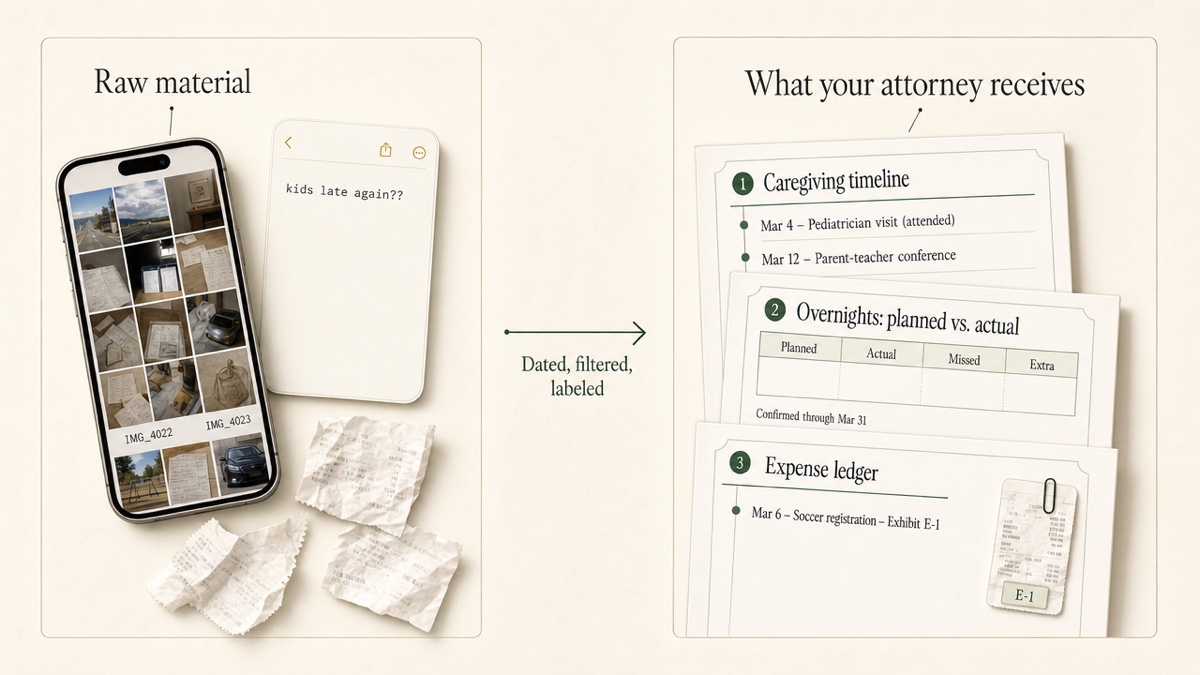
A camera roll, a notes app and a pile of receipts are raw material. What your attorney needs is a few organized summaries: a caregiving timeline, an overnight count with a planned-versus-actual comparison, and an expense ledger with receipts labeled as exhibits. Organized records also save your attorney the hours they would otherwise spend sorting your files. More on structure: how to document custody for court.
Propose your own parenting plan, with your attorney
A parenting plan sets out where the child lives, when they are with each parent, and how decisions get made. Courts often distinguish legal custody (decision-making about health, education and welfare) from physical custody (where the child lives). Either can be shared or held by one parent.
Rather than only reacting to the other side's proposal, work with your attorney on a plan of your own that fits your child's actual life: school location, your work schedule, childcare, activities, holidays. Your records strengthen it. If you have handled most Tuesday and Thursday pickups for a year, a plan that keeps those days with you rests on fact. Some states have forms where a parent states a proposed schedule and explains why it serves the child. Your attorney will know what your court expects.
Composure is part of the record
How you behave during a dispute becomes evidence. Hostile texts, social media posts and confrontations at exchanges can end up in front of a judge. Some practical rules:
- Keep written messages short, civil and about logistics.
- Do not argue at exchanges. If something goes wrong, leave, then write it down.
- Do not speak badly about the other parent to or around your child.
- Prepare for testimony with your attorney so you can answer in facts, calmly, even when the questions are provocative.
Good documentation helps here too. Once the facts are written down and dated, you have no need to prove them in the moment.
If you use Custody Proof
Custody Proof is a private record for one parent. The other parent is never invited or notified. Your schedule can be built from your uploaded order or a plain-words description, then compared day by day against what you logged, with a "Confirmed through" date in reports. Overnights and timed visits are counted separately. An encrypted evidence vault keeps files in seven categories, including Health and Activities, and the expense ledger tracks receipts and reimbursement status. Exports include the Court Packet, a single PDF with a plain-English summary, color-coded calendars and a chronological journal.
Documentation is $14.75/month or $144/year. Case Builder, at $29/month or $278/year, adds Vero, the AI assistant, which turns voice notes, pasted texts and photos into drafts you review before saving. The first charge has a 30-day money-back guarantee.
Frequently asked questions
Do custody courts favor mothers over fathers?
Courts generally apply a best-interests standard, and several state court systems say they do not favor either parent. What tends to matter is caregiving history, stability and each parent's ability to meet the child's needs. That is why records of your involvement are worth keeping.
I'm an unmarried father. Where do I start?
Usually with legal paternity, because many courts need it established before addressing custody or parenting time. The process differs by state, so ask a family law attorney in your state what applies to you.
Do day visits count toward my parenting time?
They are parenting time and belong in your record, but they are usually tracked separately from overnights. Keep a count and total hours for visits, and keep overnights as their own number so neither inflates the other.
Will the other parent know I'm keeping records in Custody Proof?
No. There is no shared account, invitation or notification. If you want someone to see a record, you export a file and hand it over yourself, usually to your attorney.
I didn't document anything until now. Is it too late?
No. Start logging today, then add past custody time and incidents with their real dates and attach evidence you already have, such as screenshots, emails and receipts. Be honest about which entries were made at the time and which were added later.
Keep reading
- How to Create a Divorce Log Your Attorney Can Use
- How to Document Custody Exchanges: Times, Places, Proof
- Best Interest of the Child Factors Explained
- Which custody app fits your situation
Custody Proof is a documentation tool, not a law firm. Nothing on this page is legal advice. Whether and how a record is used in a case is a question for your attorney.