How to Document Custody Exchanges: Times, Places and Proof
By EJ Archuleta, Licensed attorney · Updated
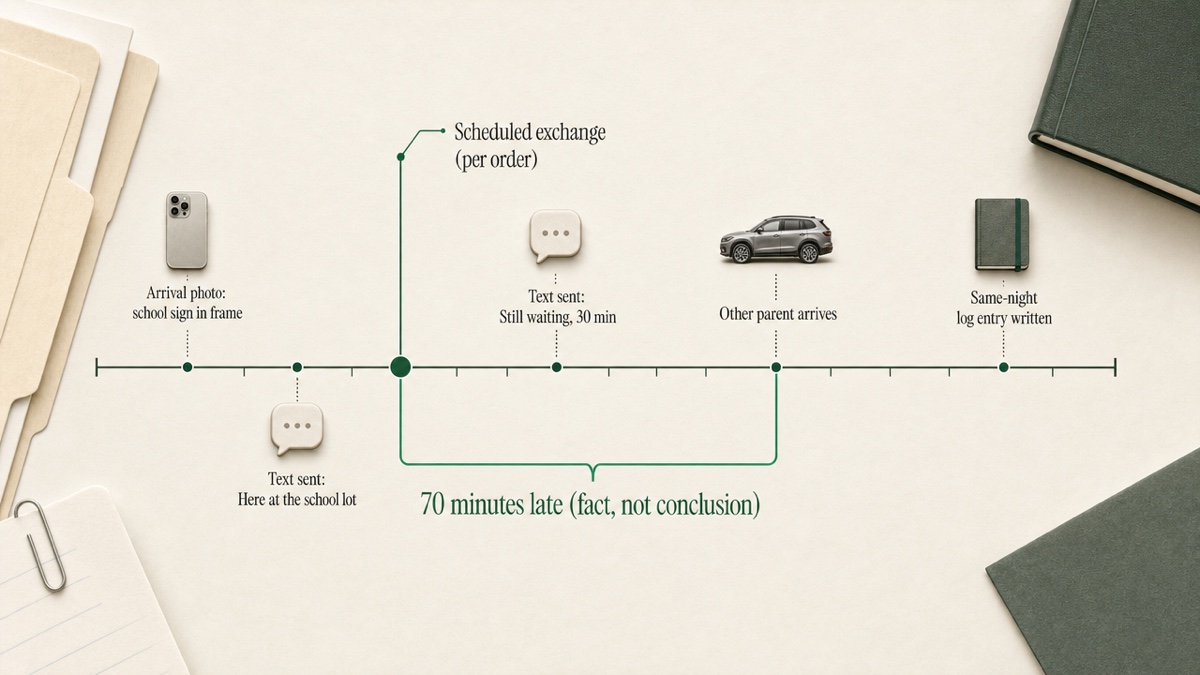
To document custody exchanges, write a short factual entry the same day as each one. Include the scheduled time, the time each parent actually arrived, the place, and who was present. Then attach proof you already have: a phone photo taken on arrival, the text you sent saying you were there, a receipt with a time stamp, or the name of someone who saw it. Do this for every exchange, including the ones that go fine, and the record starts to show patterns that one bad Friday can't.
You don't need a shared app, a check-in feature, or the other parent's cooperation. You need a habit and a phone.
This page is general information, not legal advice. Custody law and evidence rules vary by state, so ask your own family law attorney how they apply to your case.
The facts every exchange entry needs
Each exchange gets the same short set of fields. Write it within hours, not days.
- Scheduled time and place, as your order states them. If the order says "6:00 p.m. at the school," write that.
- Actual time you arrived, and the actual time the other parent arrived or the child was handed over.
- Actual place, if it differed from the order. Note who changed it and how you learned of the change.
- Who was present: you, the other parent, the children, anyone else (a new partner, a grandparent, a staff member).
- The child's condition, in plain observation. "Had backpack and medication." "Was crying and said she was hungry." Not "was neglected."
- What was said, only if it matters, in quoted words where you remember them.
- Witnesses, by name and how to reach them.
Keep it boring. A useful entry reads like a delivery log. An entry that reads like a closing argument works against you.
Log the on-time exchanges too
Most parents only write things down when something goes wrong. The result is a log made entirely of complaints, which looks selective even when every entry is true.
A record that shows 40 exchanges, 34 on time and 6 late, says something specific. It also shows you were present and punctual, which is often the half of the story nobody else will tell. An on-time entry can be one line: "Fri 6:00 p.m., school lot, both on time, handoff normal."
Proof you probably already have
Photos and their metadata
A photo taken at the exchange spot carries more than the image. Phones usually save the capture date and time with the file, and sometimes a location. Take one wide shot that shows where you are: the storefront, the school sign, the dashboard clock. Keep the original file. Edited or screenshotted copies can lose that data.
Don't photograph the other parent or the children to make a point. A picture of the empty parking lot at 6:05 makes the point better.
Texts sent on arrival
A short text at the moment you arrive ("Here at the school lot, 5:58") creates a timestamp on both phones. Keep it neutral and factual. If the other parent replies with a reason for running late, that reply is part of the record too. Screenshot the thread so the dates show.
Receipts
A gas station receipt or a coffee shop receipt near the exchange point shows a time and place. They aren't strong proof alone. Next to a photo and a text, they help confirm the timeline.
People who saw it
A school staff member, a friend who rode along, a grandparent who handled the handoff. Write down their names the same day. A witness who remembers "the Tuesday in March" is less useful than one you can point to a dated entry for.
What location data can and cannot show
Phone location is an estimate. Accuracy can drop indoors, near tall buildings, and in large parking lots, where a reading may place you in the wrong row or the wrong building. A location stamp supports a timeline. It rarely settles a dispute about which side of a lot someone stood on.
Two privacy points matter more than accuracy:
- Don't share your live location with a hostile co-parent to prove you showed up. A text and a photo do the same job without telling anyone where you are the rest of the day.
- Don't track the other parent. Document your own arrival and what you observed. Secretly tracking someone's phone or car can create legal problems for you.
Recording audio or video at an exchange raises the same caution. Whether you can record a conversation, and whose consent you need, depends mainly on state law. The rules differ from state to state, and they can also turn on where the other person is located and what your custody order says. Ask your attorney before you press record.
Public and supervised exchange locations
Exchanging in a safe, public place lowers the chance of an argument turning into something worse. Common choices are the child's school or daycare, a well-lit parking lot at a busy business, a coffee shop, or a spot near a police station. In contentious cases, a location with security cameras and steady foot traffic is generally better.
Some areas have designated safe exchange locations, and some courts order exchanges at a supervised visitation center or a monitored site. A neutral third party, or a relative handling the handoff instead of you, can also calm things down. That usually needs to be built into the custody arrangement ahead of time.
If the place you exchange has cameras, the footage won't sit there forever. Many systems overwrite recordings after a limited period. If something happens, note the camera locations in your entry and tell your attorney right away. Footage is usually controlled by whoever owns the camera, and getting it may take a formal request before it is overwritten, so your attorney can decide whether and how to request it.
If you want to change the exchange spot, remember the location in your order is usually the default unless both parents agree otherwise. Talk to your attorney rather than moving it on your own.
Late pickups and no-shows: facts, not conclusions
A late arrival is a number. Write the number.
- Weak: "He's always late and doesn't care about the kids."
- Useful: "Scheduled 6:00 p.m. Arrived 7:10 p.m. No text before 6:45. Text at 6:45 said 'traffic.'"
A no-show is a date, a time you waited until, and what you did: "Waited until 6:45. Texted at 6:15 and 6:40, no reply. Left with the children at 6:45." Some orders say how long a parent must wait or what happens to a missed visit, so check yours with your attorney. More on this in missed visitation and late pickups.
Be just as factual about your own lateness. If you were 10 minutes late, log it. A record that only catches the other parent's mistakes is easy to attack.
Patterns over time: planned vs. actual
One late exchange is an incident. Twelve over four months, mostly on Sundays, is a pattern. You can only see it if you log the exchanges that went right as well as the ones that went wrong.
Compare what the order says against what happened, week by week. Missed weekends, shortened weekends, and repeated late returns tend to show up only when the plan and the actual record sit side by side.
Safety first, documentation second
If an exchange turns threatening, leave with the children if you safely can, and call 911 if anyone is in danger. Don't stay to get a better photo.
Police called to an exchange are usually limited to documenting what is happening or what already happened. Ask for the officer's name and an incident or report number, and write both into your entry that night. If you have urgent safety concerns, talk to your attorney about emergency options in your state.
Doing this in Custody Proof
Custody Proof is a private documentation app for one parent. The other parent is never invited or notified.
- Log the time. Overnights and timed visits go on your calendar as separate things. See adding custody time.
- Flag the problem on the day. Late pickups and missed visits are among the preset violation categories. Attach your arrival photo and text screenshots to that event, and they sync into your evidence vault, where files are encrypted. Witness notes have their own category.
- Compare plan to actual. Once your schedule is saved, missed and extra time is listed by date. Confirm weeks that went as planned so your reports show the full record, not only the exceptions.
- On Case Builder, you can describe the exchange in a voice note in the parking lot. Vero, the AI assistant, drafts a dated entry for you to review. If a photo has its original capture date, Vero uses that date, and she never guesses one.
Custody Proof doesn't verify your location. Your proof is the photo, the text, and the entry you write.
If tonight's exchange already happened, start there: document tonight. Or create your record. Plans start at $14.75/month, with a 30-day money-back guarantee on your first charge.
Frequently asked questions
Do I need to log exchanges that went fine?
Yes. On-time entries show you were there. They also make the late and missed ones stand out as a real pattern rather than a list of complaints. One line per exchange is enough.
Is a phone photo enough to prove I was on time?
It helps, especially with the original file and its timestamp. It's stronger alongside a text you sent on arrival and a same-day written entry. How a court treats any piece of evidence is a question for your attorney.
Should I share my live location with the other parent at exchanges?
Usually not. A timestamped text and photo show you arrived without revealing where you are the rest of the day. If your order requires something specific, follow it and ask your attorney.
Can I record the exchange on my phone?
It depends on your state's recording laws and what your order says. Ask your attorney before recording audio or video.
Will the other parent see my exchange log in Custody Proof?
No. There is no shared account and no notification. If you want someone to see your records, you export a file and hand it over yourself.
Keep reading
- Best Interest of the Child Factors Explained
- Status Quo in Custody Cases: What It Is, How to Show It
- 80/20 Custody Schedule Examples and Overnight Math
- Which custody app fits your situation
Custody Proof is a documentation tool, not a law firm. Nothing on this page is legal advice. Whether and how a record is used in a case is a question for your attorney.