80/20 custody schedule examples and how the overnights add up
By EJ Archuleta, Licensed attorney · Updated
Common 80/20 custody schedule examples are alternating weekends with extra time, every weekend, and assigned weekends such as the first, third and fifth. A true 80/20 split gives one parent about 292 overnights a year and the other about 73, and most of these examples do not land at 20 percent. Alternating weekends alone come to about 52 overnights, roughly 14 percent. Every weekend comes to about 104, roughly 28 percent, which is closer to 70/30.

This page counts each pattern night by night. It shows how holidays and summer move the total and how to document whether the real split matches the plan. It is general information, not legal advice. How your order, your state, or a support worksheet counts time is a question for a family law attorney where you live.
What "80/20" means in nights
The label describes a share of the year, and family courts commonly measure that share in overnights. A night counts when the child sleeps at your home. The return morning does not count. Friday after school to Sunday evening is two nights, not three days. The full method is in how courts count parenting time.
So the target is simple. Twenty percent of 365 is 73 nights. Every pattern below is measured against that number.
Common 80/20 patterns, counted
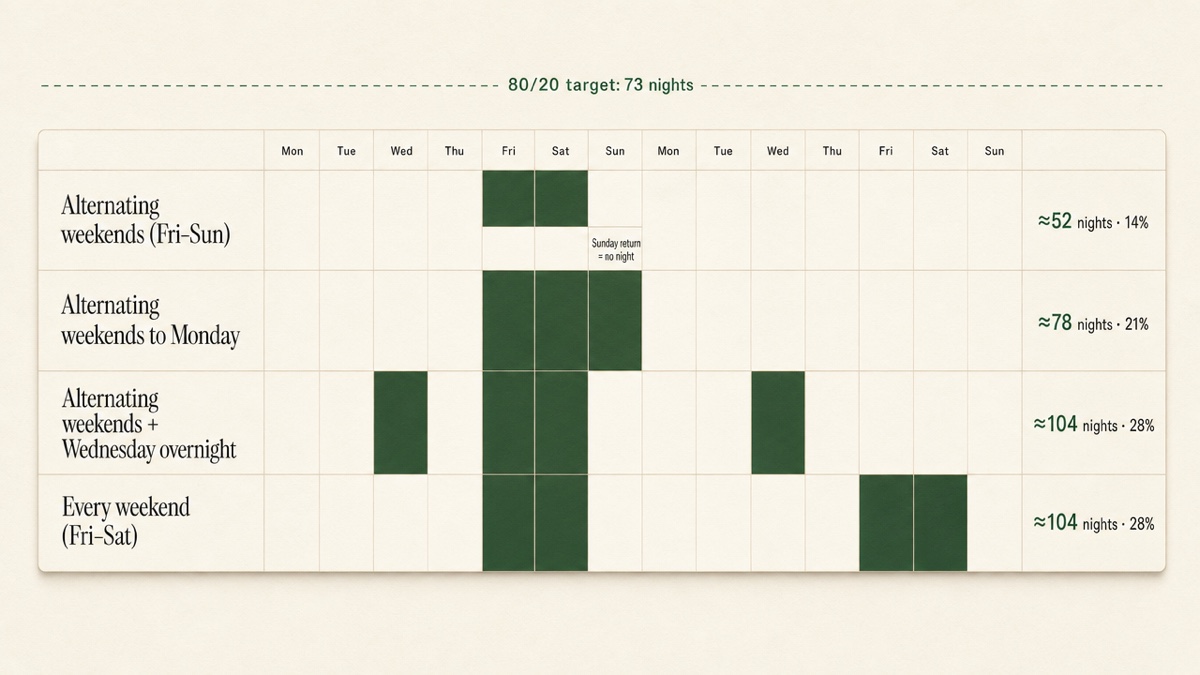
All figures are approximate and assume a 365-day year with no holiday or summer changes.
Alternating weekends, Friday to Sunday
26 weekends × 2 nights = about 52 overnights (14%). This is the classic "every other weekend" arrangement. It is often called 80/20, but on its own it is closer to 85/15.
Alternating weekends through Monday morning
If the weekend ends at Monday school drop-off instead of Sunday evening, each weekend gains a night. 26 × 3 = about 78 overnights (21%). That single change in the return time is the closest thing to a true 80/20 base.
Alternating weekends plus a midweek overnight
Add a Wednesday overnight every week: 52 + 52 = about 104 overnights (28%). That is no longer 80/20. If the midweek time is a dinner instead, the count stays at 52.
Every weekend
Friday and Saturday nights every week: 52 × 2 = about 104 overnights (28%). One parent has every school night and the other has every weekend. It is sometimes called a 5/2 schedule.
Assigned weekends
These are weekends tied to the calendar, such as the first and third weekend of each month, sometimes with the fifth added. First and third alone is 24 weekends, about 48 nights (13%). Adding fifth weekends brings it to roughly 52–58 nights, depending on how many months have five. Check how your order defines "first weekend" (for example, the weekend starting on the first Friday, the first weekend with a Saturday, or the first Thursday of the month), because that changes the count.
Why the label drifts
Schedules get named by feel. "He has weekends" sounds like a small share, but every weekend is more than a quarter of the year's nights. Three things move the real number:
- The return time. Sunday evening versus Monday morning is 26 nights a year on an alternating schedule.
- Midweek time. An overnight adds 52 nights a year. A dinner adds none.
- Blocks. Summer, winter break and alternating holidays can add or remove two or three weeks of nights.
Ask what the order's calendar actually produces, not what the arrangement is called.
80/20 compared with 70/30, 85/15 and 2-2-3
| Split | Nights for the smaller share | Patterns that often produce it |
|---|---|---|
| 85/15 | ≈55 | Alternating weekends, or assigned weekends |
| 80/20 | ≈73 | Alternating weekends plus summer and holiday time, or alternating weekends to Monday |
| 70/30 | ≈110 | Every weekend, or alternating weekends plus a midweek overnight |
| 50/50 | ≈182–183 | 2-2-3, week-on/week-off, 2-2-5-5 |
A 2-2-3 rotation works like this. The child spends two days with one parent, two with the other, then three with the first, and the order flips the next week. Each parent gets a full weekend every other week. It equalizes time but uses six exchanges every two weeks. Comparing every weekend with 2-2-3 is really comparing about 28 percent with about 50 percent.
Pros and cons for children and logistics
No pattern is right for every family. These are the trade-offs to weigh.
Weekend-heavy schedules (alternating weekends, every weekend, assigned weekends)
- Few exchanges, which matters when contact between parents goes badly.
- One home for school nights, so homework and routines stay predictable.
- They work when parents live far apart.
- The trade-off: long stretches without seeing one parent, which can be hard for young children. A midweek dinner is a common fix.
- Under every weekend, the school-week parent never gets a weekend at home.
Frequent rotations (2-2-3 and similar)
- Shorter gaps between seeing each parent.
- They need homes close together and many handoffs.
- Six exchanges in two weeks can be a lot of friction in a high-conflict case.
Afternoons don't move the percentage
A Wednesday 3:30–7:30 visit is real parenting time, but it is not a night. An overnight percentage counts nights only. Fold dinner hours into it and you are mixing two units, and the number becomes easy to attack.
Keep day visits in their own column: how many visits and how many hours. They still show involvement. They just don't show up as a share of overnights.
States differ on whether a long daytime block can count toward a parenting-time figure. Some count a daytime period as a "day" once it passes a set number of hours. Some say a short visit can never count. A few states, mainly in their child support guidelines, convert significant daytime care into "overnight equivalents." Your attorney will know which approach your state uses. The in-app rules are in how custody time is counted.
How holidays and summer shift the year
The base pattern is only part of the count. Blocks override it, and the overlap matters. When a holiday falls on a weekend you already have, it adds little. When it falls on the other parent's weekend, it adds the whole stretch. Many orders say holiday time takes priority whenever it overlaps regular weekend time, so check your order's wording.
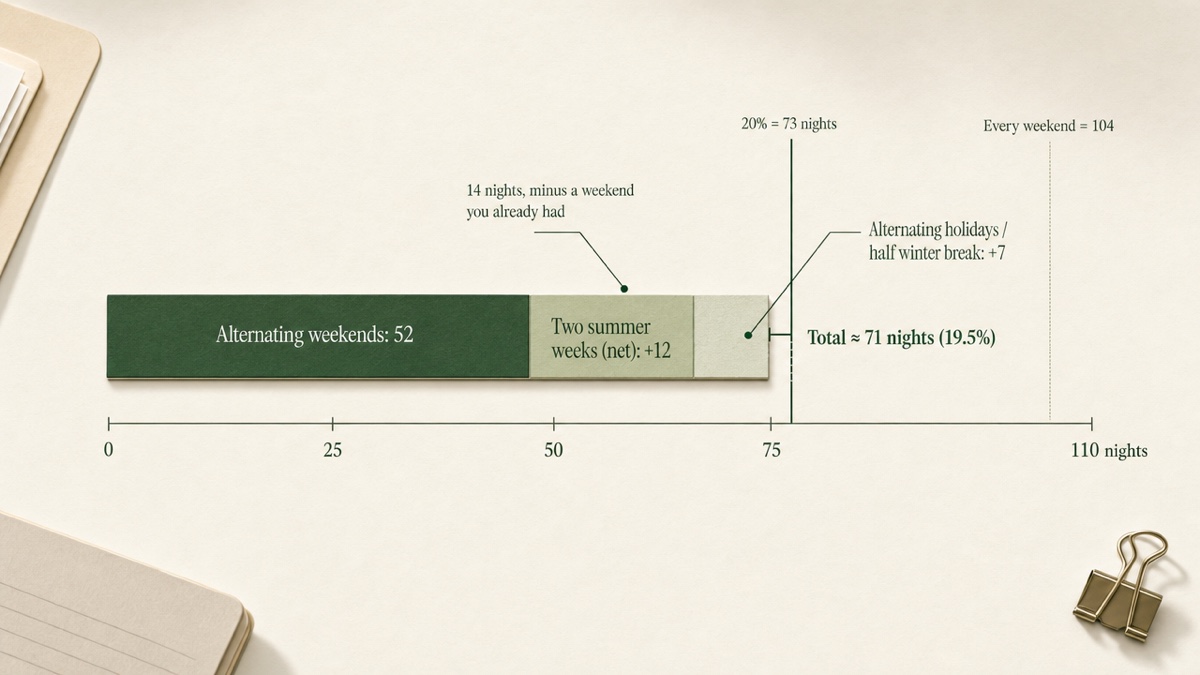
Here is a worked example starting from alternating weekends (52 nights):
- Two summer weeks with you. That is 14 nights, but one of those weekends was already yours. Net gain is about 12.
- Alternating holidays and half of winter break. These add about 7 in an average year.
- Total: about 71 nights, roughly 19.5 percent. That is close to a real 80/20.
Alternating-year holidays make individual years uneven. Because alternating-year holidays make individual years uneven, it can help to look at the count over a two-year cycle.
Vague language can't be counted. "Reasonable summer time" has no dates, so it produces no nights until dates are set. "Dates to be designated by April 1" gives you a deadline, but still no nights until you designate them. In Custody Proof, these become holiday and vacation blocks. You can set them as "with you" or "with the other parent," repeating every year, in odd years only, or in even years only. You can also save them as an open "dates to be set" item that prompts you as the period approaches.
Ordered time versus exercised time
The order states what is supposed to happen. The exercised count is what actually happened. In practice these drift apart: weekends get skipped, summer weeks get shortened, or extra nights become routine.
Many states look at parenting time actually exercised when support or a modification is on the table, not only the time on paper. In many states, a consistent pattern of not using ordered time can be raised as a change in circumstances when someone asks the court to modify support or parenting time. Attorneys tend to ask the same questions:
- How many overnights were ordered for the period?
- How many were exercised?
- On which dates did the two differ?
If you can't answer those from a record, the conversation falls back to memory against memory.
Tracking planned versus actual
You can keep this record yourself, without the other parent's participation.
- Turn the order into a plan. Load the regular pattern and every block, with the dates as written.
- Log what happened. Record each overnight with the return morning as the end date. Record day visits as timed visits with their real hours.
- Flag deviations on the day. Missed weekends, late returns, swapped nights and extra nights each get their own dated entry.
- Confirm the good weeks too. A record that only lists problems has no baseline. Confirming normal weeks shows what share of the plan was kept.
In Custody Proof, you can upload the agreement or describe the schedule in plain words, such as "every other weekend through Monday drop-off plus two summer weeks." You review the result week by week before it saves. The Plan vs Actual view then compares the schedule with what you logged: nights kept, missed, and extra, by date. Confirming a period adds a "Confirmed through" date that appears in your reports.
Your percentage is your logged nights divided by the days in the period, so it won't automatically sum to 100 with the other parent's. Unlogged days aren't assigned to anyone.
Start your record. It's private to you, from $14.75 a month, with a 30-day money-back guarantee on the first charge.
Frequently asked questions
What percentage is every other weekend?
About 14 percent with Friday-to-Sunday weekends: roughly 52 nights a year. Extending each weekend to Monday morning brings it to about 21 percent. Holiday and summer time push it higher.
Is an every-weekend schedule 80/20?
Usually not. Friday and Saturday nights every week come to about 104 nights, around 28 percent. That is closer to 70/30.
What is the difference between 80/20 and 70/30?
About 37 nights a year: roughly 73 versus 110. A single weekly midweek overnight is enough to move an alternating-weekend schedule from one to the other.
Do midweek dinners count toward my percentage?
Not toward an overnight percentage. They count as visits and hours. Some states treat long daytime periods differently for specific purposes, so ask your attorney how yours counts them.
Will the other parent see my calendar or be notified?
No. Custody Proof is used by one parent only. Nothing is shared unless you export a report and hand it over yourself.
Keep reading
- Who Claims the Child on Taxes After Divorce?
- Ex Won't Use a Co-Parenting App? What to Do
- What to Do If Your Child Refuses Visitation
- Which custody app fits your situation
Custody Proof is a documentation tool, not a law firm. Nothing on this page is legal advice. Whether and how a record is used in a case is a question for your attorney.