What to do if your child refuses visitation, and how to write it down
By EJ Archuleta, Licensed attorney · Updated
If your child refuses visitation, the court order usually still controls, and what to do depends on which side of the exchange you are on. The parent who has the child is generally expected to make real, good-faith efforts to get the child to the exchange, and the parent whose time is missed should not force the issue at the door. A child's "I don't want to go" is rarely treated as a reason, on its own, to skip court-ordered time. Either parent should keep a dated, factual record of each refusal and bring it to their attorney.

This page is for both sides of the exchange: the parent handing over a reluctant child and the parent whose time is being refused. The aim is the same for both. Write down what was scheduled, what happened, what the child said, and what you did. With that record, an attorney or evaluator can begin to tell a child's resistance apart from a parent's interference. That is what the case usually turns on.
This is general information, not legal advice. Custody law varies by state, so take questions about your own order to a family law attorney licensed where your case is.
Why children resist going
Refusal is a symptom, and several different situations produce it. Professionals who work these cases warn against settling on one explanation too early. The common categories:
- Ordinary preference (affinity). A child may simply feel closer to one parent at a certain age, or prefer one house because of friends, a pet, or a phone signal. This is normal and often temporary.
- Loyalty conflict. A child who senses tension between parents may feel torn and pick a side to make the stress stop. This can happen even when neither parent asks for loyalty.
- Alignment. A stronger, fixed wish to be with one parent, often with that parent's view of the other one repeated back.
- Justified concern (estrangement). The child is reacting to something real: harsh or neglectful parenting, violence, abuse, or substance use or mental health problems that are not being managed.
- Alienation dynamics. One parent's conduct pushes a child to reject a parent they previously had a reasonably good relationship with.
Most real cases mix more than one of these. Your log is not where you decide which one applies. Its job is to give the professionals who do decide something better than two competing memories.
Why "the child chose not to go" usually isn't enough
A custody order binds the parents, not the child. When a scheduled exchange doesn't happen, a court typically asks what the parent with the child did to make it happen. Whether the child agreed is not the main question. A parent who shrugs and says the child didn't feel like it can look like a parent withholding time, even with no bad intent.
The reverse also holds. A parent who made repeated, documented efforts is in a very different position from one who made none. The record of effort is the difference.
Is there an age when a child can refuse?
No single age applies everywhere. As a general rule, a minor cannot legally decline court-ordered parenting time on their own authority. Many states allow judges to consider the preference of a child mature enough to explain it, and older children's views tend to carry more weight. That preference is usually one factor among many, though in a few states an older teenager's choice can carry especially heavy weight.
States differ in how a child's view gets to the judge: an interview in chambers, a guardian ad litem, an evaluator, or not at all. Judges in the same state also weigh preferences differently. Ask your attorney how it works where your case is pending. Don't rely on what a friend's teenager "got to decide."
If you are the parent handing over the child
Your job is to show the order was followed in good faith, and to show it in writing.
At the exchange:
- Treat the visit as non-negotiable, the same way you treat school. Get the child ready, packed, and to the exchange point on time.
- Keep the message short and calm. A script: "I know this feels hard. It's [parent]'s time. You'll be okay, and I'll see you Sunday."
- Don't offer a reward for staying home, and don't let the visit sound optional ("Do you want to go?").
- Keep your own feelings about the other parent out of the car.
If the child still won't go:
- Notify the other parent promptly. Use the communication method your order names, or one that shows when the message was sent, such as text or email. Say what you tried, plainly.
- Record it the same day. Include the scheduled time, where you were, what you did, how long you tried, and the child's words.
- If your child sees a counselor or therapist, tell them. A professional's observations can help show the refusal didn't come from you.
If you are the parent whose time was refused
Your job is to record the gap without making it worse.
- Show up on time, as scheduled, even if you expect a refusal. A no-show from you undermines your own record.
- Don't force a physical handoff, and don't argue at the door in front of the child.
- Write down what happened while it is fresh: arrival time, who came out, what was said, how long you waited, when you left.
- Keep any message you received about the refusal, and note when it arrived.
For handling the late and missed exchanges that often come with refusals, see missed visitation and late pickups.
What a useful refusal entry looks like
Each parent records their side of the same exchange. Here is a fictional example.
| Field | Parent handing over | Parent receiving |
|---|---|---|
| Date | Fri, Mar 6 | Fri, Mar 6 |
| Scheduled | 6:00 p.m. pickup at my home, per order | 6:00 p.m. pickup at the other home, per order |
| What happened | Child packed at 5:30. At 6:00 refused to leave the bedroom. Talked with child for 20 minutes. Walked child to the door twice. | Arrived 5:55. Waited in the driveway. Other parent came out at 6:25 and said child would not come. Left at 6:35. |
| Child's words | "I don't want to go. It's boring there and I have Maya's party Saturday." | Did not see child. Heard "I'm not going" through the open door. |
| What I did | Texted other parent at 6:27 and offered Saturday 9 a.m. pickup. Told child the weekend still belongs to the other parent. | Replied 6:40 and accepted Saturday 9 a.m. Did not go to the door. |
| Overnights | 0 of 2 planned kept (Fri) | 0 of 2 planned received (Fri) |
Notice what's missing: no adjectives, no theories about the other parent, no "as usual." A late pickup is a time. "She always poisons them against me" is an argument, and it belongs in your attorney's office, not your log.
Writing down a child's words without coaching
The child's own words often matter most, and they are easy to spoil.
- Write what the child says on their own, in quotation marks, as close to word for word as you can. Note the time and what prompted it.
- Don't question the child to build your record. Repeated questions, especially leading ones ("Did they yell at you?"), can shape what a child remembers and how they tell it. If you need to respond, keep it open ("Tell me about it") or just listen.
- Don't ask the child to repeat it, sign anything, or say it to someone else. Questioning a child belongs to doctors, child protection workers, and the professionals the court appoints.
- Record your observations separately from their words: "Cried at drop-off. Slept 11 hours Saturday. Teacher emailed about missed homework Monday."
If anything the child says suggests abuse or danger, write it down right away, exactly as said. Contact child protective services or emergency services if the child is at risk, then call your attorney the same day about protective options.
One refusal or a pattern?
A single refused weekend before a birthday party says little. Eight refused weekends in a semester says a lot. What separates the two is the totals: planned time against the time that actually happened.
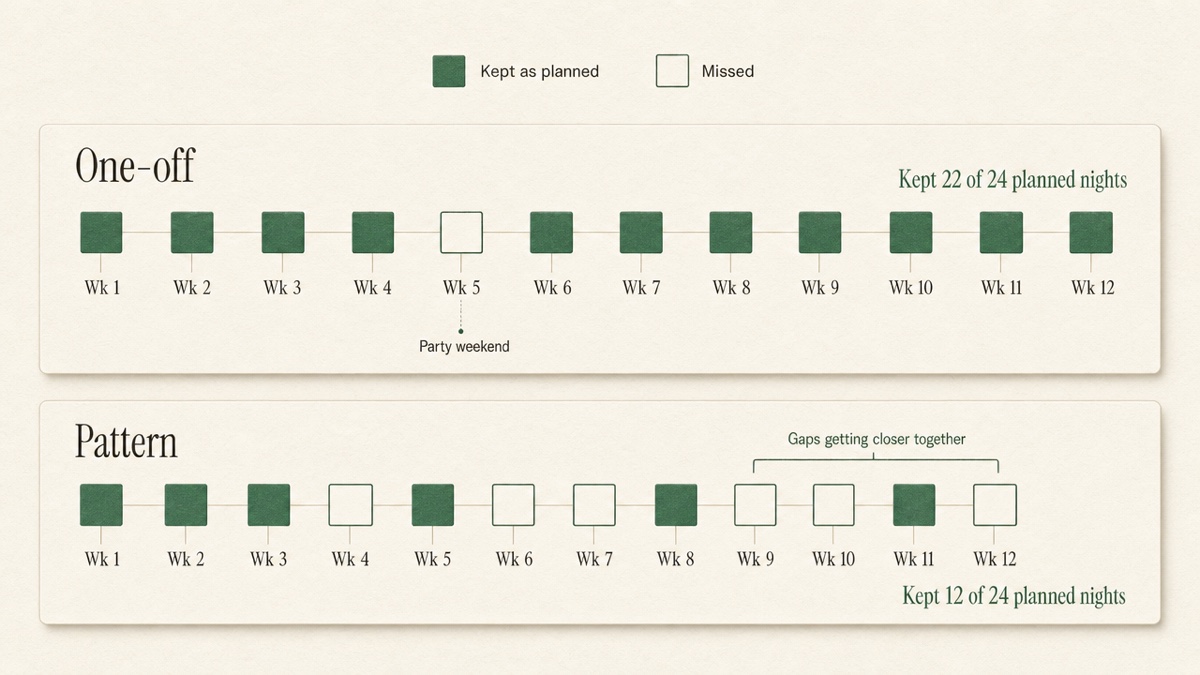
Two habits keep those totals honest. Log the exchanges that went fine, not only the bad ones, because a record made only of failures has no denominator. And count in overnights, the unit many courts use. A Friday-to-Sunday weekend is two nights. More on that in how courts count parenting time.
When to call the attorney, a therapist, or ask about reunification
Some decision points:
- Call your attorney now if the child discloses something that sounds like abuse, if a refusal comes with a safety concern, or if you were served with an enforcement or contempt motion.
- Call your attorney soon after a second refusal in a short span, or when refusals start covering whole weekends or holidays. Bring the log and the totals.
- Ask about a therapist when the reasons are unclear or the child is visibly distressed. Individual or family therapy often helps milder cases, where the child protests but goes and then settles in.
- Ask about reunification therapy, a parenting coordinator, or a custody evaluation when refusals become frequent or complete. Professional guidance warns that a therapist shouldn't also decide parenting time or the pace of a step-up schedule. That job usually stays with the judge, or with a parenting coordinator where one is available and the court has given that person decision-making authority.
- Ask whether a modification makes sense if an older child's refusal has become steady. Many states require a significant change in circumstances to change a schedule.
Easing transitions for the child
- Keep exchanges short and predictable: same time, same place, same goodbye.
- Pack the night before so the morning isn't a negotiation.
- Name the feeling without debating it: "You're sad to leave. That makes sense."
- Avoid asking for a report after the visit. "Glad you're home" is enough.
- Let the child bring a comfort item back and forth.
Keeping this record in Custody Proof
Custody Proof is private documentation software for one parent, and the other parent is never invited or notified. Either side of a refusal can use it.
- Load your schedule from your order, or describe it in plain words, and review it week by week before it saves.
- On the calendar, mark a missed exchange with a violation flag. The flag is your own label for your records. It is not a legal finding.
- Put the child's words and your notes in the evidence vault under Incidents or Emotional, and attach the text you sent under Communications.
- Plan vs. Actual compares the schedule to what you logged, day by day, and your reports can carry a "Confirmed through" date.
- On Case Builder, Vero turns a voice note made in the driveway into a dated draft you review before it saves.
For how all of this goes into a packet for your attorney, see how to document custody for court. Plans start at $14.75/month with a 30-day money-back guarantee on your first charge. Start your record.
Frequently asked questions
At what age can a child refuse visitation?
No single age applies everywhere. Generally a minor can't legally decline ordered parenting time, though many states let judges weigh a mature child's preference as one factor among several. How your state handles this is a question for your attorney.
I'm the parent with the child. Will a refusal make me look like I'm interfering?
It can if there's no record of effort. Notify the other parent promptly in a way that shows when you sent it, say what you tried, and log each attempt the same day.
Does a violation flag in Custody Proof mean the other parent broke the order?
No. A flag is a label you put on your own record to mark that something didn't go as scheduled. Whether anything was a violation of your order is for your attorney and the court.
Does the other parent need to log their side too?
No. Custody Proof is used by one parent, and nothing is shared or sent to anyone. Your record stands on its own. If you choose to share it, you export a file and hand it over yourself.
Can I add refusals that happened months ago?
Yes. You can enter past custody time and incidents with their real dates and attach messages you saved. Mark which entries were written later, so no one mistakes a reconstruction for same-day notes.
Keep reading
- Emergency Custody Evidence: What Qualifies, What to Gather
- High-Conflict Parenting Plan Clauses You Can Prove
- How to Prove Text Messages in a Custody Case
- Which custody app fits your situation
Custody Proof is a documentation tool, not a law firm. Nothing on this page is legal advice. Whether and how a record is used in a case is a question for your attorney.