Emergency custody evidence: what qualifies and what to organize first
By EJ Archuleta, Licensed attorney · Updated
Emergency custody evidence is anything that shows a judge a child faces serious harm now and that the matter cannot wait for a regular hearing. That usually means dated facts you saw or heard yourself, supported by police or medical reports, photos, messages, and the names of witnesses. Courts generally reserve emergency orders for immediate danger or a real risk that the child will be taken away. They do not use them for ordinary co-parenting disputes.

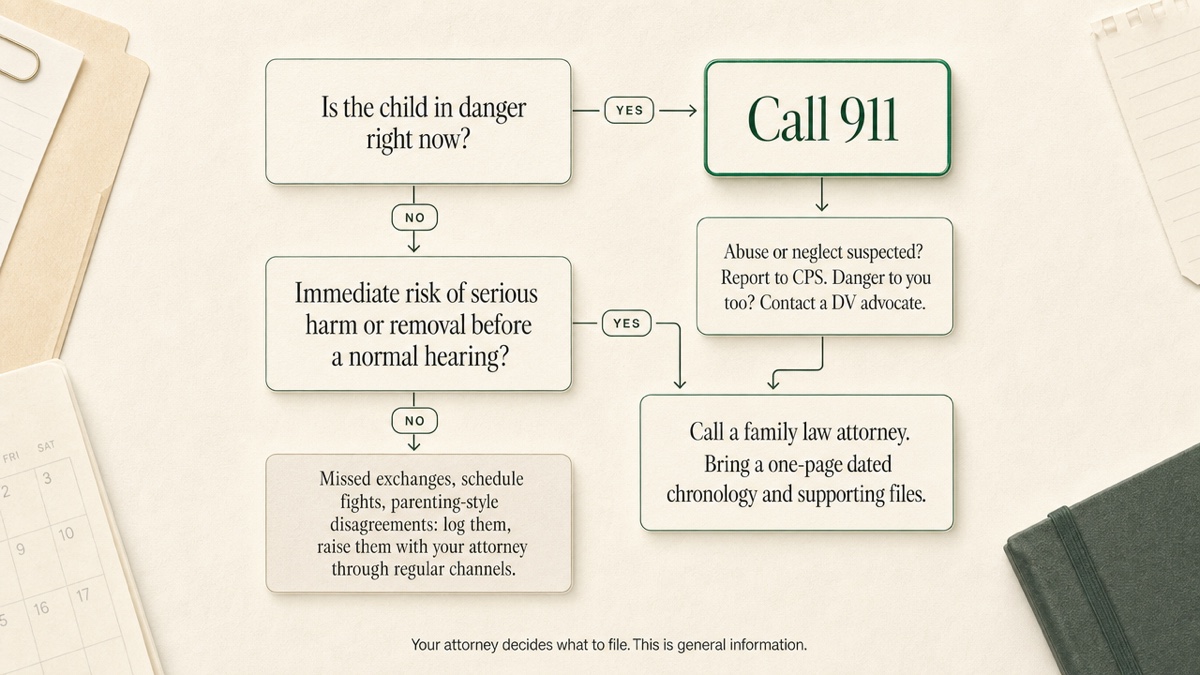
If your child is in danger at this moment, stop reading and call 911. Everything below can wait.
This page covers the hours after a child is safe: what tends to qualify, what an attorney will ask for, and how to put it in order fast. It is general information, not legal advice. Emergency custody rules differ by state, so talk to a family law attorney licensed where your case is.
Safety first, paperwork second
Get the child safe before you get organized. An emergency filing does not replace a call to people who can act right now.
- Call 911 if anyone is being hurt, threatened with a weapon, or is in immediate physical danger, or if you believe the child is being taken right now. A police report made today also becomes a record later.
- Call child protective services in your state if you suspect abuse or neglect. CPS runs its own investigation, and its findings may become part of the court's picture.
- Reach a domestic violence advocate if the danger involves you as well as the child. Local advocates can help with safety planning and protective-order options. The National Domestic Violence Hotline is 1-800-799-7233.
Then call a family law attorney. Bring the material below, but don't hold back the call while you gather it.
Emergency, ex parte, and temporary orders
The labels overlap, and each state uses its own terms. In general:
- Emergency order. A short-term custody order for a situation that cannot wait for the court's normal calendar. Courts typically look for immediate danger of serious harm to the child, or a real risk the child will be removed from the state or country, though the exact standard is set by each state's law.
- Ex parte order. A request heard with little or no notice to the other parent, usually because warning them could put the child at risk. Many emergency custody orders are entered ex parte. Courts usually expect a sworn statement of facts, such as an affidavit or a declaration signed under penalty of perjury, to support one.
- Temporary order. Any order that controls custody until a later hearing or final judgment. An emergency order is one kind of temporary order. Temporary orders can also come from a regular, noticed hearing.
How quickly a judge rules, and how long the order lasts before a hearing, varies widely. Some courts can decide within a day. Others set the follow-up hearing anywhere from a few days to a few weeks later. Your attorney will know the local schedule.
What commonly qualifies, and what usually doesn't
The question a judge asks is "Is this child in danger before we can hold a normal hearing?" The question is not "Is this parent behaving badly?"
| Situations that commonly support an emergency request | Situations that usually do not | |
|---|---|---|
| Recent physical or sexual abuse of the child | Late or missed exchanges | |
| A recent incident or ongoing pattern of domestic violence in the home | Disagreements over bedtime, diet, screens, or discipline within ordinary limits | |
| Credible signs the other parent plans to take the child out of the state or country without an order or consent | A new partner you dislike | |
| A parent caring for the child while severely impaired, such as driving intoxicated with the child | Late or unpaid child support | |
| Serious neglect: no food, unsafe housing, a child left alone at an age where that is dangerous | Rude texts or refusing to communicate | |
| A threat of serious harm to the child | A long-running schedule dispute | These categories are general examples; what qualifies as an emergency is defined by each state's law. |
The right-hand column can still matter. Missed weekends and unpaid expenses belong in your record and may support a regular modification or enforcement action. An emergency filing built on them is likely to be denied, and an unsupported emergency request may hurt your credibility later.
The evidence attorneys typically want
An attorney preparing a rapid filing needs facts they can put into a sworn statement. Courts generally want what you personally saw, heard, or know, not conclusions or rumors. Gather:
- Dated incident notes. Date, time, place, what happened, who was present. Write each one as soon as you can, and say when you wrote it.
- Photos. Injuries, property damage, unsafe living conditions. Keep the originals; the file's metadata can carry the capture date.
- Messages. Texts, emails, and social posts, especially threats, admissions, or plans to leave. Screenshots should show the sender, date, and time.
- Official reports. Police report numbers, CPS case numbers, ER or pediatrician records, and letters from a counselor or doctor.
- Witness names. Who saw it, with contact information and one line on what each person saw. A teacher, neighbor, or relative with firsthand knowledge counts.
- Your current orders. A copy of any existing custody order, or a short note on where and with whom the child has been living.
Black out Social Security numbers, account numbers, and similar private details on anything you hand over. If a report isn't ready yet, list it as pending. Your attorney can decide whether to file it later.
Build a one-page chronology in under an hour
A judge reading an emergency request has limited time. A short, dated chronology is the fastest way to hand over the facts. Use five columns:
| Date | Time | What happened (facts only) | Witnesses | Exhibit |
|---|---|---|---|---|
| Mar 3 | 6:40 p.m. | At exchange, the other parent's breath smelled of alcohol; they drove away with the child in the car | Neighbor (J. Ruiz) | Photo A, text B |
| Mar 3 | 7:15 p.m. | Called police; report taken | Officer, report # | Report C |
| Mar 4 | 9:00 a.m. | Pediatrician noted bruise on child's left arm | Dr. office | Record D |
Rules that keep it usable:
- Newest serious incident first, then the history that shows a pattern. Your attorney may reorder it.
- One fact per row. If you need a paragraph, you're writing an argument. Save it for the attorney.
- Every row points to an exhibit, or says "none." A gap is fine. A made-up exhibit is not.
- Label exhibits with letters, not file names. "Photo A" can be found again. IMG_4022 cannot.
For a fuller method, see how to document custody for court.
Why the quiet weeks help
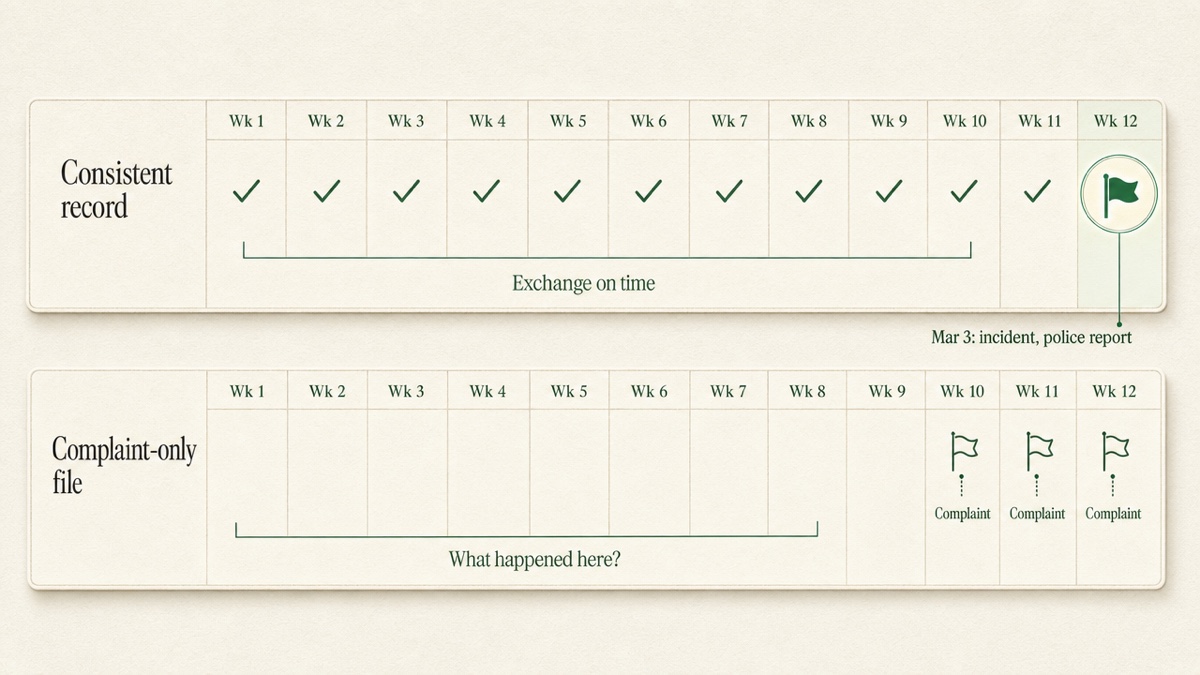
The record that makes an emergency believable usually started long before the emergency. A log that shows twelve routine exchanges, on time and uneventful, makes the thirteenth stand out. It also shows you write things down when nothing is wrong, which is hard to call a campaign.
A file that appears all at once, full only of complaints, invites the question of why there's nothing else in it. Logging the ordinary days is less dramatic and more persuasive. If you're starting from scattered screenshots, stop losing evidence covers how to pull them into one place.
Stay factual; exaggeration costs
Emergency requests are often decided on paper, fast, sometimes without the other parent heard. Because these decisions are made quickly and often on one side's account, accuracy and avoiding exaggeration matter. Some states impose costs, fees, or other sanctions when an emergency order rests on false information.
- Write "pushed me against the wall," not "attacked me violently."
- Write "said she would take him to her mother's in another country and not come back," and quote the message. Don't write "is planning to kidnap him."
- Leave out what you suspect but didn't see, or label it plainly as something you were told and by whom.
- Correct mistakes openly. An error you fix yourself is a detail. An error the other side finds is an attack on everything else you wrote.
What happens after an emergency order
An emergency order is temporary by design. When a judge rules on the request, a follow-up hearing is usually set, and the other parent gets notice and a chance to respond. At that hearing the judge decides whether to extend, change, or end the order.
Keep documenting through that period. Note exchanges, compliance with the temporary order, and any new incidents. The follow-up hearing gives both sides a chance to present evidence, and keeping your record current after the filing can help show what has happened since the order.
If the request is denied, the facts don't disappear. They can still support a regular motion, and your attorney can tell you which.
Keeping the record in Custody Proof
Custody Proof is a private documentation tool for one parent. The other parent is never invited or notified. It does not file anything with a court or contact anyone on your behalf. You export files and hand them to your attorney.
- The evidence vault holds dated entries in seven categories, including Incidents, Communications, Health, and Witness. Photos, screenshots, PDFs, video, and audio attach to the entry they belong to. Files are encrypted with AES-256 before storage.
- Timestamped calendar entries record overnights, timed visits, and flagged violations, so the routine weeks are already logged.
- Plan vs. actual compares your schedule against what happened, and reports can show a "Confirmed through" date that you reviewed.
- PDF exports, including an evidence report with exhibits and the Court Packet, put entries in chronological order for your attorney.
- On the Case Builder plan, Vero turns a pasted text thread, a screenshot, or a voice note into dated drafts you review before saving. Vero never guesses a date.
Plans are $14.75/month or $144/year for Documentation, and $29/month or $278/year for Case Builder, with a 30-day money-back guarantee on your first charge.
Start your private record so the quiet weeks are already written down when they matter.
Frequently asked questions
What evidence is strongest for emergency custody?
Independent records usually carry the most weight: police reports, CPS findings, and medical records. Your own sworn account of what you personally saw also matters, along with photos, messages, and named witnesses. Your attorney decides what to file.
Can I get emergency custody because the other parent keeps missing exchanges?
Usually not. Missed or late exchanges are generally treated as enforcement or modification issues, not emergencies. Keep logging them and raise them with your attorney through regular channels.
Will the other parent be told about an emergency request?
It depends on the state and the circumstances. Some requests are heard with shortened notice, and some without notice when notice would put the child at risk. The other parent typically gets notice before the follow-up hearing. Custody Proof never notifies anyone of anything you log.
How long does an emergency custody order last?
It is temporary and usually lasts until a follow-up hearing, where the judge decides whether to extend or change it. The specific time limits vary by state, so check with your attorney.
Does Custody Proof file the emergency request or call the police for me?
No. It is a documentation tool. You keep the record and export the reports. Your attorney handles filings, and calls to 911, CPS, or an advocate are yours to make directly.
Is it too late to start documenting if the emergency already happened?
No. Write down what happened now, with the real dates, and add photos, messages, and report numbers you already have. Then keep logging going forward, including the uneventful days.
Keep reading
- High-Conflict Parenting Plan Clauses You Can Prove
- How to Prove Text Messages in a Custody Case
- How to Prepare Evidence for Custody Court
- Which custody app fits your situation
Custody Proof is a documentation tool, not a law firm. Nothing on this page is legal advice. Whether and how a record is used in a case is a question for your attorney.