High-conflict parenting plan clauses that make breaches easy to prove
By EJ Archuleta, Licensed attorney · Updated
The best high-conflict parenting plan clauses are the ones whose breach you can measure. A clause works when it sets an exact time, a named place, a fixed grace period, a written channel, or a deadline counted in days. Then "was it followed?" has a yes-or-no answer. "Reasonable," "flexible," and "as agreed" leave every exchange open to a new argument, and an argument is hard to document.

This page applies that test to each common clause: exchanges, holidays, swaps, communication, decisions, expenses, right of first refusal, travel, and dispute resolution. For each one it shows vague and measurable wording side by side and what you would record. It is written from a family lawyer's perspective, but it is general information, not legal advice. Custody law and court forms vary by state, so have a family law attorney in your state review any wording before you propose or sign it.
The one test: can a breach be measured?
In a contempt or modification hearing, someone has to compare what the order required with what happened. If the order says "Sunday at 6:00 p.m. at the school parking lot," the comparison is short. You need a date, a time, and a place.
If the order says "Sunday evening at a mutually convenient location," the hearing turns into a debate about what the words meant. Your log can be perfect and still prove nothing, because the clause gives the log nothing to measure against.
So read every clause and ask three questions:
- What number or name does this clause fix? A time, a count of days, a location, a method.
- What would a breach look like on a calendar? "Arrived 7:10 p.m., grace period ended 6:15" is a breach. "Was not cooperative" is a description.
- What document would show it? A dated log entry, a sent email, a receipt, a reply that never came.
If you can't answer all three, the clause needs another draft.
Vague vs. measurable, side by side
| Topic | Vague wording | Measurable wording | What you can record |
|---|---|---|---|
| Exchange | "Sunday evening" | "Sunday at 6:00 p.m." | Actual arrival time |
| Lateness | "Parents will be on time" | "15-minute grace period; after that, the waiting parent may leave" | Minutes late, whether you waited |
| Location | "A convenient public place" | "Front entrance of [named store], [address]" | Who showed up, and where |
| Notice | "Reasonable notice" | "30 days' written notice by email" | Date sent, date received |
| Swaps | "Parents may adjust as needed" | "Requests by email; reply within 48 hours; no reply means declined" | Request date, reply or silence |
| Expenses | "Split costs fairly" | "50/50; receipt sent within 30 days; reimbursed within 30 days of receipt" | Each date, each amount |
| First refusal | "Offer time when unavailable" | "Absence over 4 hours triggers an offer by text; 2-hour reply window" | Offer time, response, outcome |
The numbers in that column are examples, not recommendations. The right grace period or reply window depends on your family, the distance between homes, and what your state's courts tend to approve.
The clauses, one by one
Exchange times, locations, and grace periods
A measurable exchange clause names four things:
- The time. "6:00 p.m.," not "evening" or "after dinner."
- The place. A specific address, door, or parking lot.
- The grace period. How late counts as late, and what the waiting parent may do once it passes.
- Who transports. Whether the receiving or the dropping-off parent drives, who else may transport, and who pays.
Some court-published standard plans set a fixed wait time before a parent may leave an exchange, and the number varies by state and county. Good drafts also cover the edge cases that turn into fights: bad weather, illness on exchange day, and what happens if the waiting parent leaves before the other arrives.
Record each exchange the same way: scheduled time, actual time, place, and anything that broke the pattern. A late pickup is a clock reading. Write it down that day.
Holidays, vacation, and "to be designated" dates
Holiday and vacation clauses fail in two places: overlap and open dates.
Overlap. Say which time wins when periods collide. A common hierarchy is holidays over vacation, and vacation over regular parenting time. Without a priority rule, Thanksgiving that lands on the other parent's regular weekend becomes a negotiation every year.
Alternation. "Alternating years" should say who starts. "Odd-numbered years with Parent A" can be checked against a calendar. "Alternating" alone cannot.
Open dates. Many orders give summer time "to be designated." That is workable only with a deadline and a method: "Parent A designates 30 days of summer possession in writing by April 1." Also say what happens when nobody designates by the deadline, and give a tie-breaker for conflicts, such as one parent choosing first in even years and the other in odd years.
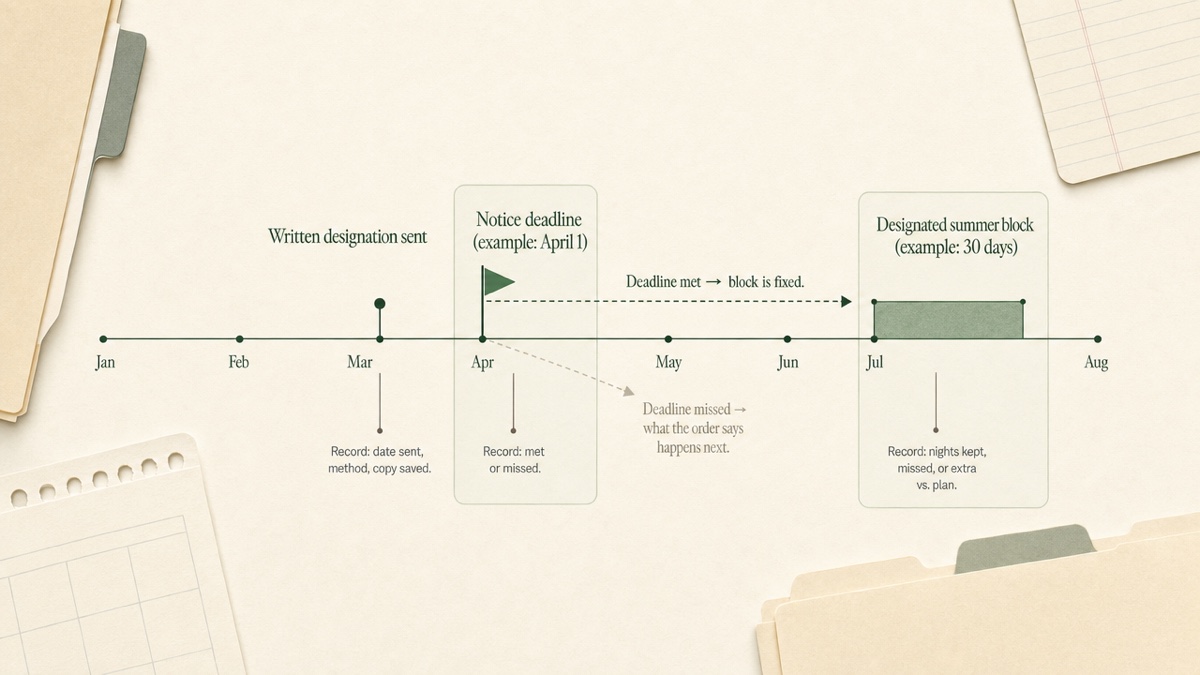
Two things to track, then: whether notice went out by the deadline, and whether the possession happened as designated. Custody Proof keeps these apart. "Dates to be set" blocks wait as open items until you fill them in, and notice deadlines go to a separate reminders page. See holiday and vacation blocks.
Schedule changes and swaps, in writing
Most high-conflict plans allow swaps. The question is how they are requested and answered. A measurable swap clause says:
- the method for requests (email, text, letter),
- the reply window, in hours or days,
- what silence means (declined, usually), and
- whether make-up time is owed, and by when.
There is a second issue many parents miss. A swap you both agree to is not the same as a modified court order. Some court forms warn that voluntary changes cannot be enforced unless they become an order of the court. If you rely on a series of "just this once" changes that turn into a new pattern, ask your attorney whether that pattern needs to be formalized.
For your record, log every swap request with its date, the method, the reply or the absence of one, and whether the swapped time happened.
Communication channel and response windows
Name the channel and the clock. "Parents will communicate by email about scheduling, school, and medical matters; non-emergency messages answered within 48 hours; emergencies by phone call followed by text." That gives you a channel to search and a window to measure.
Read notice clauses word by word. Courts generally apply a plan's plain wording. If a plan says notice goes "by email and certified mail," a court may expect both, so an email alone may not count. If your plan lists more than one method, use every one listed and keep proof of each: the sent email and the mailing receipt.
Whatever channel the plan names, keep your own copies. Screenshots of texts and saved emails, filed by date, are your record. They don't depend on anyone else's account or settings.
Decision-making for education, medical, and extracurriculars
"Joint decision-making" without detail invites deadlock. Stronger plans assign each category separately (school, medical and mental health, religion, extracurriculars, passports) and say:
- who decides, or who has the final say after a set consultation period,
- how a proposal is sent and how long the other parent has to respond,
- which routine decisions each parent makes alone during their own time,
- that either parent may authorize emergency care, with notice to the other within a fixed number of hours, and
- that both parents may access school and medical records and must share provider contact information.
For extracurriculars, add a limit. For example, how many activities, whether they may land on the other parent's time, and who pays.
What to record: the date you sent a proposal, the response deadline, and the outcome.
Expense sharing: what's covered, proof required, deadlines
Expense clauses fail when they say "share costs" and stop. Measurable versions answer:
- What is covered. List the categories: uninsured medical, childcare, school fees, named activities.
- The split. 50/50, a percentage, or an income-based share.
- Proof. A receipt, an invoice, or an Explanation of Benefits.
- Deadlines on both sides. How soon the paying parent must send proof, and how soon the other parent must reimburse. Some court forms use 30 days for each step, at least for uninsured health care costs.
Keep a ledger row for each cost. Each row should hold the date incurred, the amount, the receipt, the share owed, when you sent the request, what was received, and a status. A running balance with dates beats "they never pay." The full method is in how to track unreimbursed child expenses.
Right of first refusal and travel notification
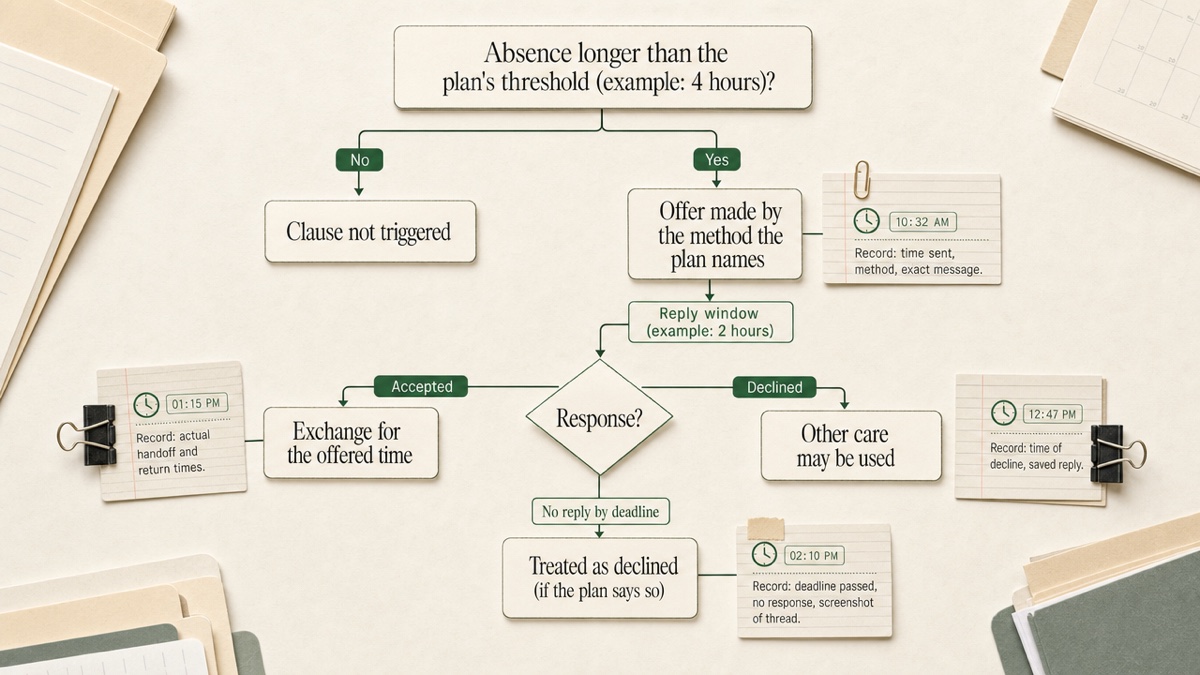
Right of first refusal is the clause most often written too loosely to prove. It needs:
- A trigger. An absence longer than a set number of hours during your parenting time.
- An offer method. For example, by text, with the time window stated.
- A reply window. After it passes, the offering parent may use other care.
- Exceptions. Usually school, scheduled activities, and named relatives.
Travel clauses work the same way. Require notice of overnight or out-of-state travel a set number of days ahead, with the itinerary and contact information, and name who may hold passports. Many states have separate relocation rules, often in statute, with their own notice requirements, so ask your attorney about relocation directly.
Log every offer you make and every one you receive, including the ones that were ignored.
Dispute resolution and record-keeping
A dispute clause should set steps in order, with time limits. For example: a written request by a named method, a set number of days to respond, then mediation, then court, with an exception for emergencies. In some states, parenting plan forms set out dispute steps the parents must follow before going to court, and the law allows sanctions against a parent who frustrates the process without good reason.
Add a record-keeping line: any agreement reached gets written down and a copy goes to each parent. Keep your own copy of every request, response, and outcome, dated.
How a clear plan becomes your documentation baseline
A measurable plan is a schedule you can check reality against. Each clause becomes a column in your log. Exchange times become expected-vs-actual entries. Notice deadlines become dates that were met or missed. Expense deadlines become rows with a status.
Custody Proof is built around that comparison, for one parent, without the other parent being invited or notified:
- Schedule setup. Upload your order (PDF or Word), or describe it in plain words. It becomes a recurring calendar with rotations, alternating holidays, and summer blocks. You review it week by week before anything saves. See set up your custody schedule.
- Deadlines from your order. Notice deadlines the order states, like "designate by April 1," are offered as in-app reminders, each with the order's sentence attached.
- Plan vs. actual. Days that differed from the plan are flagged, you fix or keep each one, and you confirm the record through a date. Reports can cite that confirmation.
- Violations and evidence. Late pickups and missed visits go on your timeline, with screenshots and emails attached in an encrypted vault.
- Expense ledger. Each row holds the receipt, the share owed, the order provision that makes the cost shared, and the date notice was sent.
When your attorney asks, you export dated, filtered reports. For the export order and what goes in a packet, see how to document custody for court. Custody Proof does not draft plans. It keeps the record your plan makes possible.
If your plan already sets times, places, and deadlines, start your record and measure against it. Plans start at $14.75/month, with a 30-day money-back guarantee on your first charge.
Frequently asked questions
What is the most important clause in a high-conflict parenting plan?
Usually the exchange clause, because it produces the most incidents. An exact time, a named place, and a stated grace period let you prove a breach with a date and a clock reading. Which clause matters most in your case is a question for your attorney.
How long should a custody exchange grace period be?
There is no universal number. There is no universal number, and standard plans that set a wait time vary. What matters most is that the plan states a number and says what the waiting parent may do once it passes.
Can I use this sample wording in my own plan?
Treat it as material for discussion, not language to paste in. Courts and states differ in what they approve and how they read particular words. Have a family law attorney in your state review any clause before you propose it.
Are text-message swaps enforceable?
A swap both parents agree to may be followed in practice, but some courts will not enforce informal changes unless they become an order. Keep the messages either way, and ask your attorney whether a recurring change should be formalized.
Does Custody Proof notify the other parent when I log a violation?
No. It is a one-parent tool. The other parent has no account and gets no notifications. If you share a record, you do it by exporting a file yourself.
Can my attorney log in to see my record?
No. Your attorney receives the PDF, CSV, or ZIP files you export and hand over.
Keep reading
- How to Prove Text Messages in a Custody Case
- How to Prepare Evidence for Custody Court
- How to Track Child Expenses With an Uncooperative Co-Parent
- Which custody app fits your situation
Custody Proof is a documentation tool, not a law firm. Nothing on this page is legal advice. Whether and how a record is used in a case is a question for your attorney.