My Ex Won't Use a Co-Parenting App. What Now?
By EJ Archuleta, Licensed attorney · Updated
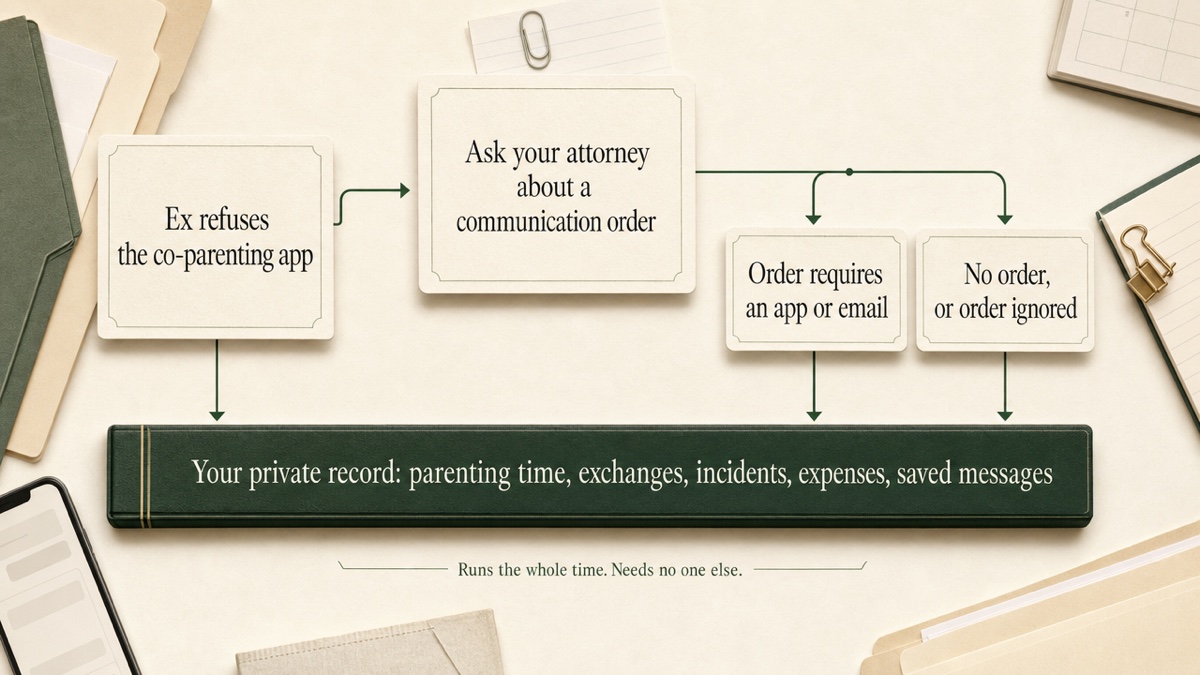
If your ex won't use a co-parenting app, you have two options: ask your attorney whether a court order could require a communication method, and start a private record of your own today, one that doesn't need the other parent at all. The second option works whether or not the first one ever does.
Most advice on this topic is about persuasion: better timing, softer wording, answers to every objection. That advice assumes the other parent will eventually say yes. In a high-conflict case, that assumption is often the problem.
This page is general information, not legal advice. Custody law and evidence rules vary by state, so take questions about your own case to your own attorney.
Why persuasion usually fails in high-conflict cases
A shared app is a joint project. In a high-conflict case, a joint project is the one thing the two of you can't run.
The parent who refuses often has reasons that no script can fix:
- A shared record cuts both ways. Every message is time-stamped, and every slow reply is visible. A parent who doesn't want to be on the record won't volunteer to be.
- Saying no is a form of control. If refusing gets a reaction, the refusal has done its job.
- Your request is coming from you. In a dispute, a suggestion from the other parent can be rejected simply because of who made it.
You can make one clear, polite request in writing and keep a copy. After that, more pitching tends to produce more conflict, not adoption.
What a shared app actually needs from both parents
A shared co-parenting platform is built around two accounts. Typical features include messages that can't be edited or deleted, time stamps on every interaction, searchable history, and PDF exports of the log. Some courts recommend these apps, and some require them.
All of those features depend on the other parent taking part:
- They create and keep an account.
- They read and answer messages on the platform instead of by text.
- They enter or accept calendar changes.
- They log or approve shared expenses.
If any one of those steps fails, the shared record has gaps. A log of your messages with no replies does show something. It does not show what happened at exchanges, which nights the children actually spent where, or what you paid for.
Ask your attorney about a communication order
If voluntary use isn't going to happen, the realistic route is usually the court. Parenting plans and orders can set a communication method. That might be a specific app, email only, or a rule against messages passed through the children. Some orders also set response times.
Questions worth bringing to your attorney:
- Does my current order say anything about how we communicate?
- Could we ask the court to add or change a communication provision?
- Is changing a communication term held to a different standard than changing the parenting schedule? In some states, changing the parenting schedule requires showing a significant change in circumstances, while a smaller change, like how parents communicate, may be easier to get, especially if both parents agree.
- If an app is ordered and my ex keeps texting, emailing, or using the children as messengers, what should I do?
On that last question, the general approach is to keep every off-platform contact, note its date, and let your attorney decide how to raise it. Don't punish the rule-breaking by breaking the rule yourself. Judges tend to act on documented patterns, not on general frustration.
Document on your own, without notifying anyone
A private record is one parent's dated account of what happened. The other parent never joins it, never sees it, and never finds out it exists. That's the point. It doesn't need anyone's consent to stay complete.
For a fuller walkthrough of what that record should look like, see custody documentation. Here are the core rules.
What to record
- Parenting time. Count overnights and timed day visits separately. A Friday-to-Sunday weekend is two nights. A Wednesday dinner is a visit with hours attached, not a night.
- Exchanges. Write down the scheduled time, the actual time, and who was there. "Arrived 6:42, scheduled 5:00" is a record. "Always late" is an opinion.
- Violations. Missed weekends, late pickups, refused calls. Each one gets a date and a short factual description.
- Expenses. Note the date, amount, what it was for, and which child. Attach the receipt, and add the order provision if the cost is shared.
- Communications you already have. Save texts, emails, and voicemails, attached to the date they relate to.
How to keep it credible
Write entries on the day things happen, and keep them factual: who, what, when, where. Leave out adjectives and guesses about motive. Assume anything you write could be read by the other side someday. A private journal may have to be shared with the other side in a court case, depending on the circumstances and your state's rules.
Stay away from covert monitoring. Tracking a child's phone location during the other parent's time can be intrusive and misleading. It can damage your credibility with the court, and it may be unlawful in some places. Record what you saw and what you were sent, not what you dug up.
Handling texts and emails as evidence
If your ex refuses an app, most of your communication probably lives in texts and email. Two things are worth knowing.
First, a screenshot of a text taken from a phone often won't meet a court's requirements for admitting evidence on its own. Each state sets those rules. Dedicated export tools for iPhone and Android can preserve a full text history in a form a lawyer can work with. Ask your attorney which format they want before you rely on screenshots alone.
Second, email creates a real written record. If you can move logistics to email, keep messages short, number each issue so replies can refer to the numbers, and send only once or twice a day unless there's an emergency. That habit helps you even if the other parent ignores it.
Screenshots still matter. They're the fastest way to capture a message the moment it arrives, so keep them and tie each one to its date. Your attorney can decide what else to request.
One more caution. A message log shows your habits too. Slow replies, sharp wording, and late-night messages are part of the record. Write as if a judge will read it.
Using a shared app and a private record together
Some parents end up with both. That happens when an app is ordered, or when the other parent joins and then barely uses it.
The two do different jobs. A shared app holds the conversation between parents. A private record holds everything the conversation leaves out: which nights the children actually slept at your home, how exchanges went, receipts, notes, and messages that arrived somewhere else. If the app is ordered and your ex keeps texting anyway, those texts go into your record with their dates.
For a longer look at where shared tools break down, read why co-parenting apps fail in high-conflict cases. For a side-by-side view, see Custody Proof vs. co-parenting apps.
What it costs, in plain terms
A shared app only produces a complete record if both parents participate, so its value depends on someone you can't control. A private record costs one parent one subscription, and its value depends only on your own consistency.
Custody Proof's Documentation plan is $14.75 a month or $144 a year. It covers the custody calendar, overnight and visit tracking, schedule violations, an encrypted evidence vault, an expense ledger, and PDF and CSV reports. Case Builder is $29 a month or $278 a year. It adds Vero, an AI assistant that turns a voice note, a pasted text thread, or a screenshot into a dated draft you review before anything saves.
Compare that with attorney time. At $250 to $600 an hour, a few hours spent rebuilding a year from your camera roll costs more than the software does. An organized record lets your lawyer spend those hours on strategy.
How Custody Proof fits
Custody Proof is built for one parent. You can upload your order or describe your schedule in plain words, and it becomes a calendar you review week by week. You log what actually happened, compare it to the plan, and confirm the record as you go.
Evidence files are encrypted with AES-256 before they're stored, and the Communications category keeps saved messages tied to their dates. When your attorney asks, you export a Court Packet. The other parent has no account and gets no notifications.
It was built by a family lawyer, but it doesn't give legal advice. Whether a record is used in court is a question for your attorney.
Start your private record. You're charged at signup, the first charge has a 30-day money-back guarantee, and you can cancel anytime.
Frequently asked questions
Can I make my ex use a co-parenting app?
Not on your own. Some courts recommend or order a communication method, and orders can set one. Whether to ask for that, and how, is a question for your attorney.
Will my ex know I'm keeping a record in Custody Proof?
No. There's no shared account, no invitation, and no notification. If you want to share something, you export a file and hand it over yourself.
Can Custody Proof send messages to my ex?
No. It's a private documentation tool with no messaging feature. You keep communicating the way your order requires, and you save what's sent and received in your record.
My ex keeps texting even though an app is ordered. What do I do?
Keep every message, note when it arrived, and tell your attorney. Respond through the ordered channel yourself so your own record stays clean.
I already have months of screenshots. Is it too late?
No. You can add past custody time and incidents with their real dates and attach the files you already have. On Case Builder, Vero can draft entries from pasted threads or screenshots for you to review.
Keep reading
- What to Do If Your Child Refuses Visitation
- Emergency Custody Evidence: What Qualifies, What to Gather
- High-Conflict Parenting Plan Clauses You Can Prove
- Which custody app fits your situation
Custody Proof is a documentation tool, not a law firm. Nothing on this page is legal advice. Whether and how a record is used in a case is a question for your attorney.