Best interest of the child factors and the records that speak to them
By EJ Archuleta, Licensed attorney · Updated
The "best interest of the child" factors are what courts weigh to decide custody and parenting time, and the question they answer is not which parent wins but which arrangement serves the child. Every state writes its own list of factors, but most return to the same themes:

- who has done the day-to-day caregiving
- how stable and consistent the child's life is
- each parent's health and any history of violence
- the child's ties to home, school, and community
- whether each parent supports the child's relationship with the other parent
This page explains those themes and maps each one to the ordinary records that can speak to it. It also covers the mistakes that quietly undercut a parent who is otherwise doing well. It is general information, not legal advice. Your state's factors and how your judge weighs them are questions for a family law attorney licensed where your case is.
What the standard actually is
Courts apply the best-interest standard when they decide who the child lives with, what parenting time looks like, and related questions such as support. The deliberation is broad. A judge considers what orders will serve the child and who is best suited to care for them.
Two things follow from that.
There is no single checklist. Some states put a fixed set of factors in statute and expect the court to address each one. Others give a shorter list and let the judge weigh "all relevant factors." Some states set presumptions, for example about joint custody, that change when there is a history of domestic abuse.
No one factor usually decides a case alone. Many courts are expected to weigh the factors together rather than resting on one. That is why a good record covers ordinary life, not only the worst weekend.
The factor themes most states share
The wording differs from state to state. These are the recurring ideas, grouped so you can see what a court is trying to learn.
Caregiving history
Who has been the child's main caregiver? Who schedules the pediatrician, fills out the school forms, knows the teacher's name, handles the fever at 2 a.m.? Courts commonly look at the history and nature of each parent's participation in care, and at each parent's ability to meet the child's needs, including special needs.
This factor is about a pattern built over months and years. Memory is a weak witness for it. A dated list of appointments, school contacts, and routines is a strong one.
Stability and consistency
How long has the child lived in a stable setting? How settled are they at home, at school, and in the community? Is parenting time exercised consistently, and does each parent follow through on what was scheduled?
Two kinds of records speak here. One is the child's own life: school attendance, activities, friendships. The other is parenting time itself: which nights the child actually spent where, and how that compares to the schedule. A late pickup is a time. A skipped weekend is a date. Both belong on a calendar, not in an argument.
Supporting the child's relationship with the other parent
Many states ask, in some form, whether each parent encourages the child's relationship with the other parent when it is safe to do so. Courts may also look at whether a parent complies with court orders and whether a parent pulls the child into the dispute.
This is the factor where parents most often hurt themselves without noticing. Your own conduct is evidence. That includes what you text, what you say in front of the child, and whether you hand the child over on time.
Safety and health
Courts commonly consider any history of family or domestic violence, and the mental and physical health of the parents as it bears on caring for the child. A disability does not by itself decide custody in many states. If safety is an issue in your case, speak to your attorney first. That includes what to document and how to store it.
The child's ties and wishes
Courts look at the child's age and health, their emotional bonds with each parent, siblings, and extended family, and their ties to school and community.
A child's preference may be considered depending on age and maturity. It typically carries weight only if the court finds the child mature enough to express an independent, reliable view. Children are often heard indirectly, through a guardian ad litem, an interview with the judge, or a custody evaluator, rather than by testifying.
Which records speak to which factor
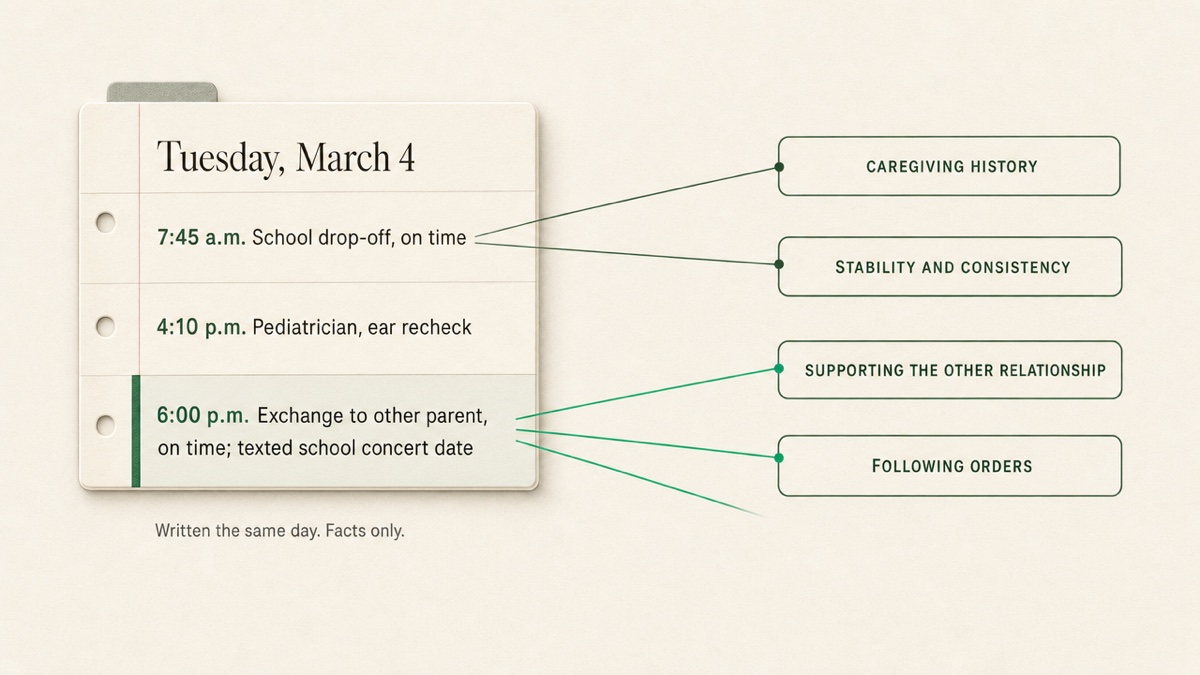
Most of what helps is boring. It is the dated, specific, unglamorous record of normal parenting.
| Factor theme | Records that tend to speak to it |
|---|---|
| Caregiving history | Medical and dental appointments you attended; school conferences and emails with teachers; forms you completed; a log of routines such as homework, bedtime, and therapy |
| Stability and consistency | An overnight calendar of actual time; planned-versus-actual comparisons; school attendance; activity schedules and registrations |
| Supporting the other relationship | Exchanges completed on time; your own neutral messages offering time or sharing information; notes that you passed along school or medical news |
| Following orders | Dated logs of missed or late exchanges; your compliance with deadlines in the order; your own on-time handoffs |
| Child's needs and ties | Activity records; health records; notes on the child's behavior and mood, written as observations |
| Child-related expenses | Receipts and a ledger showing what you paid for the child's care |
Two habits make these records more useful. Write each entry the day it happens. Keep entries to facts: who, what, when, where. "Dropped Maya at Dr. Ruiz, 4:10 p.m., ear recheck, follow-up in two weeks" is useful. "I'm the only one who ever takes her to the doctor" is not. For more on why, see records, not memories.
Mistakes that undercut the factors
These come up over and over. Each one turns a factor you could have won into one the other side gets to argue.
Badmouthing the other parent
Derogatory comments about the other parent in front of the child, or telling the child about the court case, are the kinds of things judges ask about under the relationship factor. It does not matter that the comment was true. The question is what it does to the child.
Withholding parenting time without an order
If you believe the child is unsafe, the move is to talk to your attorney about emergency options. Keeping the child on your own is not that move. Denying ordered time, even once and even out of frustration, can be read as a failure to follow orders and a failure to support the relationship. Some states treat genuinely protective actions differently, but the safer path is to go through your attorney and the court.
Emotional messages
Texts are permanent. A 10 p.m. reply written in anger can sit in an exhibit binder next to months of careful parenting. Compare:
- Instead of: "You're late AGAIN. You obviously don't care about her. I'm done with this." Send: "Pickup was 6:00. It's 6:40 and I haven't heard from you. We're home when you get here."
- Instead of: "Maybe if you actually paid attention you'd know she has a recital." Send: "Lena's recital is Friday, May 9, at 6:30 p.m. at Oak Elementary."
The rewritten versions are shorter, dated, and impossible to read as hostility. They also show you sharing information, which is part of what the relationship factor looks at.
Using the child as a messenger
Passing notes through the child, asking what happened at the other house, or asking the child to choose all put the child in the middle. That is exactly what several states' factors name as a concern.
A journal full of conclusions
A diary that says "he's a terrible father" tells the judge about you, not the child. Observations hold up. Verdicts invite cross-examination. If you have to vent, do it somewhere other than your custody record.
What a record can and cannot do
A well-kept record does not guarantee any outcome, and no export is admitted automatically. Rules of evidence decide what a court will consider. Three principles come up often:
- Hearsay. Out-of-court statements offered for their truth can be limited. That can include what someone else told you, and sometimes your own notes, though notes can often be used to refresh your memory. Statements made by the other parent are usually treated differently when offered against them.
- Authentication. Someone usually has to establish that a screenshot or photo is what you say it is.
Completeness. Selected snippets of a conversation may invite the rest of it.
What a contemporaneous record does is give your attorney organized, dated material to work from. Whether and how it is used is their call. The practical steps are in how to document custody for court. If parenting time is disputed, it also helps to know how courts count parenting time, usually by overnights rather than calendar days.
Questions to bring to your attorney
- Which factors does our state list, and does the court make findings on each?
- Are there presumptions in our state, and does anything in my case change them?
- Which of my records are most useful, and in what format do you want them?
- How might my child be heard: guardian ad litem, interview, evaluator?
- Is anything I am currently doing hurting me under the relationship factor?
- What should I stop writing down, or write differently?
Keeping this record in Custody Proof
Custody Proof is private documentation software for one parent. The other parent is never invited or notified, and nothing you log is shared unless you export it yourself.
It maps directly onto the record above:
- Overnights and timed visits are logged separately, and a planned-versus-actual view shows where real time differed from the schedule.
- Late or missed exchanges can be flagged as violations on your own timeline.
- The encrypted evidence vault sorts entries into seven categories: Incidents, Communications, Expenses, Activities, Health, Emotional, and Witness.
- The expense ledger keeps receipts attached to each child-related cost.
- The Court Packet is the PDF you export for your attorney. It groups evidence under the best-interests factors courts evaluate, flags schedule deviations, and includes a sworn verification page.
Documentation is $14.75/month or $144/year. Case Builder is $29/month or $278/year and adds Vero, an AI assistant that turns voice notes, pasted texts, and photos into drafts you review before saving.
Frequently asked questions
Are the best interest factors the same in every state?
No. The themes overlap, but each state sets its own list, wording, and presumptions. Some list fixed factors; others leave room for "any relevant factor." Ask an attorney in your state which ones apply.
Which factor matters most?
There usually isn't a single one. Courts are generally expected to weigh the factors together. Safety concerns such as domestic violence can carry special weight or change presumptions in some states.
Do communication logs win custody cases?
No record guarantees an outcome. Messages are one kind of evidence, and your own messages can work against you. A calendar of actual parenting time, caregiving records, and neutral notes often say more about the child's daily life than a message thread does.
Should I write down everything the other parent does wrong?
Write down specific, dated facts that bear on the child: missed exchanges, late pickups, safety concerns. Skip opinions and labels. Record your own caregiving too. The factors ask about both parents.
Will the other parent see what I log in Custody Proof?
No. There is no shared account, no invitation, and no notification. If you want someone to see a record, you export a file and hand it over yourself, usually to your attorney.
Keep reading
- Status Quo in Custody Cases: What It Is, How to Show It
- 80/20 Custody Schedule Examples and Overnight Math
- Who Claims the Child on Taxes After Divorce?
- Which custody app fits your situation
Custody Proof is a documentation tool, not a law firm. Nothing on this page is legal advice. Whether and how a record is used in a case is a question for your attorney.