How to Create a Divorce Log (Custody Journal) Your Attorney Can Use
By EJ Archuleta, Licensed attorney · Updated
To create a divorce log, keep two separate records. One is a private journal where you process what you feel. The other is a factual log where every entry has a date, a time, a place, who was there, what happened in plain words, and any attachment that backs it up. Write log entries the same day, keep them short, and record ordinary days as well as bad ones.

Most advice blends the two records into one notebook. That is where logs become hard to use. A page that mixes a missed pickup with three paragraphs of anger gives your attorney work to do and gives the other side material to quote. The rest of this page covers how to keep them apart, what goes into the log, and how to turn months of entries into a chronology your attorney can read in one sitting.
This is general information, not legal advice. Custody procedure and evidence rules vary by state, so ask your own attorney how they apply to your case.
Keep the venting journal and the factual log apart
The venting journal is for you. Write in it to sleep at night, to sort out what you think, or to get ready for a hard conversation. Feelings, guesses, and worst-case fears belong there.
The factual log is for your attorney. It holds events, not reactions.
Keep them physically separate:
- Use a different notebook, a different app, or at minimum a different folder. Never one document with two sections.
- Do not paste journal passages into the log, even to "add context."
- Write the log as if a judge and the other parent's attorney will read every word, because in a contested case they might. Logs and journals can sometimes be requested in discovery.
- Ask your attorney whether your private journal has any protection at all where you live. Do not assume it does.
The separation also helps you. When the log is free of emotion, you can reread it without reliving everything, and patterns show up faster.
What a usable entry contains
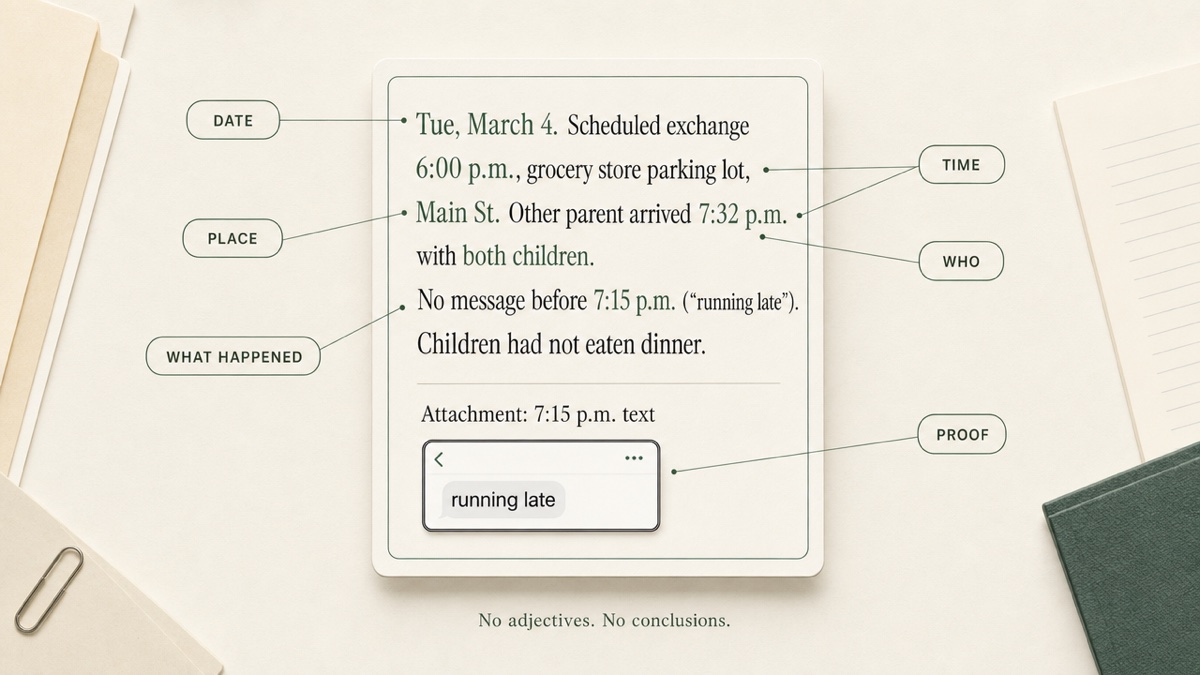
Every log entry answers the same six questions:
- Date. The day it happened, not the day you wrote it down. If those differ, note both.
- Time. As exact as you have it. "5:47 p.m." beats "evening."
- Place. The school pickup loop, the pediatrician's office, your driveway.
- Who. Every adult and child present, including bystanders.
- What happened. In order, in plain sentences, with direct quotes where you have them.
- Attachment. The photo, screenshot, receipt, or email that supports it, or a note of where the original is kept.
Here is an example:
> Tue, March 4. Scheduled exchange 6:00 p.m., grocery store parking lot, Main St. Other parent arrived 7:32 p.m. with both children. No message before 7:15 p.m. ("running late"). Children had not eaten dinner. Attachment: screenshot of 7:15 text.
That entry takes under a minute to write, and nobody has to guess what it means.
Write facts, not conclusions
Conclusions are where logs lose credibility. A reader can check a fact. A conclusion only asks to be believed.
| Conclusion | Fact |
|---|---|
| "He's always late." | "Arrived 7:32 p.m. for a 6:00 p.m. exchange." |
| "She's turning the kids against me." | "Child said, 'Mom says you don't want us.' Said in the car, unprompted, 6:10 p.m." |
| "He doesn't care about her health." | "Child returned without inhaler. I texted at 8:02 p.m. No reply by 10:00 p.m." |
Courts that design their own logs take the same approach. Massachusetts' supervised parenting time log, for example, calls for facts, observations, and direct statements, and keeps the supervisor's opinions out. Your log is not a court form, but the standard is a sensible one.
If you notice a pattern, let the entries show it. Ten dated late arrivals make the point better than any sentence you could write about them.
What to log
Cover the areas a custody case usually turns on:
- Parenting time. Every overnight and visit you have, with start and end times. Note time the schedule gave you that you did not get, and time you had beyond it.
- Exchanges. Scheduled time, actual time, place, and anything notable. Record the on-time ones too.
- School. Conferences, events you attended, report cards, behavior notes, IEP meetings. School portals let you pull these records yourself rather than relying on the other parent.
- Medical. Appointments, who took the child, diagnoses, and medications given, with amounts and times. Include over-the-counter medicine.
- Expenses. Date, amount, what it was for, the receipt, and whether your order treats it as shared.
- Communications. Date, time, channel, topic, and tone, in neutral words ("calm," "ended the call"). Keep the original message, not just your summary of it.
- Incidents. Missed visits, refused exchanges, safety concerns, anything that departs from the order.
Log the quiet weeks
Your instinct will be to write only when something goes wrong. Resist it.
A log made up only of conflict reads like a grievance file. A log that also shows ten routine exchanges, a dentist appointment you handled, and homework nights reads like a parent who is present and paying attention. It also gives the bad entries a baseline: "late three times in twelve weeks" only means something when the other nine weeks are on the record too.
A one-line entry for an ordinary week is enough: "Week of March 10: all exchanges on time. Took both kids to Saturday soccer."
Recording what your child says, without coaching
Children say things in the car, at bedtime, or out of nowhere. When it matters, write it down exactly:
- Put the child's words in quotation marks, word for word.
- Note what came just before. "Unprompted, while coloring" carries different weight than "after I asked about the weekend."
- Note who else was present.
- Describe behavior in observable terms: "cried for 20 minutes after drop-off," not "traumatized."
Do not question your child to fill the log, ask them to report on the other home, or repeat a statement back to them to get it clearer. Coaching can harm your child and your credibility, and courts tend to notice it. Exact wording matters because the rules about using a child's out-of-court statements are technical and differ by state. Your job is to record accurately. Whether and how a statement can be used is your attorney's call.
Consistency beats volume
A few minutes the same day is worth more than an hour on Sunday trying to remember Tuesday. Entries written close to the event are generally given more weight than recollections pieced together months later, and they are more accurate. If you only have time for the six fields, write the six fields.
If tonight is the night you start, start with tonight's entry and work backward later. Why same-day records hold up better than memory is covered in Records, not memories.
Preserve the originals
An entry is only as strong as what backs it up.
- Keep original photos and files, not edited or cropped copies. Originals carry dates and other metadata.
- Screenshots are useful for quick capture, but they do not always satisfy evidence rules. Ask your attorney whether you should also export full message histories.
- Back up the log somewhere besides your phone.
- Do not rewrite old entries. If something was wrong, add a dated correction.
Turning the log into a chronology for your attorney
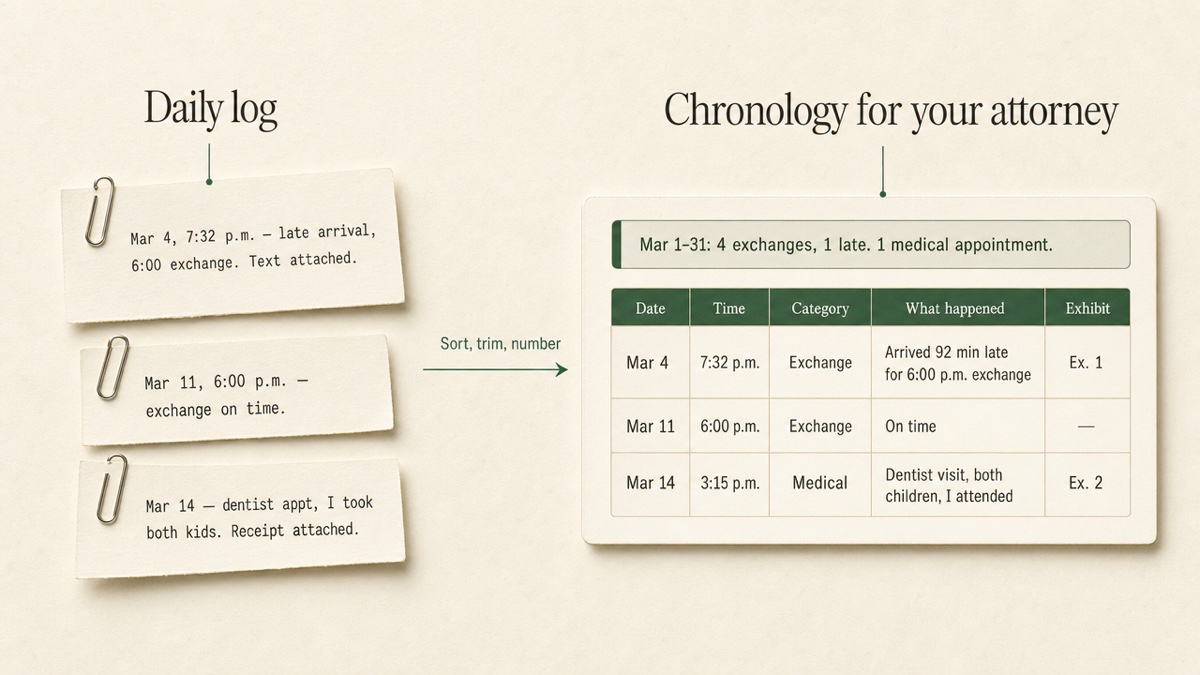
Raw entries are the source material. What helps your attorney is a chronology.
- Ask what period and issues matter. The last six months of exchanges? Medical decisions? Don't hand over everything by default.
- Sort by date. One line per event.
- Use consistent columns: date, time, category, short factual description, exhibit number.
- Number the attachments. Exhibit 1, 2, 3, matched to each line, so nobody has to hunt for a file.
- Add a summary on top: counts by category ("14 exchanges, 4 late, 1 missed"), and the dates the log covers.
- Keep the full log available in case your attorney wants the underlying entries.
For the full structure of a court-ready record, see How to document custody for court.
If you keep the log in Custody Proof
Custody Proof is a private log for one parent. The other parent is never invited, never notified, and has no account. Log overnights and timed visits on your calendar, flag violations, and attach photos, screenshots, and files to the entries they belong to. Evidence goes into an encrypted vault with seven categories, including Incidents, Communications, Health, Emotional, and Witness. Child expenses go into a ledger with receipts attached.
When your attorney asks, the Court Packet combines a plain-English summary, color-coded calendars, deviations from the schedule, and every record in one chronological journal. You can also confirm periods as reviewed, so the report shows a "Confirmed through" date.
On the Case Builder plan, Vero turns a voice note, a pasted text thread, or a photo into a draft entry in neutral language. You review every draft before it saves, and Vero does not guess at missing dates. Documentation is $14.75/month or $144/year. Case Builder is $29/month or $278/year.
Start your log today. Your first charge has a 30-day money-back guarantee.
Frequently asked questions
Is a custody journal admissible in court?
Not automatically. Whether a log, or any part of it, can be used depends on your state's evidence rules and how your attorney presents it. A dated, factual, consistent log is easier for your attorney to work with, but only your attorney can tell you how it will be used in your case.
Paper or app?
Either works if you are consistent and keep the originals. Paper is hard to back up and hard to search. An app makes timestamps, attachments, and sorting easier. Whichever you choose, keep the venting journal somewhere else.
I'm months behind. Is it too late?
No. Start today with full entries. Then add past events you can date from texts, emails, receipts, or photos, and note that each one was recorded later. Do not invent times you don't remember.
Should I tell the other parent I keep a log?
That is a strategy question for your attorney. This log is for you and your attorney, not for sharing, and it does not depend on anyone else taking part.
Where can I get a custody journal template?
Use the six fields as your template: date, time, place, who, what happened, attachment. Add a category column (exchange, medical, school, expense, incident, communication) so the log is easy to sort into a chronology later.
Keep reading
- How to Document Custody Exchanges: Times, Places, Proof
- Best Interest of the Child Factors Explained
- Status Quo in Custody Cases: What It Is, How to Show It
- Which custody app fits your situation
Custody Proof is a documentation tool, not a law firm. Nothing on this page is legal advice. Whether and how a record is used in a case is a question for your attorney.