Custodial interference: what it looks like and how to prove it
By EJ Archuleta, Licensed attorney · Updated
To prove custodial interference, you line up three things: the court order showing which time was yours, a same-day record of what happened on each date that time was denied or cut short, and the messages that show it. Then you count the lost time in overnights, planned against actual, so your attorney sees a number instead of a feeling. Whether that record supports enforcement, contempt, or a modification is your attorney's call. Building the record is yours.
This page is general information, not legal advice for your case. Custody law varies by state. Questions about your order belong with a family law attorney licensed where your case is.
What custodial interference usually looks like
Interference is conduct that keeps you from time or contact the order gives you. Some of it is direct and obvious. Some of it is quieter and only shows up as a pattern.
- Withheld overnights. The weekend arrives and the child does not. Or the child is kept past the return time without your agreement.
- Chronic lateness. Forty minutes late every exchange takes real hours off your time and can make some plans impossible to keep.
- Moving the exchange. The order says the school parking lot at 6:00. The other parent texts at 5:15 that it is now their house, an hour away.
- Blocking calls. Scheduled phone or video calls go unanswered, the phone is off, or your number is blocked.
- Undermining. Making school, medical, or religious decisions alone when the order requires consultation. Keeping you out of school events or activities. Telling the child the visit is optional, as if a child should decide whether parenting time happens.
One late pickup with a flat tire is a late pickup. The same delay fourteen weekends in a row is something else. For the everyday versions, see missed visitation and late pickups.
Civil interference and criminal custodial interference
Most interference is handled in family court, as a violation of a civil order. Your attorney can ask the court that issued the order to enforce it.
Many states also have criminal laws about taking, concealing, or keeping a child in violation of a custody order. These are usually aimed at more serious conduct than a late exchange, and the elements differ from state to state.. Investigators in such cases often look at whether the parent knew about the order, whether they meant to keep the child from you, and for how long, though the exact factors depend on your state's law.. Your record can speak to all three.
If a child is in danger, call 911. Short of that, whether police will step in to enforce a custody order at an exchange varies widely by state and by department.. Many attorneys suggest pursuing family court enforcement before criminal charges. Ask your attorney which path fits your situation before the next exchange goes wrong, not during it.
Start with the order as your baseline
Interference only means something measured against the order. Not against what seems fair, and not against last year's informal arrangement.
Pull out the provisions that matter:
- the regular schedule and holiday blocks
- exchange times and locations
- phone or video contact terms
- notice deadlines, such as electing summer dates in writing by a certain day
- any decision-making or consultation requirements
In Custody Proof, you upload the order or describe the schedule in plain words, and it becomes a recurring calendar you approve week by week before anything saves. Notice deadlines the app finds in the order are offered as in-app reminders, which helps you meet your own obligations.
Document it the same day
Write the entry while the details are exact. A note made that evening carries more detail than one reconstructed a month later, and it is harder to pick apart.
For each incident, record:
- What was scheduled. Date, time, and place, from the order.
- What happened. Arrival time, or that no one arrived. When the child was returned, if late.
- The communication. Any text, email, or call before, during, or after.
- Witnesses. Anyone present: a school staff member, a friend who drove with you, the person at the exchange location.
Keep the wording factual. "She's doing this to punish me again" is an argument. "Scheduled exchange 6:00 p.m. at school per order. I arrived 5:52. No one arrived. Texted at 6:10 and 6:30, no reply. Neighbor present" is a record. An attorney can use the second one. The first one gives the other side something to argue with.
Attaching texts without losing the context
A cropped screenshot of one message invites the question of what came before it. Preserve the whole exchange.
- Capture the thread header with the contact name or number, and the date stamps.
- Include the messages before and after the key one, even if your own replies were not your best.
- Keep the originals on your phone. Do not delete threads, and back up the device.
- Save emails with their headers and full chains, not just the last reply.
- Ask your attorney what format they prefer. Some want a full thread export rather than images.
In Custody Proof, screenshots attach directly to the calendar event or incident they belong to and sit in the encrypted vault under Communications, dated. On the Case Builder plan, Vero can turn a pasted thread or a screenshot into a dated draft for you to review. If no date appears in what you gave it, Vero asks you for one rather than guessing.
Quantify the lost time: planned vs. actual
"They keep taking my weekends" is hard for a court to measure. "I was scheduled for 48 overnights this period and received 34" is a number someone can check.
Count in overnights. A Friday-after-school to Sunday-evening weekend is two nights, not three days. The full math is in how courts count parenting time. Keep lateness separate, in minutes, and missed calls separate, as a count.
A simple log template:
| Date | Scheduled per order | What happened | Nights planned | Nights received | Lost (running) | Attached | Witness |
|---|---|---|---|---|---|---|---|
| Mar 6 | Fri 6 p.m. to Sun 6 p.m. | No-show; texts unanswered | 2 | 0 | 2 | Texts 6:10, 6:30 | Neighbor |
| Mar 20 | Fri 6 p.m. to Sun 6 p.m. | Child arrived Sat 11 a.m. | 2 | 1 | 3 | Text moving pickup | None |
| Apr 3 | Fri 6 p.m. to Sun 6 p.m. | As planned | 2 | 2 | 3 | None | None |
Log the weekends that went as planned too. A record that shows only the bad days has no denominator and looks selective.
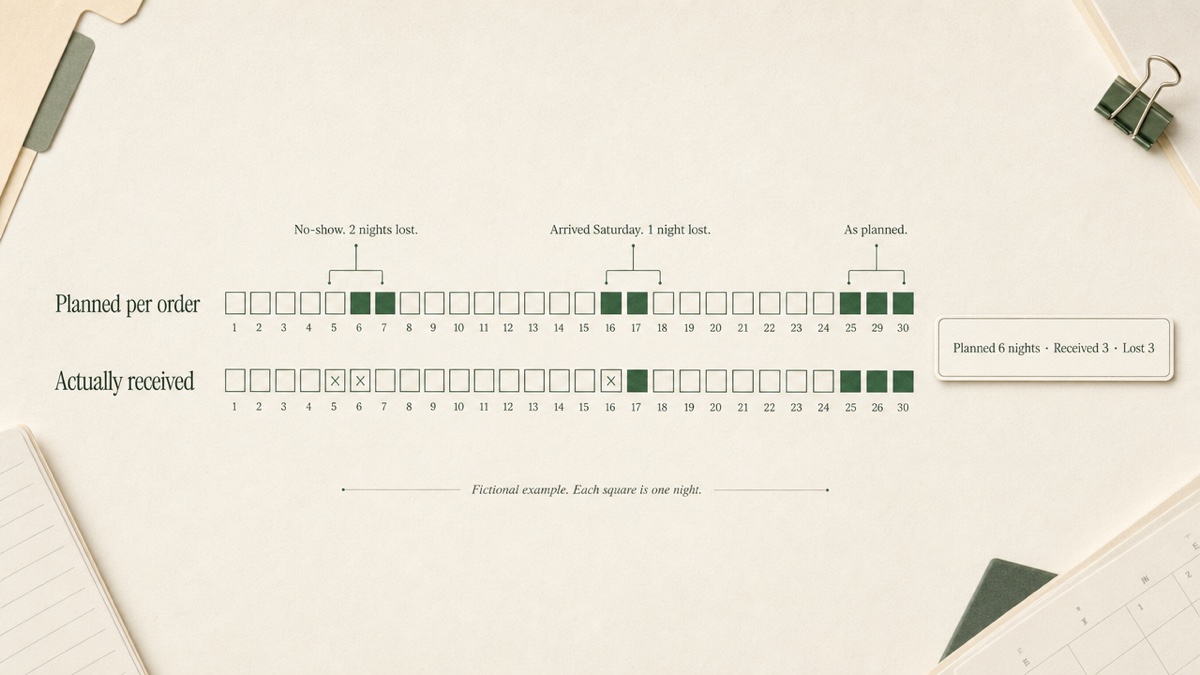
Custody Proof does this comparison automatically. Plan vs. Actual shows nights kept, missed, and extra, with a day-by-day deviation table. When you confirm the record, reports show a "Confirmed through" date. The violation flag is your own label on your own record. It does not decide anything. Whether the conduct is interference is a legal question for your attorney and the court.
Never log a withheld night as yours to make the calendar look normal. The gap is the record.
Pattern evidence vs. isolated incidents
A single missed exchange may not justify a court filing. Your attorney may tell you to log it and wait. A pattern is different. Frequency, trend, and timing are what turn scattered incidents into something a judge can weigh: every exchange late, weekends missed mostly before holidays, calls blocked every Sunday.
Look at your log over months, not days. A slow squeeze shows up in trends, not in any single entry. In Custody Proof, the Statistics Trends and Patterns tabs show how often violations happen and when.
Keep your own record clean
An enforcement request is weaker when your own record has problems.
- Do not retaliate. Withholding the child in return, or holding back child support, can turn your case into a mutual-violation dispute and may put you in violation of the order yourself.
- Show up anyway. Arrive on time to exchanges you expect to be skipped, and log that you were there.
- Log your own on-time exchanges. Confirmed weeks show you followed the schedule.
- Meet your deadlines. Give the notice your order requires, in the form it requires.
- Write messages you would not mind a judge reading. Short, specific, civil. Ask your attorney whether a brief written note listing missed dates is worth sending.
What attorneys may pursue
This is a general overview, not a prediction for your case. Depending on the state and the facts, an attorney may consider:
- Enforcement. Asking the court to order compliance with the existing schedule.
- Contempt. A civil contempt motion asks the court to find the order was violated. The standard of proof varies. Some courts require clear and convincing evidence for civil contempt, and contempt that is punitive rather than aimed at compliance generally requires proof beyond a reasonable doubt.. Civil contempt usually aims at compliance, so the court may set conditions the other parent can meet to resolve it, such as make-up time or following the schedule for a set period.
Make-up time. Some states have guidelines for when and how lost time is made up..
- Modification. Changing the order itself. Modification. Changing the order itself. Courts generally look at the child's best interests, and many require a showing of changed circumstances..
No record guarantees any of these outcomes. A clear record makes them easier for your attorney to evaluate.
What to hand your attorney
Ask what they want first. If they have not said, this is a sensible set:
- the current order and any modifications
- your log or detailed report for the period, with planned vs. actual overnights
- communications attached to the dates they belong to, with full context
- witness names and how to reach them
- school or medical records showing decisions made without you, if the order required consultation
- evidence of your own compliance: on-time exchanges and notices sent
Reports and exports covers a packet order. How to document custody for court covers the broader record.
Custody Proof is private to you. The other parent is never invited or notified, and nothing you log is shared unless you export a file and hand it over yourself. Plans start at $14.75/month. Start your record.
Frequently asked questions
What counts as custodial interference?
Generally, conduct that keeps you from time or contact the order gives you. That includes withheld or shortened overnights, chronic lateness, moved exchanges, blocked calls, and decisions made alone when the order requires consultation. What qualifies legally in your state is a question for your attorney.
Does flagging a violation in Custody Proof prove interference?
No. A flag is your dated label on an entry, so the incident is easy to find and count. Whether it amounts to interference is for your attorney and the court to decide.
Will the other parent know I am documenting?
Not through Custody Proof. There is no shared account, no invitation, and no notification. Flagging an incident notifies no one.
I did not log anything until now. Is it too late?
No. Add past incidents with their real dates and attach the texts you already have. Entries made close to the event are stronger, so log everything from today on the same day it happens.
Should I keep the child next time to even things out?
No. Self-help withholding can put you in violation of the order and weaken your enforcement request. Keep your own record clean and let your attorney pursue the remedy.
Keep reading
- How to Win Custody as a Father: The Records That Matter
- How to Create a Divorce Log Your Attorney Can Use
- How to Document Custody Exchanges: Times, Places, Proof
- Which custody app fits your situation
Custody Proof is a documentation tool, not a law firm. Nothing on this page is legal advice. Whether and how a record is used in a case is a question for your attorney.