Custody log template: the fields every entry needs
By EJ Archuleta, Licensed attorney · Updated
Every entry in a usable custody log template has five fields: the date, what the order planned, what actually happened with exact times, a factual description, and a reference to any attachment. Overnights and timed visits go in separate columns so your totals mean one thing each. The layouts below can go into a notebook or a spreadsheet today. They cover parenting time, exchanges and violations, expenses, and a short contact sidebar.

This is a log for one parent. You keep it yourself. It doesn't depend on the other parent filling anything in, agreeing to a format, or using any shared tool. It is written the way a family lawyer would want to receive it: dated, consistent, and easy to check against the order.
This page is general information, not legal advice. Custody rules and how courts weigh records vary by state, so ask your own attorney how your order counts time.
The parenting-time log
Write one row per stay or visit, including the ones that went exactly as planned.
| Column | What goes in it |
|---|---|
| Entry # | Sequential number, never reused |
| Date(s) | Start date to end date |
| Planned | What the order says for this slot ("Alt. weekend, Fri 6:00 p.m. to Sun 6:00 p.m.") |
| Actual start | Exact time the child arrived with you |
| Actual end | Exact time the child left you |
| Overnights | Number of nights the child slept at your home |
| Timed visit hours | Hours of same-day time, if there was no overnight |
| Children | Which child or children |
| Attachment ref | ID of any photo, text or receipt tied to this row |
| Written on | Date and time you wrote the entry |
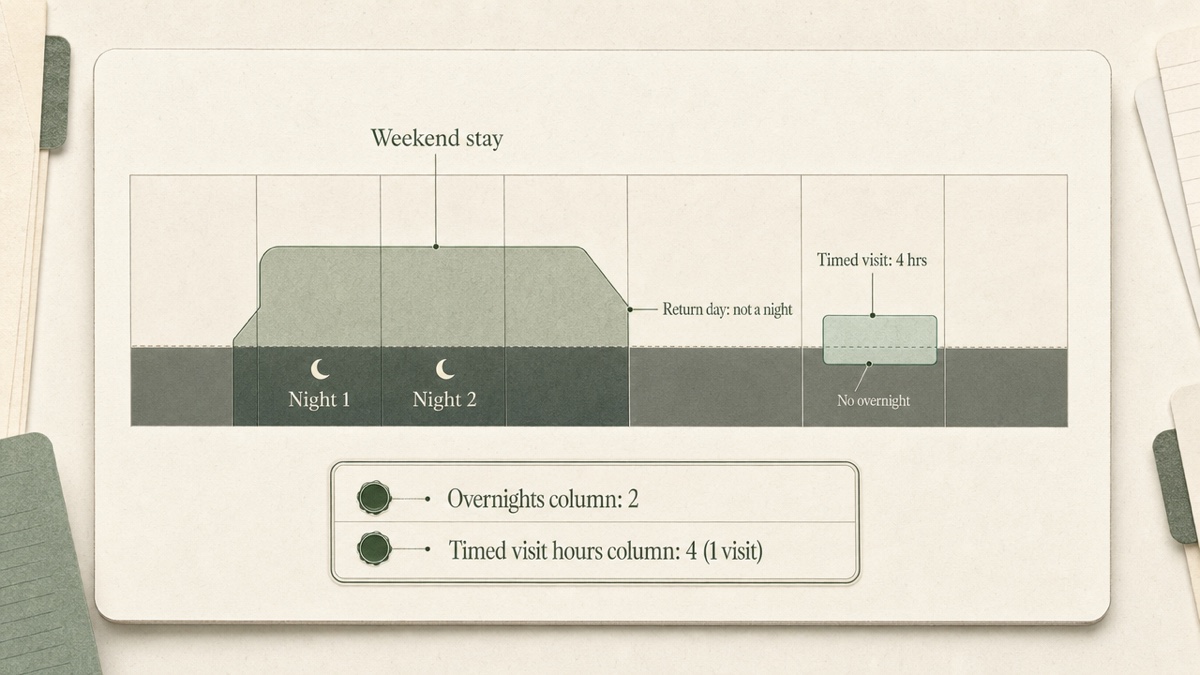
Keep the overnight and visit columns apart. A Wednesday dinner from 3:30 to 7:30 p.m. is real parenting time, but it is four hours, not a night. If you blend the two, a percentage built from them stops meaning anything specific.
Count nights the way courts commonly do. The end date is the return morning, so it is not a night. Friday to Sunday is two nights. If both children stayed Tuesday, that is still one night of your time. The full explanation is in how courts count parenting time.
The exchange and violation log
Use this page for anything that differs from the order. That includes late pickups, missed visits, early returns, no-shows and refused exchanges.
| Field | Example |
|---|---|
| Entry # | 041 |
| Date | Fri, March 7 |
| Scheduled time | 6:00 p.m. |
| Actual time | 7:32 p.m. (or "did not occur") |
| Location | The exchange point named in the order |
| People present | Who was there, including any witness, with full name |
| What happened | Facts in order, with direct quotes in quotation marks |
| What you did | Waited, texted, called, left at a stated time |
| Attachment ref | Text screenshot, timestamped receipt, photo, report number |
| Written on | March 7, 8:15 p.m. |
If an exchange didn't happen, record proof that you were there and ready. That can be a timestamped store receipt from nearby, a witness name, or a photo with its original file intact. If police took a report, write the report number in the attachment field. For more on these specific situations, see missed visitation and late pickups.
Write facts, not conclusions
California's court standards for professional supervised visitation providers say case records should stick to facts, observations and direct statements by the parties, and leave out the provider's conclusions and opinions. That is good discipline for your own log too, even when no rule requires it.. That is good discipline even when no form requires it. A conclusion invites an argument. A fact invites a question someone can check.
Before: "He was late AGAIN because he doesn't care about the schedule, and he was rude to me in front of the kids."
After:
> Entry 041. Fri, March 7. Scheduled pickup 6:00 p.m. at the exchange point in the order. I arrived 5:52 p.m. The other parent arrived 7:32 p.m. I sent texts at 6:10 and 6:40 p.m. with no reply (screenshots: A-041a, A-041b). At the exchange the other parent said, "I'll get here when I get here." Maya (8) asked me in the car, "Are we still going to the party tomorrow?" Written March 7, 8:15 p.m.
The second version has no adjectives about anyone's character. It lets the times, the quote and the screenshots do the work. When you're unsure, write what a camera would have recorded.
Log the quiet weeks too
A log that only has incidents reads like a complaint file. It also leaves out the numbers your attorney may need most: how many scheduled exchanges happened at all, and how many went as planned.
When the week matches the order, write one row per stay with actual times. Use the word "as scheduled" where it is true. Twelve uneventful weekends make the three late ones meaningful. They show the problem is a pattern measured against a baseline, not a mood. They also show that you showed up.
The expense log
| Date incurred | Amount | Category | What it was for | Child | Receipt ref | Shared? (%) | Requested on | Received | Status |
|---|---|---|---|---|---|---|---|---|---|
| Mar 3 | $45.00 | Medical | Prescription copay | Maya | R-018 | 50% | Mar 4 | $0 | Unpaid |
The status column can use five values: not requested, unpaid, partially paid, paid and disputed. Mark a cost as shared only when your order or agreement says that kind of cost is split. If you are unsure, record the spend and ask your attorney. When money comes in, update the received column instead of deleting the row. The full system is in how to track unreimbursed child expenses.
Sidebar: emergency and school contacts
Keep a one-page contact sheet in the front of your binder or on its own spreadsheet tab. It should list each child's school or daycare and the front office number, pediatrician, pharmacy, allergies and medications, and two emergency contacts. It is useful for you and for anyone caring for the children.
Keep that sheet out of the log you hand over. Children's addresses, phone numbers and schools are the kind of identifying details courts may treat as confidential. Ask your attorney before anything with them leaves your hands. If you don't have one, check with the court clerk or self-help center about how that court handles confidential information..
Keeping a paper or spreadsheet log consistent
- Write it the same day. Memory drifts by Sunday, and a same-day entry is easier to stand behind. Record the "written on" time on every entry.
- Number every entry and never skip or reuse a number.
- On paper: use ink in a bound notebook with no blank lines between entries. To correct something, strike it through once, write the correction, and date it. Never tear out a page.
- In a spreadsheet: use one row per event and one date format throughout. Add a separate "entered on" column. Never overwrite an old row. Add a correcting row instead.
- Keep originals. Save full, uncropped screenshots that show the date and sender. Keep photos as the original files, not edited copies. Store attachments in a folder named by the entry's reference ID.
- Cross-reference both ways. The log names the attachment, and the attachment's filename names the log entry.
Where paper runs out
Paper works until someone asks a question that requires math or searching. How many overnights did you have this year? How many scheduled weekends were missed? Show every late pickup since September. Can you find the copay receipt from February?
A notebook can't total itself or compare planned time against actual time without hours of hand-counting. It also can't find entry 041 in under a minute. Spreadsheets help with totals but need formulas you keep correct. They also don't hold the screenshots themselves.
Handing the log to your attorney
Ask what format your attorney prefers before you assemble anything. If they haven't said, this order is easy to work from:
- A one-page summary for the period: overnights, timed visits, missed and late exchanges.
- The parenting-time log, in date order.
- The exchange and violation log, with attachment references.
- The expense log, filtered to what they asked about, with receipts labeled to match.
- The attachments, indexed by reference ID.
Give a defined date range, not everything you have ever written. More on structure is in how to document custody for court.
If you'd rather not count by hand
Custody Proof keeps this same log as a private web app for one parent. The other parent is never invited or notified. You can upload your order or describe your schedule in plain words, and it becomes a recurring calendar you review before it saves. Overnights and timed visits are counted separately. Planned vs. actual is compared day by day, and you can confirm your record as you go.
Violations are flagged on your own timeline. Texts, photos and receipts go into an AES-256 encrypted evidence vault, attached to the entry they belong to. Expenses keep a running balance. When your attorney asks, you can export PDF reports, a CSV, or the Court Packet, with receipts as labeled exhibits.
The Documentation plan is $14.75/month or $144/year. Case Builder, at $29/month or $278/year, adds Vero, an AI assistant that turns a voice note or pasted text into a draft entry you review. Vero never guesses dates.
Start your record. The first charge has a 30-day money-back guarantee.
Frequently asked questions
Is there a printable file I can download?
This page gives you the layouts rather than a file. Copy the column headings into a bound notebook or a spreadsheet. That way you can match them to your own order's schedule and exchange terms.
Does keeping a log make my records admissible?
No log does that on its own. A consistent log makes your records dated, organized and easier to check. Whether and how any record is used in your case is a question for your attorney, and the answer varies by state and by court.
I didn't start logging until recently. Can I add past months?
Yes. Enter past events with their real dates, attach what you still have, and mark them as written later. A "written on" date that differs from the event date is honest. Pretending otherwise isn't.
Should the other parent see my log?
It is your private record. If it needs to go anywhere, your attorney can advise on when and how it is shared.
What if the order doesn't give exact times or an exchange location?
Log what actually happened anyway, with real times and places. Then raise the gap with your attorney. Vague terms can make an order harder to enforce, and that is worth knowing early..
Keep reading
- How to Prove Custodial Interference
- How to Win Custody as a Father: The Records That Matter
- How to Create a Divorce Log Your Attorney Can Use
- Which custody app fits your situation
Custody Proof is a documentation tool, not a law firm. Nothing on this page is legal advice. Whether and how a record is used in a case is a question for your attorney.