What Is a Child Custody Evaluation, and How Do You Prepare?
By EJ Archuleta, Licensed attorney · Updated
A child custody evaluation is a forensic assessment of a child's needs and of each parent's ability to meet them, used by courts when custody or parenting time is contested. A mental health professional interviews the parents, observes them with the children, gathers information from schools, doctors, and other outside sources, and then writes a report for the judge. That report often includes recommendations.

Most of the evaluation is out of your hands. The quality of the information you bring is not. Evaluators work with what they can verify. A short, dated record of what actually happened is easier to check than a long account of what the other parent is like. This page explains the process in general terms and shows how to organize that record.
This is general information, not legal advice. Evaluation rules, timelines, and costs vary by state and by court, so talk to a family law attorney licensed where your case is.
When an evaluation is ordered
An evaluation is usually requested when parents cannot agree and the judge needs more than testimony to decide. Depending on the court, the request may come from a parent, from someone representing the child, or from the judge.
Common triggers include:
- disagreement over which parent the child should primarily live with
- a contested parenting-time schedule
- a parenting plan the court won't approve
- complex needs in the child's health, schooling, or development
- allegations of abuse, substance use, mental illness, or unfitness
- a parent who wants to relocate with the child
Evaluations come in two sizes. A partial or brief evaluation looks at a single question, such as whether a proposed schedule fits a toddler. A full evaluation investigates several issues and takes longer.
Who the evaluators are
Court-connected evaluators
Some courts have their own family services staff. Others contract with outside evaluators or keep a list of approved ones. Court-connected evaluators are usually counselors or other mental health professionals. These evaluations tend to cost the parties less and often finish sooner than private ones.
Private evaluators
Private evaluators are usually licensed psychologists or other credentialed mental health professionals. The parents' attorneys may agree on one, or the court may appoint one. They generally offer more time and more testing, and they cost more.
Professional guidelines for psychologists say the evaluator should explain at the start who retained them, what the information will be used for, and the limits of confidentiality. Assume nothing you say is private. Anything you say can end up in the report.
What typically happens
Courts and evaluators differ, but these steps show up in most evaluations.
Paperwork and releases. You may get a detailed questionnaire covering your history, your children, and your concerns. You may also be asked to sign consents so the evaluator can request school, medical, counseling, social service, and police records.
Parent interviews. Expect several sessions alone. Some evaluators also meet with both parents together to see how you communicate. Evaluators typically ask about any history of child abuse, domestic violence, substance use, psychiatric illness, and involvement with the legal system.
Observation. The evaluator may watch you with the children in the office or visit your home. Stepparents, partners, and other adults or older siblings living in the home may also be interviewed.
Collateral contacts. Evaluators often reach outside the family: teachers, childcare providers, pediatricians, therapists, and sometimes law enforcement or a guardian ad litem.
Psychological testing. When a parent's emotional or mental status matters to the case, a qualified psychologist may give several standardized tests.
The child. Whether and how a child is interviewed depends on age, maturity, and the circumstances.
The report. Most evaluators write a report that may include specific recommendations. An evaluator generally should not recommend anything without having interviewed both parents.
What it costs, in general terms
There is no standard price. In general:
- Private evaluators usually bill by the hour, and a full private evaluation is a significant expense.
- A full fee or a substantial retainer may be due up front.
- Testimony at a hearing or trial is often billed separately.
- The court may split the fee between the parents or assign it to one parent.
- Court-connected services tend to cost less.
Ask your attorney what is realistic in your court, including who is likely to pay and how costs may be split, before you agree to a particular evaluator or scope. In many courts the judge appoints the evaluator and sets the scope in an order.
Prepare a record an evaluator can check
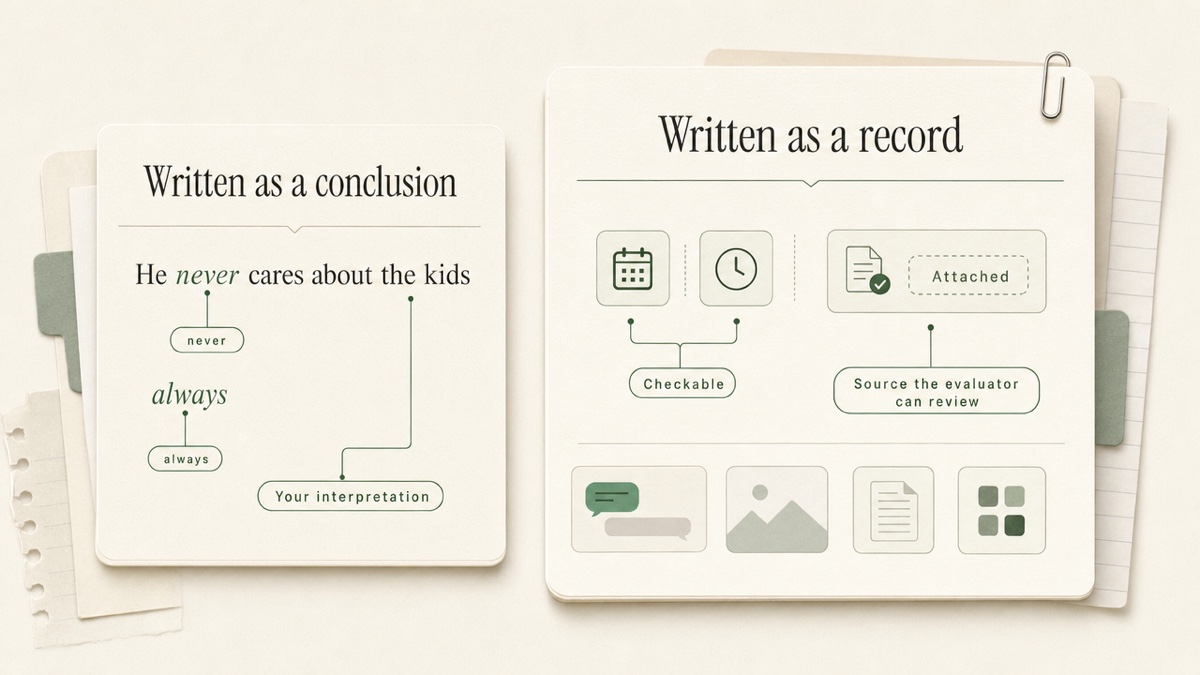
Evaluators hear two competing stories in nearly every case. What helps is information they can check against school attendance, pediatric records, or the other parent's own account. Two documents do most of that work.
1. A parenting-time summary
This is the numbers side. For the period at issue, show:
- overnights the order gave you and overnights you actually had
- day visits, counted separately from overnights
- missed or shortened exchanges, by date
- extra time you picked up, by date
Count by nights, not calendar days. A Friday-to-Sunday weekend is two overnights. If you mix nights and dinner visits into one figure, nobody can check it. How courts count parenting time explains the math.
Include the weeks that went as planned, not only the problems. A record that shows 40 normal exchanges and 6 missed ones is more believable than a list of 6 complaints with nothing around them.
2. A short chronological timeline
This is the narrative side, and it should be short. One line per event:
- date and time
- what happened, in observable terms
- who was present
- what supports it (a text, a school email, a receipt, a photo)
Limit it to events that bear on the child: missed exchanges, medical appointments, school issues, safety concerns, changes to the schedule. For patterns of lateness or no-shows, how to document missed visitation and late pickups walks through the entry format.
Two or three pages is usually more useful than thirty. Your attorney can tell you whether to hand it over, summarize it in the questionnaire, or keep it in reserve.
What to gather before your first interview
- the current order or agreement, and any temporary orders
- your parenting-time summary and timeline
- school contacts, report cards, and attendance records you already have
- pediatrician, dentist, and therapist names and contact details
- childcare provider contacts
- names and phone numbers of people who see you parent regularly, chosen because they've seen it, not because they're on your side
- copies of relevant messages, organized by date rather than in a camera roll
- any police reports or protective orders
Releases tend to slow collateral contacts down. If you know which providers the evaluator will want, ask your attorney whether to have their names, addresses, and record numbers ready so the consent forms can go out quickly.
Tone: describe the facts and leave the conclusions to the evaluator
The evaluator's job is to reach conclusions about each parent. If you hand them conclusions about the other parent, you are doing their job badly and giving them something to discount.
Compare:
- "She's trying to alienate the kids from me" versus "On three of the last four exchanges, the children said they'd been told they didn't have to come."
- "He's an unsafe driver" versus "On May 2 he arrived for the exchange with both children unbuckled in the back seat."
- "She's impossible to co-parent with" versus "I proposed a swap for the school play by text on April 10. No reply by April 17."
The second version of each is calmer, and the evaluator can check it. Keep the same tone in interviews. Talk about your child first: routines, school, friends, what bedtime looks like at your house. Evaluators notice whether a parent can describe the child in detail and whether that parent can say anything neutral about the other one.
When the allegations are serious
Claims of abuse, domestic violence, or parental alienation tend to get closer scrutiny and are often handled differently. Depending on the evaluator and the court, that can mean separate interviews, extra screening, or more reliance on third-party records.
If safety is the issue, your first conversation is with your attorney, and with law enforcement or a protective-order process where that applies. Documentation that tends to carry weight is the kind created by someone else or at the time: police reports, medical records, school incident notes, and a dated log written when things happened. Don't diagnose anyone. Report what you saw and heard, when, and who else was there.
Children: preparation is not coaching
Children usually know when an evaluation is happening. What helps them:
- Tell them, briefly and calmly, that someone will talk with the family to help the grown-ups make good decisions.
- Tell them there are no right answers and they won't get in trouble for anything they say.
- Tell them they don't have to choose between parents.
What hurts them, and usually your credibility too:
- rehearsing answers or reviewing "what happened"
- asking afterward what they said or what the evaluator asked
- promising rewards, or hinting at consequences
- showing them court papers or the other parent's messages
Evaluators interview children all the time. A child repeating adult phrases is easy to spot.
After the report: talk to your attorney first
When the report arrives, read it with your attorney before you react. In many jurisdictions the report is confidential and may be sealed. Where it is confidential, you may be barred from sharing it with your children, family, or friends or posting it anywhere. Even where no rule applies, sharing it is unwise, so check the rules in your court with your attorney.
Depending on where you are, you may be able to object to the report, ask for a hearing, or have the evaluator testify and be cross-examined about the findings. Deadlines for receiving the report and responding to it also vary by court. An evaluation is one piece of evidence. The judge makes the decision, and no report guarantees how the case comes out.
If parts of the report rest on factual errors, such as wrong dates or a schedule described inaccurately, your dated record is what your attorney will compare it against.
Keeping the record in Custody Proof
Custody Proof is private documentation software for one parent. The other parent is never invited or notified. You can:
- Turn your order into a calendar, then log overnights and timed visits separately.
- Compare the planned schedule against what you actually logged.
- Confirm periods as accurate as you go.
- Flag missed exchanges on your own timeline.
- Attach texts and photos to the date they belong to, in an encrypted evidence vault.
When your attorney asks for something, you can export a one-page stats summary, a detailed PDF with an optional planned-vs-actual section, an evidence report, or a CSV. Reports and exports covers each one. Your attorney decides what, if anything, goes to the evaluator. For the broader approach, see how to document custody for court.
Plans start at $14.75/month, with a 30-day money-back guarantee on your first charge. Start your record.
Frequently asked questions
What is the difference between a custody evaluation and a home study?
The terms overlap, and courts use them differently. A home study is often narrower, focused on the home environment and a visit to it. A full custody evaluation usually adds multiple interviews, collateral contacts, a records review, and sometimes psychological testing. Ask your attorney which one your court has ordered and what it covers.
What should I bring to a custody evaluation?
Bring your order, a short parenting-time summary, a dated timeline, and contact details for schools, doctors, and childcare. Bring organized copies of key messages and any police or protective-order records. Bring less than you think, and make sure every item has a date.
How long does a custody evaluation take?
It depends on the scope, the evaluator's caseload, and how quickly records and releases come back. Brief evaluations of a single issue finish faster than full ones, and court-connected evaluations often move faster than private ones.
Can I see the evaluator's report?
Usually the parties and their attorneys get access before the hearing, but rules on timing, confidentiality, and sealing differ by jurisdiction. Your attorney will know the process in your court.
Will the other parent know I've been keeping a record?
Not from Custody Proof. The other parent has no account and gets no notifications. If your record is shared in the case, it's because you exported it and your attorney chose to use it.
Keep reading
- Parallel Parenting Plan Template for High-Conflict Cases
- Custody Log Template: The Fields Every Entry Needs
- How to Prove Custodial Interference
- Which custody app fits your situation
Custody Proof is a documentation tool, not a law firm. Nothing on this page is legal advice. Whether and how a record is used in a case is a question for your attorney.