Co-parent keeps changing the custody schedule? Document the pattern
By EJ Archuleta, Licensed attorney · Updated
If your co-parent keeps changing the custody schedule, treat the written order as the baseline and log each change the day it happens. Keep showing up for the time the order gives you, and record when each request came, how much notice you got, the reason given, what actually happened, and the message itself. After a few weeks, those entries turn into counts and overnight totals your attorney can work with. Your order may allow the two of you to agree to occasional swaps, but only a court can formally change the order itself. Ask your attorney whether to pursue enforcement or modification.

This page is general information, not legal advice. Custody law and local parenting guidelines vary by state, so take questions about your own case to a family law attorney.
Flexibility or a pattern?
Most parenting plans bend now and then. A child gets sick, a flight is delayed, a work shift moves. Courts generally expect some give and take, and a parent who never allows a single swap can look rigid. You still aren't required to agree to changes, and sticking to the order as written isn't a violation.
A pattern looks different:
- Changes come from one direction, and nearly always cut your time.
- Notice keeps shrinking. A day's warning becomes an hour, then a text after the exchange time has passed.
- Reasons are vague, keep shifting, or are missing.
- Promised make-up time doesn't happen.
- The children start missing activities, or spend the day not knowing which house they're sleeping at.
You don't need to settle whether it's a pattern tonight. You need a record that lets someone else answer that question later.
The order is your baseline
"He always does this" is a feeling. It becomes a fact once you compare two columns: what the order scheduled and what happened.
So the baseline is the order itself, not the latest text and not last month's habit. Write down the regular rotation, the exchange times, holidays, and any notice terms the order sets. Then every day either matches the plan or it doesn't. The days that don't match are your entries.
Count time the way courts commonly do, by overnights. A Friday-to-Sunday weekend is two nights. A canceled Thursday dinner is a lost visit, not a lost night. Keep those two units apart. The reasoning is on how courts count parenting time.
What to log for every change
Log it the same day, even if all you get down is two lines. Each entry should capture:
- Scheduled time. What the order gave you: the date, the start and end, and whether it was an overnight or a timed visit.
- Request time. When the change was proposed, to the hour if you can.
- Notice given. How long before the scheduled exchange the request arrived.
- Reason given. Write it in their words, or note "none given."
- Your response. Whether you agreed, declined, or proposed an alternative.
- Outcome. What actually happened, including any make-up time offered and whether it occurred.
- The message. A screenshot of the text or email, attached to the entry. Keep the original on your phone as well.
- Effect on the child. Missed practice, a late school arrival, a hard transition. One plain sentence is enough.
If the change was a no-show or a late pickup, use the same fields. There is more detail on missed visitation and late pickups. If something happened today and you haven't started a record yet, start with what to document tonight.
Record agreed swaps too
Log the swaps you agreed to with the same care as the ones you didn't, and label each one: agreed or unilateral.
There are two reasons. First, it's accurate. Second, a record made only of complaints reads like a grievance file. A record that shows "agreed to three swaps, five days' notice each, make-up time given" next to "two cancellations with under two hours' notice" reads like a reasonable parent tracking a real problem.
The risk of drifting from the written plan
Informal changes have a way of becoming the new normal. Every other weekend slides into "whenever works." Months later, nobody can say what the schedule is.
Several general risks are worth raising with your attorney:
An informal arrangement that was never made into a signed order usually can't be enforced the way an order can, and how much weight it carries varies by state. It can still show how the parents actually operated.
- Holding back the other parent's time to get even, or because support is unpaid, may be treated as interference with parenting time. It can also undercut your own request later.
- Agreeing to repeated changes without writing anything down can make it harder to show what the baseline was.
Some states publish parenting guidelines that expect timely notice and good-faith rescheduling of missed time within a set window. Others leave it to the wording of each order, and some guidelines are set by individual counties rather than the state. Even where guidelines exist, your own order's terms usually control. Your attorney can tell you which rules apply to you.
Replying without feeding the fight
Your reply becomes part of the record, so write every one as if a judge will read it. Two approaches help.
BIFF: Brief, Informative, Friendly, Firm. Answer the logistics. Skip the history.
> "Thanks for letting me know. Per the order, I'll be at the school at 3:15 Friday. If you'd like to propose a different weekend, send the dates and I'll look at them."
> "I can't do Saturday instead. I'll keep Friday through Sunday as scheduled. Hope the work trip goes well."
Broken record. When the pressure continues, repeat the same calm line without adding anything new.
> "I'll follow the schedule in the order. See you Friday at 3:15."
Then stop. You don't have to win the thread. You only have to keep a reply you'd be comfortable seeing printed.
Turning entries into a pattern
Single entries tell stories. Totals show patterns. Once a month, pull three numbers:
- Changes per month, split into agreed and unilateral.
- Notice lead time. For each change, the gap between the request and the scheduled exchange. A list like "5 days, 2 hours, 40 minutes, after the fact" says more than an adjective.
- Planned vs. actual overnights. Nights the order gave you against nights you actually had. Count timed visits separately.
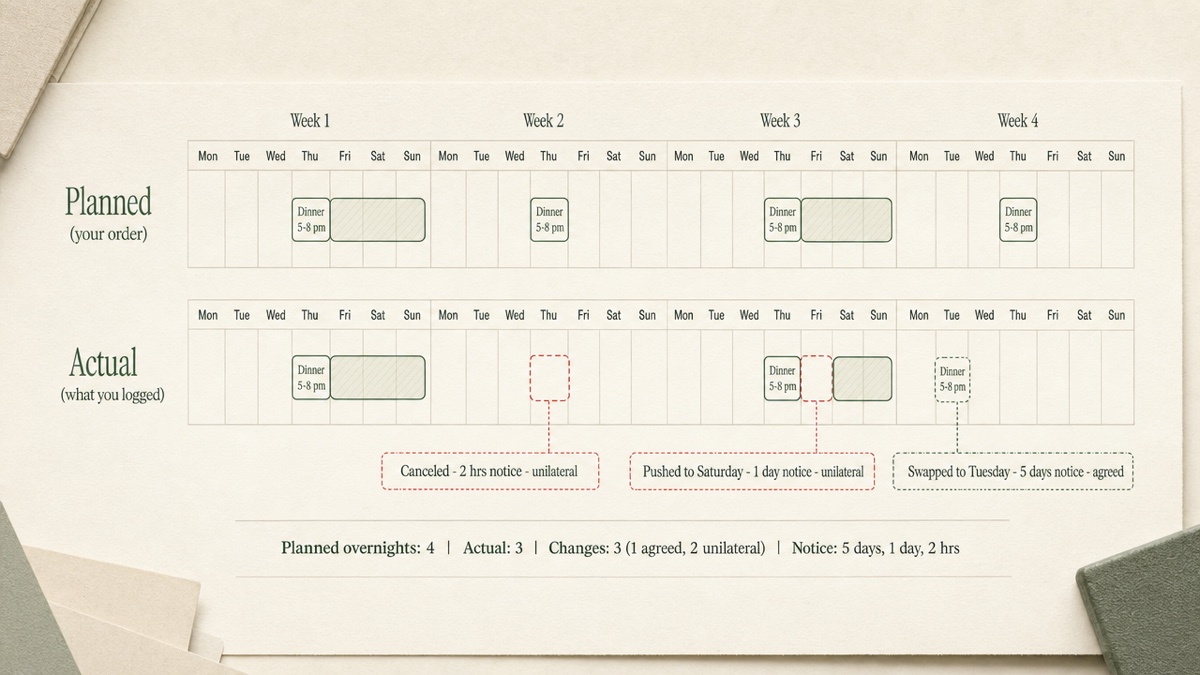
Bring these to your attorney as a summary, with the entries behind it. Don't add conclusions. "Two unilateral changes in March, both with under a day's notice, one overnight lost" is enough on its own.
Keeping the record private
A shared co-parenting app only works if both parents use it. If yours won't, or if every shared space turns into a new argument, keep your own record. It doesn't need their cooperation, and it shouldn't announce itself to them. The general approach is laid out in private custody documentation.
Two cautions:
- Don't delete the original messages. Screenshots are a good working copy. However, each state has its own evidence rules, and screenshots alone don't always meet them. Ask your attorney whether to export your full message history and how to preserve it.
- Record only what you lawfully have access to. Don't read the other parent's accounts or record conversations without asking your attorney first.
When to bring it to your attorney
Don't wait for a perfect record. Reasonable times to call include:
- The changes keep cutting your overnights month after month.
- Make-up time is promised and never delivered.
- The child's school, health, or activities are being affected.
- Your order's wording is vague enough that each exchange turns into a negotiation.
- Your own work or the child's needs mean the schedule truly no longer fits.
Depending on the facts and your state, the options might include asking the court to enforce the existing order, or to clarify or modify it. Your attorney will tell you which applies. Your job is to hand over a record that is dated, consistent, and easy to read.
If you use Custody Proof for this
Custody Proof is a private documentation app for one parent. The other parent is never invited, never notified, and never sees anything you log.
- Your order becomes the calendar. Upload your agreement as a PDF or Word file, or describe the schedule in plain words. You review the pattern week by week before anything saves.
- Plan vs. actual, day by day. The app compares your schedule against what you logged and lists each day that differed, such as a missed overnight or a modified visit. You can mark real deviations as kept, because they're your record. Then confirm the calendar through a date, and reports cite that confirmation.
- Flags and attachments. Flag a change as a violation, write the request time, notice, and reason in the details, and attach the screenshot. Files are encrypted (AES-256). A flag is your own label, not a finding. Flagging notifies no one.
- Numbers. The Statistics page shows violation counts, a Patterns tab, and Plan vs. Actual. Overnights and timed visits are counted separately.
- Reports. The Detailed PDF can include a Planned vs. Actual section, and the Court Packet marks deviations on the calendar.
- Notice deadlines. If your order sets notice dates, add them as in-app reminders.
On the Case Builder plan, Vero can turn a pasted text thread into dated drafts that you review. If a date isn't in your input, Vero asks you for it rather than guessing.
Documentation is $14.75/month or $144/year. Case Builder, which adds Vero, is $29/month or $278/year. Your first charge has a 30-day money-back guarantee.
Frequently asked questions
Should I refuse every schedule change?
Not necessarily. Reasonable, occasional flexibility is normal, and agreeing to fair swaps can reflect well on you. What matters is that every change gets logged and labeled, so the record shows both your flexibility and their pattern. Ask your attorney whether your order sets any notice rules.
Can I skip their next weekend if they keep canceling mine?
Talk to your attorney first. Withholding the other parent's time in response to their changes may be treated as interference, and it can weaken your own position.
Will the other parent know I'm documenting?
Not through Custody Proof. There's no shared account, no invitation, and no notification. If you share a record, you do it yourself by exporting a file.
Are my screenshots enough?
They're a solid working copy. Whether they're enough for court depends on your state's evidence rules. Keep the originals on your phone and ask your attorney how to preserve the full message history.
What if I didn't start logging until months in?
Start now. Add past changes with their real dates and attach the messages you still have. A record that starts late is still far more useful than memory alone.
Keep reading
- How to Document Restraining Order Violations
- Google Calendar for a Custody Schedule: Setup and Limits
- Representing Yourself in Custody Court
- Which custody app fits your situation
Custody Proof is a documentation tool, not a law firm. Nothing on this page is legal advice. Whether and how a record is used in a case is a question for your attorney.