How to track custody schedule swaps so the overnight count holds up
By EJ Archuleta, Licensed attorney · Updated
To track custody schedule swaps, keep three things for every change: the request in writing, the agreement (or refusal) in writing, and the nights as they actually happened on your calendar. Then note the terms, such as "my weekend for your Thursday" or "you'll make it up in July," in plain words next to those nights. If the other parent later says you owe them time, you can check the claim against dated entries.

Most trade-tracking advice assumes both parents approve swaps inside a shared app. Many parents in high-conflict cases don't have that option. The other parent won't join, or joins and then argues anyway. This page covers how one parent can keep that record alone, using ordinary texts and email plus a private log.
This is general information, not legal advice. Custody rules vary by state, so ask your own attorney how they apply to your order.
Ask for a change the way you'd want it read later
Assume every swap request will be read by someone other than your ex: a mediator, an attorney, or a judge. Write it that way.
Reasonable grounds are concrete and child-centered. Examples include a one-time family event, a work trip with fixed dates, a child's tournament or recital, or a medical appointment. "I'd rather have the long weekend" is weaker. A pattern of last-minute requests is weaker still.
Wording that holds up:
- One topic per message, a few sentences, no history lesson.
- Specific dates and times, both for what you're asking and what you're offering.
- Make-up time proposed in the same message, so there is no open debt.
- A clear "yes or no by" date.
- Sent directly to the other parent, not through a new partner or a relative.
A sample:
> "My sister's wedding is Saturday, June 14. Could I have the kids Friday 6/13 at 6 pm through Sunday 6/15 at 6 pm? In exchange, you could have my weekend of 6/27–6/29, same times. Please let me know by Monday 6/9 so we can both plan."
Leave out sarcasm, old grievances, and money, which belongs in a separate message. A calm request that gets refused is still useful to your record. A hostile request that gets accepted can still look bad later.
Get the yes in writing, and save the whole thread
A phone call ending in "sure, fine" is a memory. If the agreement happened by voice, send a short recap the same day:
> "Confirming what we agreed on the phone: I have the kids 6/13–6/15, you have 6/27–6/29. Let me know if I have anything wrong."
This works whether or not the other parent will use any app. If they don't correct it, you have a dated message stating the terms. If they do correct it, you've found the disagreement now instead of in a hearing.
When you save the conversation, capture the full thread: the request, the reply, and any changes. Saving only the final "ok" leaves out the terms. Be aware that phone screenshots alone often don't meet a court's requirements for admitting text messages, and the rules differ by state. Ask your attorney whether they want the full message history exported in a specific format.
Log the swap as it happened, not as planned
Your calendar should show where the children actually slept, not where the order said they would sleep. If you leave the planned weekend on the calendar after you traded it away, your totals are wrong, and anyone comparing them to the texts will notice.
When a swap happens:
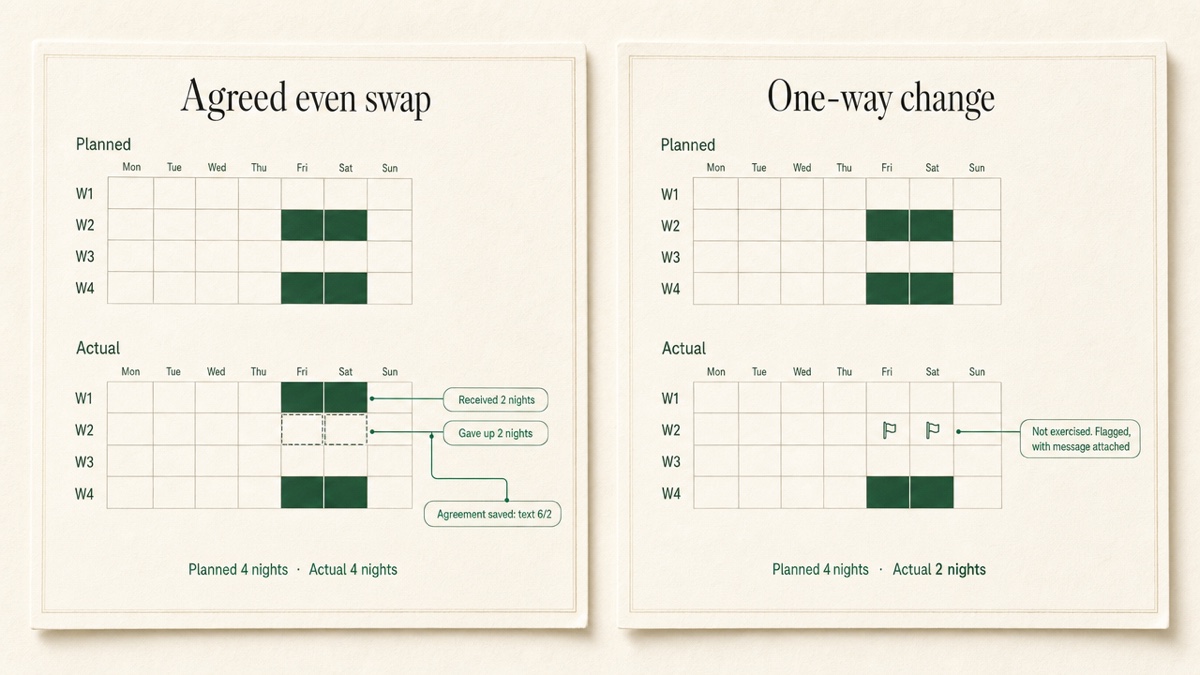
- Remove the nights you gave up and add the nights you received, with real dates. Set each stay's end date to the return morning, because that is how overnights are counted. See how courts count parenting time.
- Attach the agreement to the same dates: the request, the yes, and the recap.
- Write one neutral line of terms, for example: "Agreed swap: 6/13–6/15 to me, 6/27–6/29 to other parent. Even trade, 2 nights each."
How this looks in Custody Proof
Custody Proof has no trade-request feature, and the other parent never sees or receives anything. You log the result yourself.
Once your schedule is saved, the Plan vs. Actual review will show a swapped weekend as days that differ from the plan: a missed weekend in one place and extra nights in another. That is accurate. Use the keep options to mark those days as real. Use "Didn't happen — remove" only for time logged by mistake, never for a trade that happened. Then confirm the period, so your reports show you reviewed it.
Save screenshots or forwarded emails of the agreement in the evidence vault under Communications, dated to the swap. On the Case Builder plan, Vero can turn a pasted text thread into dated drafts that you review before saving. Vero does not guess dates.
Night credits and make-up time: useful, informal, limited
Some parents skip night-for-night trades and keep "credits." I covered your Tuesday, so you owe me one night, to be used later. Others agree on make-up time when a weekend is missed. Either can reduce back-and-forth.
Both have the same weakness: a credit only exists if the terms are written down. If you agree to one, put the details in the confirmation message: how many nights, by when, and who chooses the dates. Log it on your side as a note tied to the original swap.
Know the limits before you rely on one:
- A credit is a private understanding. A credit is a private understanding. Unless it's written into your court order, a court generally isn't bound to enforce it, though a judge might consider it as evidence of what you both agreed.
- Credits that pile up turn into the argument they were meant to avoid. Close them out in weeks, not seasons.
- A parent with limited time often cares most about make-up time. If you're that parent, ask for specific make-up dates in the same message as the swap, not "sometime."
What swaps do to your overnight total
Your overnight percentage is unique nights you logged divided by the days in the period. An even swap moves nights around without changing the total. An uncompensated change does change it.
A worked example: suppose your order plans 146 of 365 nights, which is 40%. One weekend not exercised and not made up removes 2 nights. You're now at 144 nights, about 39.5%. One weekend is minor. Six of them over a year removes 12 nights and brings you to about 36.7%.
That gap matters because overnight counts often feed child-support calculations. Some state formulas use overnight thresholds, and those thresholds vary by state. Your attorney can tell you whether your numbers are near a line that matters.
Holidays and vacation blocks add a complication. They override the regular rotation, so a "swap" made during a holiday period may not be trading the nights you assume. Check what the order says that block replaces before agreeing to a trade or calculating a credit. In Custody Proof, holiday and summer periods are saved as blocks on your schedule. One-off swaps are edited directly on the calendar.
Imposed changes vs. agreed trades: flag the event, not the person
Some changes are agreed. Others are announced: "I'm keeping them this weekend." Your log should make the difference obvious without editorializing.
- Agreed trade: log the actual nights, attach the agreement, and note the terms.
- Imposed change: log what actually happened, flag it as a deviation, attach the message, and write one factual line.
Weak: "He stole my weekend again." Strong: "Scheduled overnights Fri 6/13 and Sat 6/14 not exercised. Message received 6/13, 4:12 pm: 'Not bringing them.' No make-up offered. I replied 4:20 pm asking for make-up dates."
Keep showing up for your scheduled time, and keep a factual record. Attorneys generally advise against self-help in response, such as keeping the child past an exchange to "even it out." That can violate your order and hurt your case. Ask your attorney about formal enforcement options instead. For late pickups and no-shows specifically, see documenting missed visitation and late pickups.
A private swap doesn't rewrite the order
In general, the court order controls parenting time. A written agreement between parents that never became part of a signed order usually has little enforceable weight, though it may show what both parents understood and how they actually behaved. In general, a lasting change to a court-ordered schedule has to go back through the court to be enforceable. Some states and counties require or offer mediation as part of that process.
That has practical effects:
- An agreed swap doesn't give either parent a lasting right to the new pattern.
- If swaps have quietly become the real schedule, such as every Thursday becoming every Wednesday, ask your attorney whether a formal modification makes sense. Repeated informal practice usually doesn't change the order by itself.
What to hand your attorney when trades are disputed
Ask what format your attorney prefers. If they haven't said, bring:
- A detailed report for the disputed period with Planned vs. Actual included. It shows planned nights, missed nights, and extra nights by date, plus your confirmation that the record was reviewed.
- The agreements and refusals, dated and tied to the nights they affected. An evidence report keeps them in order.
- A short list of the entries that are actually disputed: date, what you logged, what the other parent claims, and what supports your entry. This helps your attorney most. It turns "they say I owe nights" into specific dates to check.
- A CSV of your events, if your attorney works in spreadsheets.
Custody Proof stays private to you. You can start logging swaps today, including past ones with their real dates. Start your record. Plans start at $14.75/month, with a 30-day money-back guarantee on your first charge.
Frequently asked questions
Will the other parent know I'm logging our swaps?
No. Custody Proof is used by one parent only. There is no invitation, no shared account, and no notification. If you share your record, you export a file and hand it over yourself.
Do I have to agree to a swap the other parent requests?
That depends on your order and your circumstances. Many orders don't require it, but how a refusal looks later can matter. Ask your attorney. Either way, reply in writing, briefly and neutrally, and save the exchange.
Will a judge make the other parent honor night credits we agreed to?
Don't count on it. Informal credits are private arrangements, and how a court treats them varies. A written record of the terms is still worth keeping, because it shows what was agreed.
Can I go back and log swaps from earlier in the year?
Yes. Enter the nights with their real dates and attach any messages you still have. If you've saved a schedule, the Plan vs. Actual review will show the differences so you can mark each one as real.
Does an even trade change my overnight percentage?
Not if it is truly even within the period you're measuring. Two nights given up and two received leaves the total the same. If the make-up nights fall in a different month or year, each period's percentage will shift even though the overall trade balanced out.
Keep reading
- How to Respond to Hostile Texts From Your Ex
- Court-Ready Custody Report: What to Include
- 60/40 Custody Schedule Examples and the Overnight Math
- Which custody app fits your situation
Custody Proof is a documentation tool, not a law firm. Nothing on this page is legal advice. Whether and how a record is used in a case is a question for your attorney.