Legal abuse in family court: how to document a pattern of filings
By EJ Archuleta, Licensed attorney · Updated
Legal abuse in family court is when one parent uses the court process itself to drain the other parent's money, time and stability, instead of resolving a real dispute. You cannot stop the filings yourself, but you can make the pattern visible: for every filing, log the date you received it, what it was, the hearing, the outcome, what it cost you and what it did to the parenting schedule, then give that timeline to your attorney. It usually looks like repeated motions, contempt filings without cause, endless delays and discovery requests aimed at embarrassment.

One motion is litigation. Six motions in a year, each denied, each landing on a Friday afternoon, is a pattern. A judge can only see a pattern if someone lays it out.
This page is general information, not legal advice. Talk to a family law attorney licensed in your state about your own case.
What it tends to look like
Court training materials on domestic violence describe a recognizable set of tactics. In general terms:
- Repeated motions to modify the parenting plan, child support or a protective order, often with no real change in circumstances.
- Contempt motions without cause, so you spend each hearing defending yourself.
- Requests for mental health evaluations meant to paint you as unfit.
- Frivolous motions for reconsideration, revision or appeal of orders already decided.
- Discovery used as a weapon: requests for embarrassing or irrelevant records.
- Delay: repeated continuances, or changing attorneys to restart the clock.
- Refusing to follow orders, which forces you to pay for enforcement.
- Running up legal costs, sometimes to push you to the point where you can't afford a lawyer.
The timing is often part of the tactic. A filing served late on a Friday or just before a holiday means you sit with it for days before anyone can answer your questions.
This can happen before or after a final order, and whether or not either parent has a lawyer. The cost is real. Parents who can't keep paying sometimes give up support claims or accept worse terms just to make it stop. The longer-term harm reaches mental health, job stability and the children.
Why a timeline does more than a description
"They keep dragging me back to court" is a complaint. "Seven filings in fourteen months, five denied, two withdrawn the day before the hearing" is a record.
Your attorney may already have the pleadings. What they often lack is everything around them: the day you were served, the shift you missed, the weekend that got cancelled, the invoice. That context is what turns a stack of paper into a pattern.
The filing log
Keep one row per filing. A spreadsheet works. So does a notebook, as long as you keep it current. Suggested columns:
| Column | What to write |
|---|---|
| Date received | The day you were served or saw it. Note the filing date too if it differs. |
| How received | Served in person, by mail, e-filed notice, forwarded by your attorney |
| Filing type | Motion to modify, contempt, emergency motion, discovery request, continuance |
| What it asks for | One plain sentence |
| Hearing date | Every setting, including ones that were reset |
| Outcome | Granted, denied, withdrawn, continued, pending |
| Your fees | From your attorney's invoice for this filing |
| Work time lost | Hours or days, and whether paid or unpaid |
| Parenting time affected | Dates of any missed, moved or shortened time |
Some tips on filling it in:
- Write the outcome every time. A long list of motions with no outcomes proves very little. A long list of denials says a great deal.
- Record continuances as their own rows. Delay is part of the pattern, and a hearing reset four times is its own story.
- Keep the filing attached to the row. "Contempt motion, March" means nothing without the document.
- Stick to facts. No adjectives and no guesses about motive. Your attorney will argue motive. Your log records what happened and when.
Tracking fees and time off work
Money is often the target, so track it carefully.
- Ask your attorney for detailed monthly invoices that break out time by task. That lets you assign costs to specific filings instead of reporting one large total.
- Log every hour away from work for hearings, depositions, evaluations and attorney meetings. Note whether you used vacation time, took unpaid leave or lost a shift.
- Keep the paper trail behind each number: pay stubs, leave records, childcare receipts for hearing days, mileage.
Whether a court can order any of this repaid depends on your state and on what the court finds about the filings. Raise it with your attorney early, so the records exist if the question comes up. For a sense of how fees accumulate, see attorney fees in custody cases.
Linking each filing to the schedule
This is the step most people skip, and it is often where the effect on the child shows.
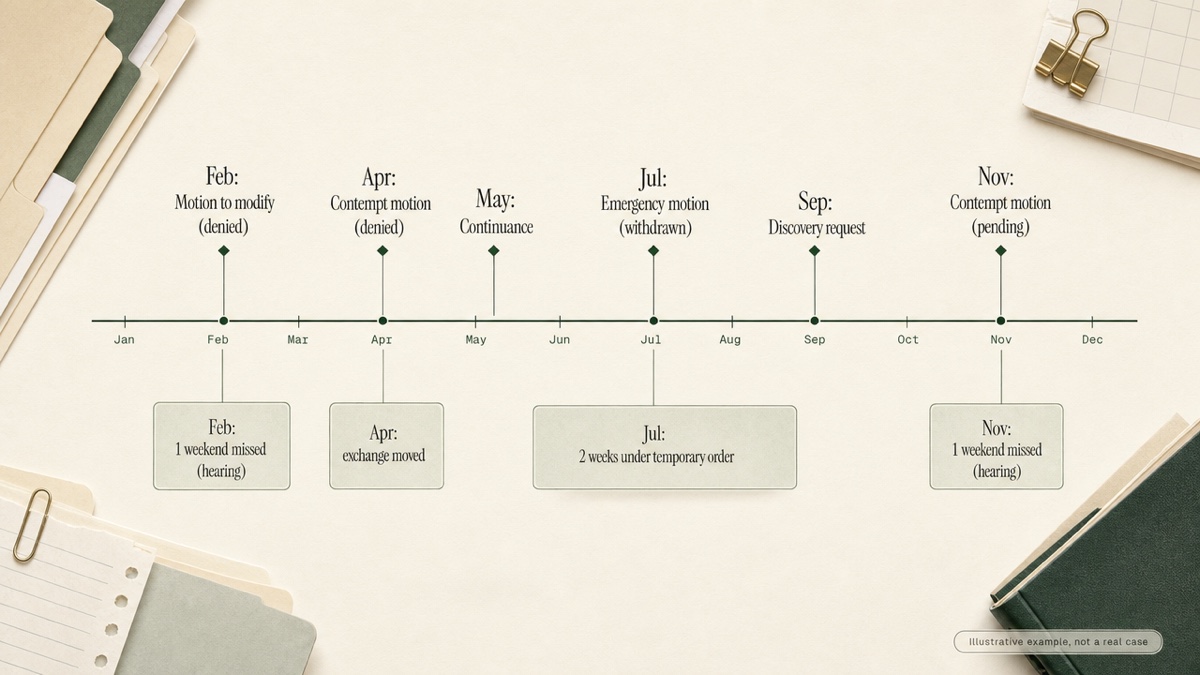
For each filing, check what happened to parenting time around it:
- Did a hearing or evaluation fall on your weekend or your exchange day?
- Did a temporary order change the schedule, and for how long before it was reversed or denied?
- Did the children miss school, activities or appointments to attend an interview or evaluation?
- Did exchanges go wrong in the days after a filing?
Mark those dates in your filing log and on your custody calendar. Over months, the overlap between filings and disrupted time becomes something you can show instead of something you have to describe.
Respond through your attorney, not in the moment
A filing is designed to provoke a fast, emotional reaction. Deny it that reaction.
- Read it once. Write down the date you received it and any deadline or hearing date you can find.
- Send it to your attorney the same day. Ask what the response deadline is. Don't calculate it yourself, because deadlines vary by court and type of filing.
- Don't answer the other parent. No texts arguing the merits, no posts, no explanations at exchanges. Anything you write in anger can become an exhibit.
- Put every hearing date where you'll see it. Confirm settings through your attorney or the court clerk, since hearings get reset.
- Ask about logistics. Your attorney can tell you whether remote appearance or being excused from certain hearings is possible where you are.
Staying steady
Coping is part of the case. A parent who stays calm through the tenth filing is easier to represent and easier to believe.
- Expect the timing. If filings arrive Friday evening, decide in advance that you'll read them, log them and set them down until Monday.
- Set a window for legal mail. You don't have to open everything the moment it lands.
- Prepare before court. Know the hearing's purpose, what you might be asked and when to stay quiet.
- Bring someone. A trusted friend or relative in the courtroom helps.
- Get support that isn't your lawyer. A therapist, counselor or support group costs less per hour and is built for this. Your attorney's time is better spent on strategy.
- Use the log as a container. Once something is written down, you don't have to keep rehearsing it.
If the litigation is part of broader abuse or you're worried about your safety, the National Domestic Violence Hotline offers confidential support.
Talking to your attorney about remedies
Many courts have some way to respond to filings brought without a reasonable basis or in bad faith. Depending on the state, that can range from ordering one side to pay the other's fees to placing limits on future filings or discovery. These tools vary widely, often require a specific record, and are not automatic.
Questions to bring to your attorney:
- Which options exist in our court for repetitive or baseless filings?
- What would a judge need to see before considering them?
- Is my log in a form you can use, and what should I add?
- Should we ask for fees, lost wages or costs, and when?
- Can anything reduce how often I have to appear?
Keeping this record in Custody Proof
Custody Proof is private documentation software for one parent. The other parent is never invited or notified. It doesn't track court dockets. Here is how it can hold the parenting side of this record:
- Custody calendar with planned vs. actual. Upload your order or describe your schedule, then log what really happened. Missed and changed nights show against the plan, which makes the overlap with filings concrete.
- Violations. Flag disrupted exchanges on the dates they happened.
- Evidence vault. Save each served filing, hearing notice and related message as a dated entry with the PDF or screenshot attached. Files are encrypted before storage.
- Deadlines & Reminders. Add hearing dates and deadlines your attorney gives you as one-time reminders.
- Exports. Hand your attorney PDF reports or the Court Packet, with deviations listed by date. See how to document custody for court.
Documentation is $14.75/month or $144/year. Case Builder, at $29/month or $278/year, adds Vero, the AI assistant. Vero turns a pasted message or screenshot into a dated draft you review before saving. Start your record.
Frequently asked questions
Is "legal abuse" a legal term?
Not usually as a formal claim. It's a descriptive term used by advocates, researchers and court training materials for using litigation to control or exhaust a former partner. Courts deal with the conduct through their own rules, which vary by state. Your attorney can tell you which rules apply where you live.
Can I get my attorney fees back?
Sometimes, depending on your state, the type of filing and what the court finds. It's never guaranteed. Keep itemized invoices and work-loss records so the question can be raised if it applies.
Should I reply when my ex texts about a motion?
Talk to your attorney before you say anything about pending litigation. Many parents keep messages limited to the children and logistics. Save what you receive.
Does Custody Proof track court filings?
It has no docket feature. You can store each filing as a dated evidence entry with the document attached and add hearing dates as reminders. Your custody calendar then shows how parenting time actually went around those dates.
Will a log like this be accepted in court?
That depends on your jurisdiction and your case, so ask your attorney. A dated, factual log is mainly useful because it gives your attorney organized material to work from.
Keep reading
- What to Do Before Separation With Kids
- What Is a Guardian ad Litem? Role, Interview, Records
- Digital Safety During Divorce: Protect Accounts and Records
- Which custody app fits your situation
Custody Proof is a documentation tool, not a law firm. Nothing on this page is legal advice. Whether and how a record is used in a case is a question for your attorney.