How to Prepare for Child Custody Court: A Record-First Checklist
By EJ Archuleta, Licensed attorney · Updated
To prepare for child custody court, do five things in order. Respond to the papers on time, and get a family law attorney involved early. Write a specific proposed parenting plan. Organize a dated record of parenting time, incidents, and expenses, along with any school and medical records. Then show up early, dressed plainly, ready to answer questions briefly and calmly.

Most guides spend their effort on the last step: what to wear, when to stand, what to call the judge. Those things matter. But a hearing is short, and the judge decides on what is put in front of them. A parent who arrives with a clean, dated record usually has more to work with than a parent with a strong speech and a phone full of screenshots.
This page is general information, not legal advice. Custody procedure varies by state and sometimes by county, so take questions about your own case to a qualified family law attorney where you live.
The custody process, in general terms
The order and the names change from state to state. The broad shape is usually similar:
- Filing. One parent files a petition or complaint asking the court to set or change custody.
- Service. The other parent is formally served with the papers.
- Response. The served parent files an answer, and sometimes a counter-request, within a set deadline.
- Temporary orders. Some cases have an early hearing to set a schedule while the case is pending.
- Mediation or other alternative dispute resolution. Many courts require or strongly encourage it before a contested hearing, though a court may excuse it in some situations, such as when there has been abuse.
- Evaluation. In some cases the court orders a custody evaluation or appoints someone to look into the child's situation.
- Final hearing or trial. If the parents don't agree, a judge decides based on the child's best interests.
- After the order. Parents can return to court to enforce the order or to ask for a change.
If the parents reach an agreement, many courts will turn it into an order without a contested hearing, after a judge reviews and approves it.
Step 1: Respond on time and get counsel
If you've been served, find the response deadline before you do anything else. Response windows are often a matter of weeks, they differ by state, and the type of paper you received can mean a court date has already been set.
Missing the deadline can mean the judge decides custody without hearing from you.
Talk to a family law attorney as early as you can, even if money is tight. Some lawyers offer limited-scope help, such as reviewing your response or preparing you for one hearing. Ask about that if full representation isn't possible. For a sense of how fees add up and where organized records can reduce them, see what custody attorneys cost.
Bring these to the first meeting:
- Every paper you were served, plus any existing orders.
- A one-page summary: the children's names and ages, the current schedule, and what you're asking for.
- Any deadlines written in your current order, such as notice dates for summer or holidays.
Step 2: Draft or review a proposed parenting plan
A vague request like "reasonable visitation" gives the judge nothing concrete to order. A specific plan does. Court self-help guidance commonly recommends spelling out:
- Regular weekdays and weekends, with exchange times.
- Exchange locations and who handles transportation.
- Holidays, school breaks, and summer, including which years alternate.
- How decisions about school, health care, and activities get made.
- How the parents will communicate.
If the other side has proposed a plan, compare it line by line against what actually happens now. A plan that looks fair on paper can quietly cut your weekends or move your exchange time. Mark the differences and bring them to your attorney.
Count your proposal in overnights, the unit courts commonly use. A Friday-to-Sunday weekend is two nights, not three days. The math is explained in how courts count parenting time.
Step 3: Build the record
Your attorney needs facts tied to dates, not general impressions. "They're always late" is a description of character. "Pickup was scheduled for 6:00 and happened at 7:35 on March 3, 10, and 24" is evidence.
A timeline of events
Keep one chronological list. Each entry should have:
- The date and time.
- Who was there.
- What happened, described plainly.
- Whether a police report, school note, or medical visit followed.
Write entries the same day if you can. Stick to what you saw and heard, and leave out your conclusions about why it happened.
Parenting time actually exercised
Compare what the current order says with what really happened, night by night. Log overnights and daytime visits separately. A Wednesday dinner is real parenting time, but it isn't a night, and mixing the two makes your numbers easy to attack.
Record the weeks that went as planned, too. A record made only of exceptions has no baseline to measure them against.
Violations
Log late pickups, missed exchanges, refused calls, and withheld time as separate dated entries. Attach whatever supports each one, such as a text or a photo of the clock at the exchange spot. If the same problem keeps happening, the dates will show the pattern without you having to argue it.
Expenses
If your order or agreement shares child costs, keep a ledger for each expense:
- Date and amount.
- Vendor.
- Receipt.
- The other parent's share.
- What has been paid back.
Whether a cost is actually shared depends on your order. Your attorney can interpret that. Details are in how to track unreimbursed child expenses.
Texts and other digital messages
Screenshots are evidence only when someone can tell what they are. To make them usable:
- Capture the date and the sender in the frame.
- Keep the whole exchange, not just the one line that helps you.
- Never edit, crop out context, or reorder messages.
- Keep the original files.
- Attach each screenshot to the timeline entry it supports.
If you have message exports from any service, save the full export file along with your summary.
Ask your attorney how messages should be presented in your court.
For the full documentation method, see how to document custody for court.
Step 4: Witnesses and third-party records
Evidence generally reaches a judge in two forms: witness testimony and exhibits. Records kept by neutral third parties often carry weight that a parent's own account does not.
Records worth requesting:
- School attendance and tardy records.
- Report cards and teacher communications.
- Pediatrician and therapy records.
- Records from activities.
Request them weeks ahead. Offices are slow, and some records need a formal process before a court will consider them.
In some courts, medical or business records come in through certified copies from the records custodian. In others, the custodian has to be subpoenaed to testify. An attorney can tell you which route your court uses and how much lead time to allow; if you don't have one, ask the court's self-help center.
Witnesses: Pick people who saw specific events, such as a coach, a teacher, a neighbor at exchanges, or a relative who regularly helps with pickups. Choose them over people who will only vouch for your character. Give your attorney each witness's name and contact information, plus one or two sentences on what they saw and when. Don't script their testimony.
As a rule, leave a new partner at home. Their presence can raise tension in the room.
Step 5: What to hand your attorney, and when
The timing below is general. Your attorney's instructions override it.
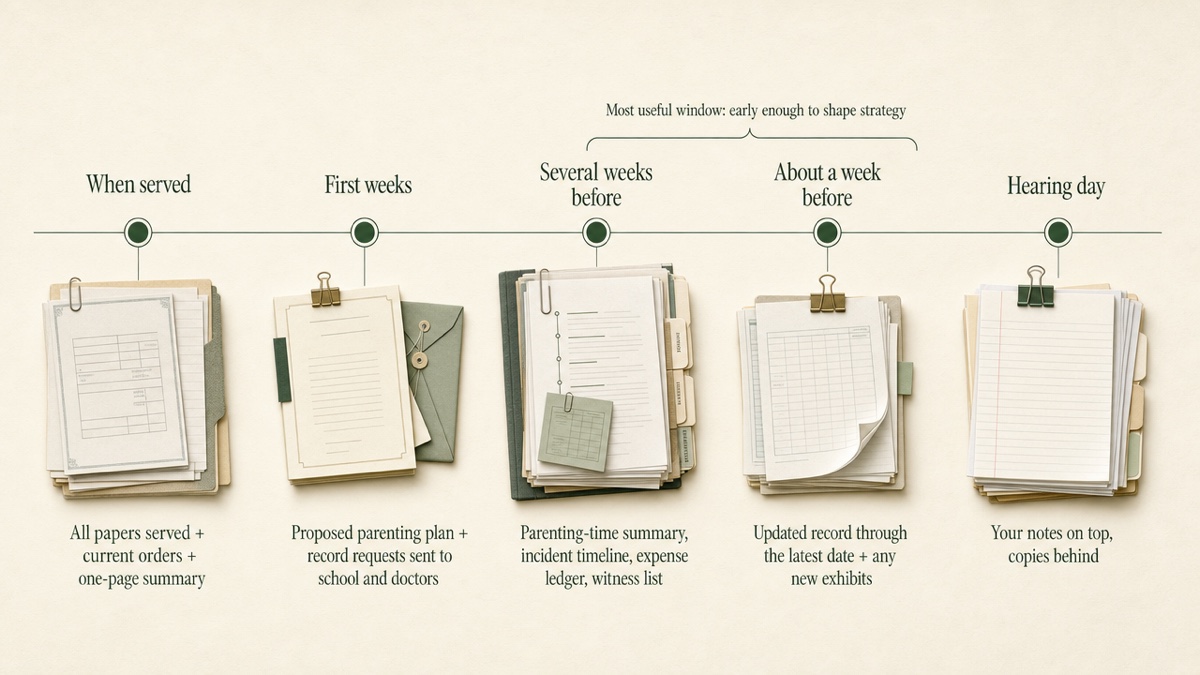
The handoff, in a sensible order:
- A one-page summary of parenting time for the relevant period, with overnight totals.
- A detailed report: the full tables, with a planned-versus-actual comparison if the dispute is about who followed the schedule.
- An expense report with receipts labeled as exhibits.
- An evidence report that ties each file to a date and an event.
- The underlying files, but only if your attorney asks for them.
- A witness list and status updates on your record requests.
Send updates as new events happen, and send one final update through the most recent date shortly before the hearing. The reports and exports guide walks through this same order.
Step 6: The day of the hearing
Arrive early. Thirty minutes is a common recommendation. Check in with the clerk. Several cases are often set for the same time and called in any order, so plan for a long wait. Arrange childcare and time off work for the whole day.
Dress plainly. Business attire if you can, otherwise clean, conservative clothes. A collared shirt, slacks, or a dress with sleeves all work. Skip hats, shorts, tank tops, and clothing with slogans or images.
Conduct:
- Turn your phone off, not just to silent.
- Don't interrupt anyone, especially the judge.
- Address the judge as "Your Honor."
- Stand when speaking if that's the courtroom's custom.
- Speak loudly and clearly.
- Don't react to the other parent's testimony, whether by sighing, shaking your head, or muttering.
What to say. Answer the question you were asked. Give the short version, then stop. Talk about the children, not about the other parent's character. If you don't know or don't remember, say so. A confident guess that the other side's records contradict will hurt you more than an honest "I don't know."
What to bring. Your notes on top, then organized copies of your exhibits, the papers the other parent filed, and your current order. If you need an interpreter or a disability accommodation, ask the court ahead of time.
Expectations versus reality
Many parents expect a full day to tell the whole story and a ruling that confirms what they've been through. What usually happens is different:
- Hearings are short. Time limits are common, so put your issues in order of importance. The last items may never get heard.
- The judge considers only what is presented. Something left out may not be easy to raise later.
- Many first hearings produce temporary orders. These hold things in place while the case continues, rather than ending it.
- The question is the children's best interests. The hearing is not a verdict on which parent behaved worse.
- Many cases settle or narrow in mediation. A strong record still matters there, because it shows the other side what a hearing would look like.
- An order isn't the end. If it's violated, the remedy is enforcement through the court. The same dated record supports that next step.
You may not get the emotional resolution you want. What you can control is arriving with facts that are dated, organized, and easy for your attorney to use.
Keeping the record without the other parent
Custody Proof is a private documentation tool for one parent. The other parent is never invited or notified.
- Schedule: Upload your order or describe the schedule in plain words. It becomes a calendar you review week by week before anything saves.
- Parenting time: Overnights and timed visits are logged separately.
- Plan versus actual: The app compares your schedule with what you logged, and you can confirm the record as you go. Your reports then show a "Confirmed through" date.
- Violations and evidence: Flag violations, and store photos and screenshots in an encrypted vault, each attached to the event it belongs to.
- Expenses: Keep a child-expense ledger with receipts.
- Reports: Export PDFs and CSVs, or the Court Packet, which combines a plain-English summary, color-coded calendars, deviations flagged in red, and a chronological journal. You hand the files to your attorney yourself.
The Documentation plan is $14.75/month or $144/year. Case Builder, at $29/month or $278/year, adds Vero, an AI assistant that turns voice notes, pasted texts, and photos into dated drafts you review before saving.
Start your record well before your hearing date.
Frequently asked questions
What should I bring to custody court?
Bring your notes, your current order, the papers the other parent filed, and organized copies of your exhibits: a parenting-time summary, an incident timeline, an expense ledger with receipts, and any third-party records. Ask your attorney how many copies the court expects.
Is it too late to start documenting if my hearing is soon?
No. Enter past events with their real dates and attach the evidence you already have. A record built from existing texts, receipts, and calendars is far more useful than none. Be honest about which entries you wrote down later and which you wrote at the time.
Will the judge read everything I bring?
Probably not. Time is limited. That's why a one-page summary and clearly labeled exhibits matter: they let your attorney point to exactly the page that proves a point.
Can Custody Proof file documents with the court or send them to my lawyer?
No. Custody Proof creates files that you export and hand over yourself. Filing is handled by you or your attorney.
Will the other parent see what I log?
No. There is no shared account, no invitation, and no notification. Nothing leaves your account unless you export it.
Keep reading
- Co-Parent Lying About You in Court? Answer With Records
- Contempt of Court for Custody Violations: What to Document
- Legal Abuse in Family Court: Document the Pattern
- Which custody app fits your situation
Custody Proof is a documentation tool, not a law firm. Nothing on this page is legal advice. Whether and how a record is used in a case is a question for your attorney.