When Your Co-Parent Lies About You in Court: Answer With Records
By EJ Archuleta, Licensed attorney · Updated
If your co-parent is lying about you in court, the most useful response is usually not a reply to them. It is a dated record your attorney can put next to the claim: what the order said would happen, what actually happened, and the original messages or photos from that day. A calm record answers a false story far better than an angry correction.

This page explains what that record looks like, how to write entries a judge can trust, and what to hand your attorney so their time goes to your case and not to sorting your phone. It is written by a family lawyer, but it is general information, not legal advice. Your own attorney should guide any decision about your case.
First, don't answer the lie where it was told
When someone says something false about you, the instinct is to fix it right away. You send a long text. You write a paragraph in the custody app. You correct them in the hallway outside the courtroom.
Each of those can become an exhibit against you. A furious message at 11 p.m. shows a judge the anger the other side said you have. The accusation was a claim. Your outburst is evidence.
Point-by-point rebuttals carry a quieter risk. When you correct every small misstatement, you can pull the court away from the issues that matter and end up looking defensive. Many false narratives are built from small things, like a minor schedule change recast as "refusing to cooperate." You don't win by litigating each one. You win by having the dates ready when one of them matters.
The goal is to come across as calm, prepared, respectful, and correct. You are allowed to feel the anger. Just don't send it.
Facts vs. conclusions: how to write an entry a judge can trust
A judge reading your log is asking one question: can I rely on this? Conclusions make that harder. Facts make it easier.
Compare:
- Conclusion: "He was manipulative again and turned our daughter against me."
- Fact: "Sat. March 8, 6:15 p.m., exchange at the school parking lot. He said to our daughter, 'Your mom didn't want you this weekend.' She asked me in the car if that was true. I said, 'I'm glad you're here.' No one else present."
The second entry gives the reader something to check. It records five things:
- The date and time.
- Exact words, in quotation marks, where you remember them exactly.
- What the child said or did.
- The location and any witnesses.
- Your own response, stated plainly.
Leave out motive, diagnosis, and adjectives. "Manipulative," "narcissist," and "unstable" are conclusions for the judge to draw, not for you to assert. Evaluators often listen for what a parent is trying to accomplish with their words, so an entry that reads like an argument can undercut itself. An entry that reads like a log does not.
Contemporaneous entries beat reconstructed memories
An entry written the same evening carries more weight than a summary written three months later for a hearing. Memory drifts. Details merge. Under cross-examination, "I'm pretty sure it was the second weekend in March" is easy to pick apart.
Write it down the day it happens, with the real date. If you are catching up on past events, enter them with their actual dates and note that you are recording them later. Don't present a reconstruction as a diary. Honesty about when you wrote something is part of what makes the rest believable. More on why this matters: records, not memories.
Let your parenting-time record answer claims about absence or lateness
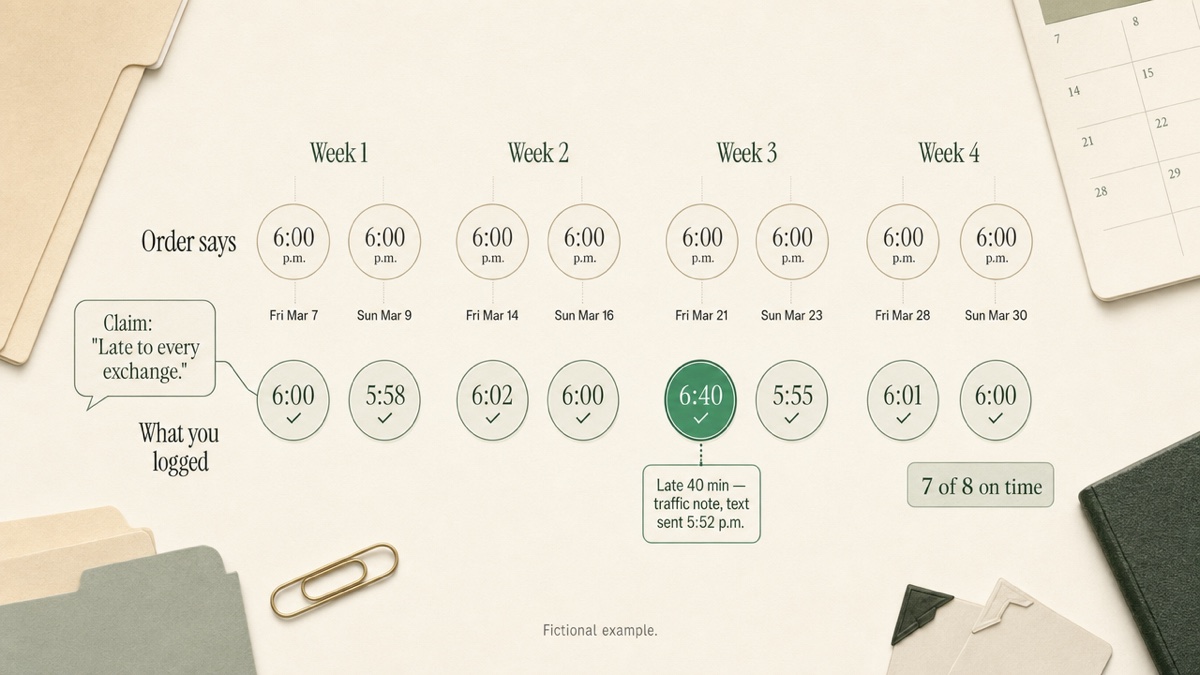
Many false claims come down to time. "He never shows up." "She's late to every exchange." "I've had the kids almost every night since January."
Those claims can be measured. The answer is a record of what the order required compared with what you logged:
- Overnights, counted as nights the child slept at your home, not calendar days touched. A Friday-to-Sunday weekend is two nights. See how this is commonly counted in missed visitation and late pickups.
- Exchanges, with the time you arrived and the time the child was handed over.
- Missed or extra time, flagged on the date it happened, with a short note on why.
When the other side says "every," your record says "one out of eight." That is far more persuasive than "that's not true."
Keep originals, not just screenshots
Screenshots are convenient, and they are often where people stop. They can also be the weakest form of a message. Each state has its own evidence rules, though many closely follow the federal rules. Courts often accept screenshots when someone with personal knowledge can explain where they came from and who sent them. A single screenshot that leaves out the rest of the conversation, or that can't be tied to the person who wrote it, is easier to challenge. Ask your attorney early what format they need.
Practical habits that help regardless of where you live:
- Keep the full conversation, not one message. A single text rarely shows the context, and a pattern of harassment is usually a series of messages. When you screenshot a thread, scroll only halfway between captures so the bottom of one image is the top of the next.
- Capture the sent time. On many phones you have to tap or swipe a message to show its exact time. Note the date you captured it, too.
- Export or back up texts with phone-export or backup software, so your attorney has more than images.
- Save emails as PDFs with full headers, which show sender information that can help establish who sent it.
- Keep the original photo file, not a cropped or edited copy. The original usually carries its capture date.
- Never alter, crop out, or delete anything, including parts that don't flatter you.
Record the quiet weeks
This is the part almost everyone skips. People document the bad weekends and leave the rest blank. Then the other side says "he's never there," and the record has nothing to show the forty exchanges that went fine.
Normal compliance is evidence. A weekly confirmation that the schedule went as planned builds a baseline: on-time exchanges, overnights kept, calls made. Against that baseline, an accusation of chronic absence has to explain a long, dated stretch of ordinary weeks. Isolated complaints are easy to dismiss. A consistent record over months is not.
It takes thirty seconds a week. It is the entry that does the most work later.
What to hand your attorney, and when
Attorneys bill for time, and sorting a client's camera roll is time. If you send 400 unlabeled screenshots, you are paying someone to do what you could have done for free. More on this: how documentation affects attorney fees.
When you learn of the allegation, contact your attorney promptly. Then send, in this order:
- A one-page summary of the claim and the period it covers.
- Your parenting-time record for that period, showing planned versus actual overnights and exchanges.
- A chronological list of dated entries related to the claim, each with its attachments labeled.
- The underlying files, only if your attorney asks for them.
Filter to the dates that matter. A three-month record that answers a specific claim is worth more than your whole history. For the structure of a full packet, see how to document custody for court.
Ask your attorney what they want before you build it. Some prefer spreadsheets. Some want PDFs. Their preference wins.
Protect yourself: brief replies and grey rock
You don't control what the other parent says. You do control how much of it you absorb and answer.
Grey rock means making your replies as flat and uninteresting as possible. No emotion, no defense, no history lesson. If a message needs an answer, answer the logistics and stop:
- "Received. Pickup is still 6 p.m. Friday at the school."
- "I have a different recollection. I'll be at the exchange as scheduled."
Reply within a reasonable time, keep every message respectful, and if you agree to something by phone, confirm it in a short message afterward. Then log the exchange.
Prolonged litigation wears people down, and a parent who is exhausted is more likely to send the message they regret. A therapist, a support group, or a trusted friend is not a luxury here. Talk to them, not to the other parent, about how unfair it is.
When documentation isn't enough
A record is for proving what happened. It is not a substitute for acting when someone is in danger.
- If a child or you is in immediate danger, call 911. Write the entry afterward.
- If you have genuine safety concerns about the child, tell your attorney right away and ask whether to contact law enforcement or child protective services. Don't wait for a pattern to build.
- If an allegation has been formally filed against you, or you are contacted by a caseworker or evaluator, call your attorney before you respond.
If allegations turn out to be knowingly false, courts in many places can respond with credibility findings, fee awards or other consequences. The rules differ by state, and courts usually require clear proof of deliberate falsehood, not just a claim that wasn't proven. Whether any of that is realistic in your case is a question for your attorney, not a goal to plan your documentation around. Document to be accurate, not to set a trap.
Where Custody Proof fits
Custody Proof is a private documentation tool for one parent. The other parent is never invited and never notified. You log overnights and timed visits separately, flag missed or late exchanges on the date they happened, and attach the original photos, screenshots, and PDFs to the entry they belong to in an encrypted vault.
When your order is on the calendar, the app compares the plan against what you logged and lets you confirm weeks that went as planned. Reports show both the numbers and a "Confirmed through" date. When your attorney needs something, you export a filtered PDF for the period that matters. On the Case Builder plan, Vero can turn a pasted thread or a voice note into a dated draft you review, and she leaves the date blank rather than guessing.
Documentation is $14.75/month or $144/year. Case Builder, with Vero, is $29/month or $278/year. Your first charge carries a 30-day money-back guarantee.
Frequently asked questions
Should I reply to the message where my co-parent accused me?
Usually only if the message needs a logistical answer, and then briefly. Don't argue the accusation in writing. Save the message, log it with its date, and send it to your attorney. Your attorney can decide whether and how it should be answered.
Will the other parent know I'm keeping a record?
Not through Custody Proof. There is no shared account, invitation, or notification. If you share your record, you do it by exporting a file and handing it to your attorney yourself.
Will my records be accepted in court?
That depends on your state's rules, your judge, and how the records are presented. A clear, dated record with originals gives your attorney better material to work with. Whether a specific item can be used is their call.
I didn't document anything before the accusation. Is it too late?
No. Start today with real dates going forward. Add past events you can support with texts, photos, or receipts, using the dates they happened, and be candid that you recorded them later.
Can I get my legal fees back if the allegations are proven false?
Sometimes courts award fees or make other findings when claims were made in bad faith, but this varies widely by state and by case. Ask your attorney whether it applies to yours.
Keep reading
- Contempt of Court for Custody Violations: What to Document
- Legal Abuse in Family Court: Document the Pattern
- What to Do Before Separation With Kids
- Which custody app fits your situation
Custody Proof is a documentation tool, not a law firm. Nothing on this page is legal advice. Whether and how a record is used in a case is a question for your attorney.