How to Modify a Custody Agreement and Document Changed Circumstances
By EJ Archuleta, Licensed attorney · Updated
There are two general ways to modify a custody agreement or order. Both parents can agree to new terms and ask the court to approve them, or one parent can file a request to modify and the court decides. In a contested case, the parent asking for the change usually has to show two things: there has been a substantial or material change in circumstances since the last order, and a different arrangement would serve the child's best interests. The exact standard and wording vary by state..

Filing is the paperwork. The evidence is what the court weighs. This page covers the second part: what a record of changed circumstances looks like, why months of consistent entries carry more weight than a list of grievances, and what to bring when you first meet with an attorney.
This is general information, not legal advice. Custody law varies by state, so take questions about your own case to a family law attorney licensed where your order was entered.
Two routes: agreed modification or contested petition
Agreed modification. If both parents accept the new terms, they can usually put the agreement in writing and submit it for the court's approval. Courts often still review agreed changes, and a judge may ask questions or set a hearing before signing.. Informal side agreements that never reach the court generally don't change the order you can enforce.
Contested petition. If you can't reach agreement, or you don't expect to, one parent files on their own. The court hears evidence and decides. Some states require a written showing of specific facts before a full hearing is set..
You can't plan around agreement. If the other parent might cooperate, good. Build your record as if they won't, because the same record supports either route. An agreed modification negotiated from a documented pattern tends to be more specific than one built on memory.
What "change in circumstances" generally means
In plain English, it means something meaningful is different now from when the current order was entered. Many courts also ask whether the change affects the child. A new job across town may count. A parent who stopped showing up for scheduled time may count. Ordinary friction usually does not, although ongoing conflict that harms the child or interferes with parenting time may..
Changes courts commonly hear about include:
- A parent moving to a new community.
- A child's school or educational needs changing.
- A parent remarrying or a new household member.
- Safety concerns about who the child is around.
- One parent repeatedly not following the existing schedule.
Two general points recur across states. The change usually has to have happened after the last order, or be something the court didn't know about at the time. The burden is on the person asking for the change.. Your record should therefore start from the date of the current order, not from the beginning of the relationship.
Why months of pattern beat a single bad weekend
One missed weekend is an event. Eleven missed weekends out of twenty-six is a pattern. A court deciding whether the current arrangement works is asking about the pattern.
A single incident invites an explanation: traffic, a sick child, a misunderstanding. A pattern recorded consistently over months is harder to explain away. That's not because each entry is dramatic. It's because the entries are dated, alike in form, and made close to when things happened.
The opposite is also true. A record that only appears in the two weeks before filing reads as preparation for litigation, not documentation. Start when you first suspect the order isn't working, and keep going on the uneventful weeks too. Those weeks are your baseline. More on why entries made at the time outlast recollection: Records, not memories.
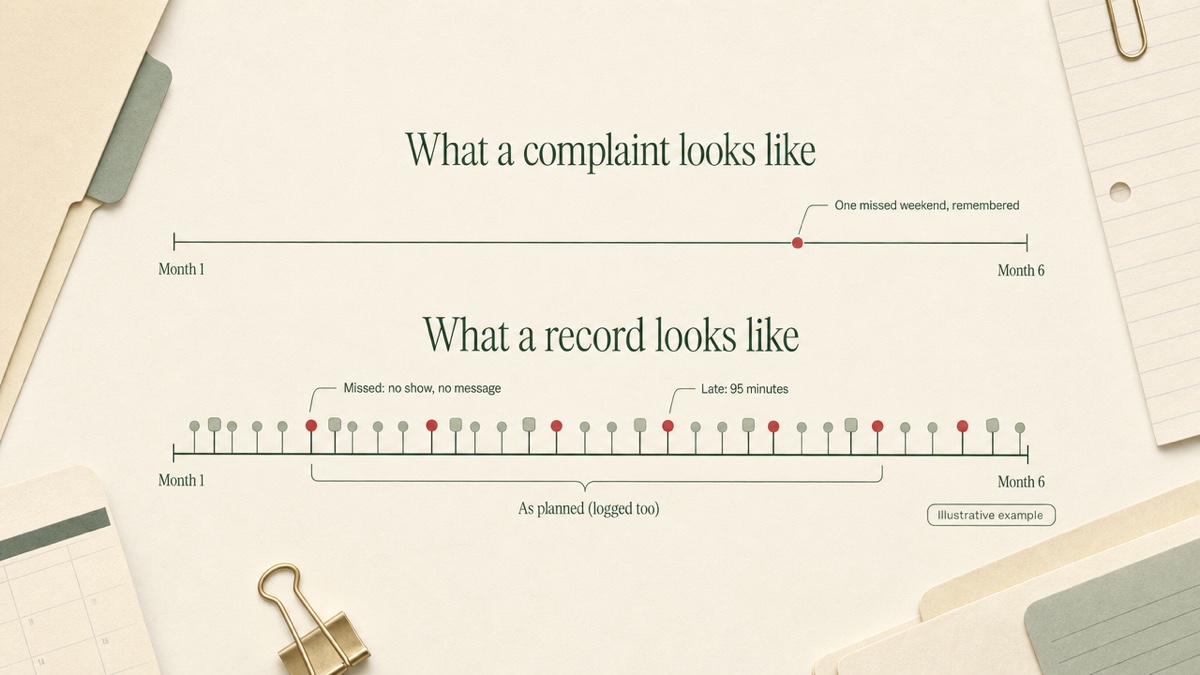
Planned vs. actual: showing how the order works in practice
The order says what is supposed to happen. Your record shows what did. Put the two side by side and you have direct evidence of how the arrangement functions.
A useful comparison has three columns for a given period:
- Planned: the nights and visits the order gives each parent.
- Actual: what happened, logged as it happened.
- Difference: missed nights, extra nights, shortened or late visits.
Totals matter here. "He's always canceling" is an opinion. "Of 52 scheduled overnights since March, 19 did not happen" is a figure an attorney can check against the calendar. Count in overnights, the unit many courts use, and keep timed day visits as a separate count of visits and hours so the percentages stay clean. The math is explained in How courts count parenting time.
Planned vs. actual cuts both ways. If you're the parent who has been picking up extra nights because the other parent stopped exercising theirs, the extra column documents that too.
What to document, and what a usable entry looks like
A usable entry is short, dated, and factual. For each event, record:
- Date, and the scheduled exchange time.
- Actual time, or "did not happen."
- Who was present, including the children and any third party.
- What happened, in neutral words. Times, not adjectives.
- Any communication before or after, with the message attached.
- Which child or children it involved.
Write it the same day if you can. Keep the format the same every time. An attorney or judge scanning forty entries should be able to read them all the same way.
Missed visits and late exchanges
Log every scheduled exchange, not only the bad ones. Late is a number of minutes. Missed is a date with no visit and, ideally, the message (or silence) that came with it. Repeated last-minute cancellations are worth recording as a category of their own.
School and medical involvement
Courts often look at which parent is involved in the child's daily life.. Record parent-teacher conferences, school events, doctor and dentist visits, therapy appointments, and who attended. Keep report cards, attendance records, and appointment summaries you lawfully have access to. A change in the child's own needs, such as a new diagnosis or a school change, belongs here with dates.
Expenses and reimbursement history
If the order splits child costs, a reimbursement history can show whether that part of the order works. Keep the date incurred, amount, what it was for, the receipt, the share owed, when you asked, and what you received. A running balance with a status on each item (unpaid, partially paid, paid, disputed) speaks for itself. Whether a cost is shared under your order is your attorney's call, not the spreadsheet's.
Texts, emails, and screenshots as exhibits
Messages are often the backbone of a modification record, but a screenshot isn't automatically evidence. Courts generally require someone to establish that an exhibit is what it claims to be. That's often the person who sent or received it, testifying that it's accurate and unaltered..
Practical habits that help:
- Screenshot the full thread with dates and the sender visible, not a cropped line.
- Keep the original messages on your device. Don't delete the source after you screenshot it.
- Attach each message to the dated entry it relates to, so its context travels with it.
- Save only what you lawfully have access to. Recordings and access to someone else's accounts raise separate legal questions.
Whether a particular message comes in, and how, is for your attorney. For how to organize exhibits so they're dated and labeled rather than loose in a camera roll, see How to document custody for court.
Regaining custody after a loss: building a record of stability
If you lost custody or had time restricted, the question a court is likely to ask is: what has changed about you? The record you need shows sustained stability, not a single good month.
That usually means documenting:
- Housing: a lease, its dates, and the child's room or space.
- Work: steady employment and a schedule compatible with parenting.
- Treatment or programs: completion certificates for anything the court ordered, with dates.
- Compliance: every supervised or scheduled visit you attended, on time, with the record to show it.
- Involvement: school contact, appointments, and activities you took part in where the order allowed.
Consistency is the evidence. A parent who attended every visit for nine months with no gaps has a different story than one who attended most visits. Address the specific reason for the original ruling head-on, and keep proof that you did. If an evaluation or home study is ordered, your attorney, the appointment order or the court's self-help center can tell you what the evaluator is likely to review, which often includes interviews, records checks and contacts with teachers or counselors..
Waiting periods and local rules
Some states limit how soon after a custody order you can ask to change it, often with exceptions such as danger to the child, persistent interference with parenting time, or written agreement. Others have no fixed wait. Terminology differs too: some states don't use "custody" or "visitation" at all. Forms, filing steps, and whether you need a written showing before a hearing all vary..
Check the rules where your order was entered before you plan a timeline. Your attorney, or your state court's self-help pages, is the place for that.
Talk to a family law attorney early: what to bring
The best time to consult is before you file, ideally while you're still building the record. An attorney can tell you whether what you're documenting is the kind of change your state's courts weigh. That saves months of logging the wrong things.
Bring:
- The current order and parenting plan, plus any later modifications.
- Your log, with a planned-vs.-actual summary for the period since the order.
- Key messages, organized by date and tied to entries.
- Expense and reimbursement records, with receipts.
- School and medical records you have.
- A one-page timeline of the major changes and their dates.
- Your questions, written down.
An organized file shortens the meeting and lets the attorney spend billable time on strategy rather than sorting. For a suggested export order, see Reports and exports.
Where Custody Proof fits
Custody Proof is a private documentation tool for one parent. The other parent is never invited or notified. It doesn't file anything or prepare court forms. It keeps the record your attorney works from.
You can turn your current order into a recurring calendar, review it week by week, then compare it day by day against what you actually logged. Missed and extra nights are flagged, and you can confirm the record as you go, so reports carry a "Confirmed through" date. Violations go on your own timeline in preset categories. Messages, photos, and documents go into an encrypted evidence vault, attached to the dates they belong to. The expense ledger tracks receipts and reimbursement status. When you're ready, you export dated PDFs, including a Court Packet, and hand them to your attorney yourself.
Documentation is $14.75/month or $144/year. Case Builder, at $29/month or $278/year, adds Vero, an AI assistant that turns voice notes, pasted texts, and screenshots into drafts you review. Neither plan guarantees an outcome. They make the record consistent.
Frequently asked questions
Can we just agree to a new schedule without going to court?
Parents can change how they share time informally, but an informal arrangement generally doesn't change the order a court will enforce. If one parent later backs out, the written order usually controls.. Ask your attorney whether to formalize any agreed change.
How long should I document before filing a modification?
There's no universal number. What matters is enough time to show a pattern rather than an episode, and some states impose a waiting period after the last order. Start now, log the ordinary weeks along with the bad ones, and let your attorney judge when the record is ready.
Will the other parent see what I'm logging in Custody Proof?
No. There is no shared account, invitation, or notification. If you share anything, you export a file and hand it over yourself, usually to your attorney.
Do my records guarantee the court will modify custody?
No. A record makes your account specific and dated. Whether it supports a modification depends on your state's standard, the other evidence, and the judge. How it's used is your attorney's decision.
Is it too late if I didn't start documenting when things changed?
No. You can add past events with their real dates and attach the messages and receipts you already have. Entries made at the time carry more weight than reconstructions, so begin consistent logging from today forward as well.
Keep reading
- What to Include in a Parenting Plan: Checklist
- How to Prepare for Custody Mediation: Records to Bring
- Gaslighting in Co-Parenting: Signs and How to Document It
- Which custody app fits your situation
Custody Proof is a documentation tool, not a law firm. Nothing on this page is legal advice. Whether and how a record is used in a case is a question for your attorney.