What to include in a parenting plan so your schedule is provable
By EJ Archuleta, Licensed attorney · Updated
Here is what to include in a parenting plan, provision by provision:
- the regular schedule, with exact exchange times, places and who drives
- holiday and vacation rules that say which time overrides the regular weeks
- deadlines for choosing any dates "to be designated"
- who makes major decisions, and what happens when you deadlock
- how parents communicate and how fast they respond
- how expenses are split, pre-approved and reimbursed, and by when
- rules for late pickups, no-shows and makeup time
- when and how the plan gets reviewed or changed
Every one of those clauses should be written so that someone reading a calendar could tell whether it was followed.
That last test is the one most checklists skip. A plan that says "reasonable visitation" or "as agreed" can't be enforced in any practical sense, because nobody can measure it. If a clause has no time, date, place or number in it, a violation of that clause is just a disagreement.
This page is general information, not legal advice for your case. Custody law and court forms vary by state, so take any specific clause to your own family law attorney before you sign or file it.
The test every clause should pass
Before you agree to a provision, ask three questions:
- Could I log compliance with this? "Exchange at 6:00 p.m. at the school's front entrance" can be logged. "Exchange in the evening" cannot.
- Does it say what happens when it isn't followed? A rule with no consequence or fallback invites the same argument every month.
- Does it say what wins when two rules conflict? Holiday versus regular weekend. Summer versus a birthday. A plan that doesn't rank its own provisions leaves the ranking to whoever is angrier.
A late pickup is a time. A missed weekend is a date. A plan written in times and dates produces a record that can be checked. A plan written in adjectives produces testimony.
1. The regular schedule and exchanges
Court forms in several states ask for the day and the time of every pickup and drop-off, plus the location. Court guidance also recommends naming who provides transportation for each exchange. The reasoning is that children do better with a reliable plan, and parents argue less when the plan is specific.
Checklist:
- Start and end of each period, to the hour. "Friday at 5:00 p.m. to Sunday at 6:00 p.m.," not "every other weekend."
- Anchor date. Which Friday starts the rotation? Without an anchor, "alternating weekends" can drift by a week and both parents can be sincerely wrong.
- Exchange location, with a backup if school is closed.
- Who transports. Common options: one parent does all transportation, the receiving parent picks up, or the parent whose time is ending drops off.
- School-day exchanges. If pickup is "from school," say what happens on teacher workdays and early-release days.
- Midweek time. Say whether it's an overnight or a timed visit with start and end hours. These count differently. Many courts and child support worksheets count parenting time by overnights, so a Wednesday dinner usually does not count as a night. Some states count time differently, so check how yours does it.
2. Holidays and vacations: say what wins
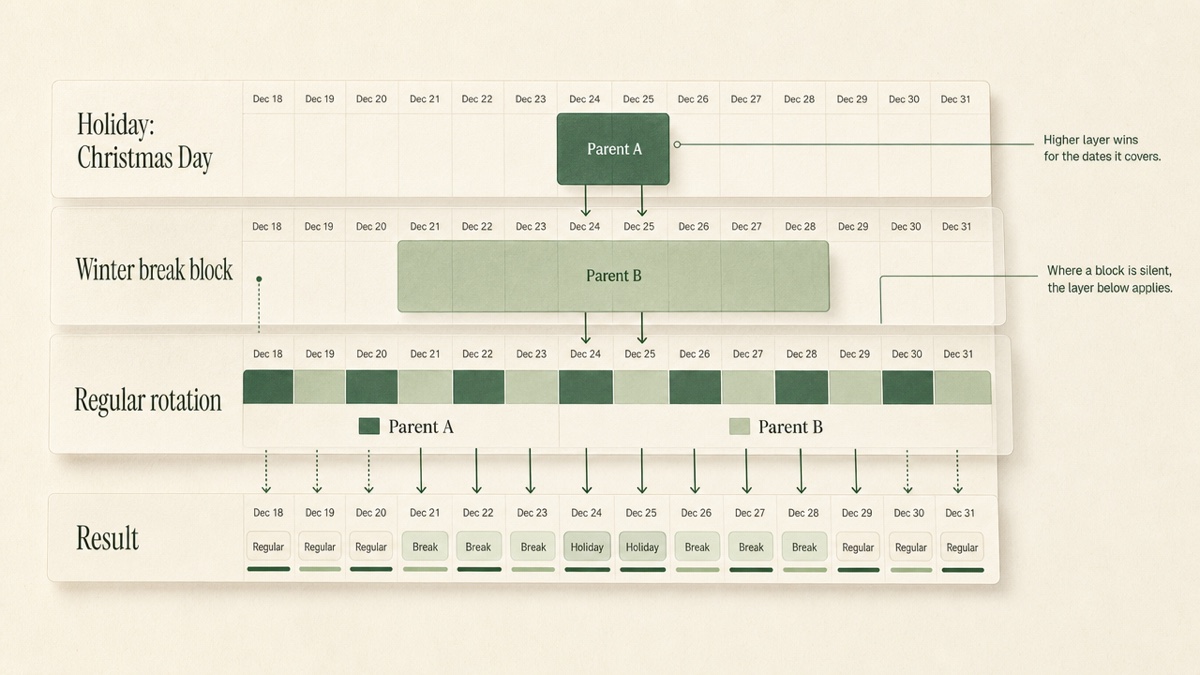
Most disputes over holidays are really disputes over precedence. Your plan should state, in order, what overrides what. A common structure:
- Specific holidays and special days
- Summer and vacation periods
- The regular rotation
Your attorney may rank them differently. The point is that the plan ranks them at all.
For each holiday, specify:
- Exact start and end times. "Thanksgiving" can mean Thursday morning or Wednesday after school through Sunday night.
- Alternation by year, such as odd years with one parent and even years with the other.
- Floating dates. Say whether a holiday follows the calendar (Mother's Day) or the school's published break.
- Travel. Say how much notice is required before taking the children out of town or out of state, and what itinerary and contact details must be shared.
3. Dates to be designated: put a deadline on the choice
Many plans give a parent "30 days of summer, dates to be designated." That's flexible, which is good. It also creates an open question every year, which is bad, unless the plan answers it.
The checklist for any open period:
- The deadline to designate, as a calendar date.
- The method of notice, such as in writing by email.
- Limits on the choice: minimum or maximum block length, and whether it can overlap the other parent's weekends.
- The default if the deadline passes. This is the clause most plans forget. Without it, a missed deadline turns into a negotiation every summer.
If your plan requires you to choose holiday or vacation time by a deadline, whether missing it costs you that time depends on the plan's wording and your state's rules.
4. Decision-making and what happens at deadlock
Plans usually separate decision-making into two kinds:
- Day-to-day decisions, such as routine discipline, minor medical care, chores and bedtime. These are typically made by whichever parent has the children.
- Major decisions, commonly grouped as education, health care (medical, dental, psychological), religion and extracurricular activities.
For each major category, say whether the decision is joint or belongs to one parent. Court guidance recommends being explicit about which decisions each parent makes alone.
Then add what joint plans often lack:
- A response window. One state form's sample language has the parent facing a choice contact the other, who must agree or disagree within 24 hours of any deadline.
- A tie-breaker. Some forms let a named parent decide after a good-faith effort fails, and require that parent to tell the other promptly. Others send disputes to mediation or a named dispute-resolution provider before court.
- An emergency exception. Either parent may act on an urgent health or safety matter, with prompt notice to the other.
- Records access. Both parents are listed with schools and providers, except where abuse or violence makes that unsafe.
5. Communication: channel and response time
You can't control whether the other parent communicates well. You can make the plan say what counts as communicating.
- The channel. Name it: email, text, or phone. A plan that names one channel ends arguments about whether a voicemail counted as notice.
- Response times by topic. Scheduling questions might get a shorter window than general updates. Use a number of hours or days.
- No children as messengers. The children don't carry schedule requests, questions or complaints.
- The children's contact with the other household. Say whether phone or video calls happen anytime or in set daily hours, and that they won't be unreasonably monitored or interrupted.
- Changes to contact details, shared within a stated time.
- Social media. Rules about posting the children's photos, locations or details of the case.
- Automated or AI-drafted messages. If either parent uses a tool to draft or filter messages, the plan can say the sending parent remains responsible for the content.
A response window turns "they ignore me" into something measurable: sent Tuesday at 9:14 a.m., no reply by Thursday.
6. Expenses: split, pre-approval and a reimbursement clock
"Parents will share extracurricular costs" is one of the most argued sentences in family law. It needs four more pieces:
- The split, as a percentage or a fixed amount, by category.
- A pre-approval threshold. For example, any single activity cost over a stated dollar amount needs written agreement before enrollment. Say how long the other parent has to object.
- A submission deadline. The paying parent sends the receipt within a stated number of days after paying.
- A payment deadline. The other parent reimburses within a stated number of days after receiving the receipt.
Also settle who claims the children as dependents for taxes, whether by alternating years or by child. If the right to claim a child is tied to support being current, the plan can say so, but the IRS won't enforce that condition. The other parent can claim the child only if the custodial parent signs an unconditional release, usually Form 8332. The plan should therefore say when that form will be signed and handed over.
For the record-keeping side, see how to track unreimbursed child expenses.
7. Late pickups, no-shows and makeup time
This is where vague plans fail fastest. Checklist:
- Wait time. How long the waiting parent stays at the exchange before the period is treated as forfeited. Some state forms ask this directly.
- Notice of delay. The running-late parent notifies by the named channel, by a stated time.
- Makeup time. Whether time missed for illness or emergency gets made up, within what window, and who picks the dates. Some plans state that time missed without notice is not made up.
- Right of first refusal. If a parent will be away for more than a stated number of hours during their time, they offer the time to the other parent first. Include the notice method and how quickly the offer must be answered.
- Swap requests. One state form's option has the parent receiving a request to rearrange time make the final call when parents disagree.
More on what to record when these happen: missed visitation and late pickups.
8. Review and modification triggers
Plans age. A schedule built around a toddler won't fit a high schooler. Include:
- Planned review points, such as when the youngest child starts school.
- Temporary versus permanent changes. Temporary changes can often be agreed in writing without a filing. Permanent changes generally need a new court order, even when both parents agree, though agreed changes can often be submitted without a contested hearing. The existing plan stays enforceable until the new order is entered.
- The dispute process, whether mediation first or straight to court, with exceptions for emergencies and for family violence.
- Relocation notice. How much notice a parent must give before moving, and the plan's effect if a move breaks the schedule. Relocation rules are heavily state-specific.
Vague wording to avoid
| Vague | Measurable |
|---|---|
| "Reasonable visitation" | Named days, start and end times |
| "As the parties agree" | A default schedule that applies when they don't agree |
| "Holidays will be shared" | Each holiday, with times and odd or even year |
| "Timely notice" | A number of days and a named channel |
| "Share costs equally" | Split, pre-approval threshold, submission and payment deadlines |
| "Make up missed time" | A window, who picks the dates, and which absences qualify |
After it's signed: keep the record the plan makes possible
A specific plan is only half the work. The other half is a dated record showing what actually happened against it.
Custody Proof is a private documentation tool for one parent. The other parent is never invited or notified. It doesn't draft or review plans. Once you have a signed order, you can set up your custody schedule by uploading the order or describing it in plain words. You review every week before it saves.
From there:
- Holiday and vacation blocks override the regular rotation for their dates, including alternating years and "dates to be set" periods. See holiday and vacation blocks.
- Notice deadlines found in the order are offered as in-app reminders.
- Plan vs. Actual compares the schedule with what you logged, day by day.
- Violations, evidence and expenses go into one record you can export for your attorney.
Start your record. Plans start at $14.75/month, with a 30-day money-back guarantee on your first charge.
Frequently asked questions
What is the most common parenting plan mistake?
Leaving a provision unmeasurable. "Reasonable," "flexible" and "as agreed" feel cooperative when the plan is signed. They leave nothing to point to when cooperation stops.
Should a plan be specific even if we get along?
Usually, yes. Specific terms can still be waived by mutual agreement. A specific default is what applies when you can't agree, and that's when you need it. Whether informal changes affect the order is a question for your attorney.
Can I use a court form as my parenting plan?
Many states publish parenting plan forms, and they are a useful map of the topics. They often leave expense deadlines, makeup time and precedence blank. Ask your attorney which form your court expects and how to fill the gaps.
Will Custody Proof write or check my parenting plan?
No. Custody Proof records what happens under a plan you already have. It turns your order into a calendar you review, tracks deviations, and exports reports. Drafting and legal review belong with your attorney.
Does the other parent need to use anything for this to work?
No. Everything on the checklist can be documented from your side alone: exchange times, missed periods, unanswered requests and receipts.
Keep reading
- How to Prepare for Custody Mediation: Records to Bring
- Gaslighting in Co-Parenting: Signs and How to Document It
- Can a Judge Order a Co-Parenting App?
- Which custody app fits your situation
Custody Proof is a documentation tool, not a law firm. Nothing on this page is legal advice. Whether and how a record is used in a case is a question for your attorney.