How to document a narcissistic co-parent: behavior, not diagnosis
By EJ Archuleta, Licensed attorney · Updated
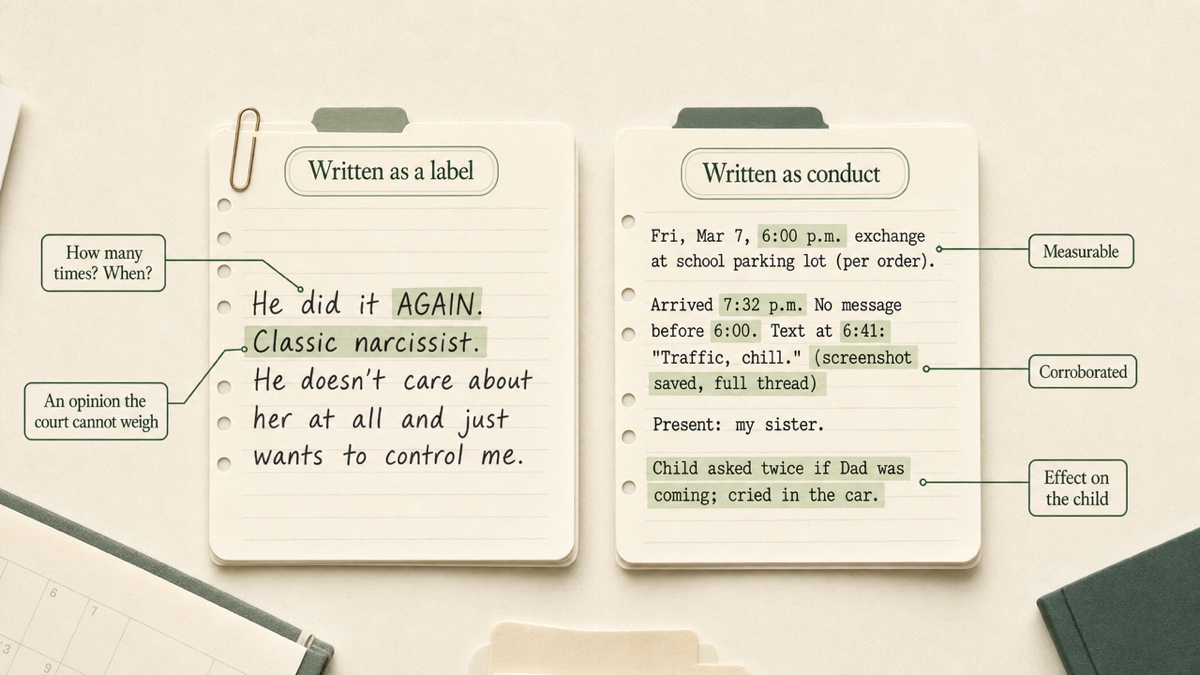
To document a narcissistic co-parent, record what they do, not what you believe they are. Each entry should give the date, the time, what was scheduled or said, what actually happened, who saw it, and how it affected the child, written in plain words with the original messages saved in full. A judge can weigh a pattern of late exchanges, ignored orders, and pressure on the children. "Narcissist" gives the judge nothing to weigh.

This page explains how to build that record yourself, with no help from the other parent. It covers how manipulation looks when you write it down as conduct, how to reply without feeding the conflict, and what to hand your attorney. This is general information, not legal advice. Custody law and procedure vary by state, so take questions about your case to your own family law attorney.
Why the label can work against you
"Narcissist" is a clinical term. The DSM-5 describes Narcissistic Personality Disorder as a pervasive pattern of grandiosity, need for admiration, and lack of empathy. Only a qualified evaluator can diagnose it, and that evaluator usually needs to see the person. In everyday speech the word means something looser, and some degree of self-esteem management is ordinary in everyone.
In a custody case, the label creates three problems:
- It asks the court to accept your opinion. Courts decide custody on evidence of what happened and on what serves the child. They do not need a psychological label to do that.
- It shifts attention to you. A parent who opens with a diagnosis can look like a parent who is fighting the other parent instead of protecting the child.
- It invites a counter-label. Once one side is name-calling, the other side starts doing it too, and the facts get buried.
Keep the word out of your log, your texts, and your conversations with the children. Bring your attorney the conduct. If a mental health evaluation is needed, your attorney can decide whether and how to ask for one.
Control tactics, written as behaviors
Most of what parents call narcissistic abuse can be described in observable terms. Write it that way:
- Schedule control: arriving late, cancelling at the last minute, keeping the child past the exchange time, refusing makeup time, changing plans after you have already arranged around them.
- Communication flooding: many messages in a short period, messages that drift from the stated topic, demands for an immediate reply.
- Rewriting events: denying an agreement that exists in writing, or insisting a conversation went differently than the record shows.
- Information control: withholding school, medical, or activity details, or enrolling the child in something without telling you.
- Using the children: asking them about your home, sending messages through them, making them pick sides.
- Threats: to keep the child, to move, to file something, to report you.
- Financial pressure: not paying a shared expense, or disputing every receipt.
Some of these patterns fall under what researchers and courts call coercive control, a pattern of intimidation, isolation, and control that can include economic pressure and using children to dominate a former partner. Some states now treat coercive control as a form of domestic violence. In other states, the law may not name coercive control specifically, and non-physical abuse can be harder to prove than physical violence. Ask your attorney how your state treats it.
What a usable entry looks like
A good entry gives the date and time, the location, who was present or witnessed it, the exact words if you remember them, the effect on the child, and what happened afterward, including any report you made. Write it the same day. Keep it short.
Logging gaslighting factually
Gaslighting means being told that what you saw or heard did not happen. You cannot log a feeling of being gaslit. You can log the gap between what was said and what the record shows.
- Note what they claimed, quoted if it was written: "I never agreed to the Saturday swap."
- Note where the contrary record lives: "Text from Feb 2, 9:14 p.m.: 'Fine, take Saturday.'"
- Attach both. Do not add commentary.
Over months, those pairs show a pattern. You do not need to argue with them in the moment. That is what the record is for. More on why this beats recall: records, not memories.
Schedule manipulation: track planned against actual
Manipulation around the schedule hides well. One late exchange looks like traffic. Forty look like a choice. The way to make that visible is to keep what the order says beside what happened:
| Date | Scheduled | Actual | Notice given | Note |
|---|---|---|---|---|
| Fri 3/7 | Exchange 6:00 p.m. | 7:32 p.m. | Text 6:41 p.m. | Sister present |
| Wed 3/12 | Dinner 5:00–7:30 p.m. | Cancelled | Text 4:50 p.m. | Child told at 4:55 |
| Sun 3/16 | Return 6:00 p.m. | 8:15 p.m. | None | Missed bedtime |
Log the exchanges that went as planned too. A record that contains only failures can look cherry-picked. A record that shows 46 on-time exchanges and 11 late ones gives a judge the full picture. Count custody by overnights the way many courts do, and keep daytime visits in a separate column. See how courts count parenting time.
Replying without feeding it: grey rock and BIFF
Every reply you send can become an exhibit. Write each one as if a judge will read it, because one might.
Grey rock means being as uninteresting as a stone. Give no emotion, explanations, or reactions. Answer the logistics and nothing else.
BIFF is a structure for written replies: Brief, Informative, Friendly (or at least civil), Firm. Answer only the question asked. Do not defend yourself against every accusation in the message. Do not send anything while you are angry.
They send four paragraphs about your parenting, ending with a question about Friday. You reply:
> "I'll have her at the school at 6:00 Friday as the order states. Her soccer bag will be in the car."
The accusations go unanswered. The record shows a calm parent following the order. If an accusation is serious and false, tell your attorney instead of arguing about it by text.
Use written channels for anything non-urgent, such as email or text. That creates a record without asking anything of the other parent. Your own order may already say how parents must communicate, so follow it.
Parallel parenting
Cooperative co-parenting assumes two people who can compromise. When one parent treats every decision as a contest, that approach fails, and many families move to parallel parenting:
- Written, business-like communication for non-emergencies.
- A rigid possession schedule with as little room for renegotiation as possible.
- Exchanges at a neutral public place, such as a school or a police station lobby.
- Each parent makes day-to-day decisions independently during their own time.
You can practice most of this on your own. Stop offering flexibility that gets used against you. Stop explaining your household. Run your time your way. If your current order is vague about holidays, exchange locations, or communication, ask your attorney whether a more detailed order is worth seeking. Vague terms give a controlling parent room to work. Why shared tools tend to fail in these cases: why co-parenting apps fail.
Keep the children out of the middle
You cannot control what happens at the other house. You can control your own side:
- Never send messages through the child. Not schedules, not money, not "tell your dad."
- When the child brings a message, take it off their hands. Say "Thanks, I'll handle that with Mom," then reply directly in writing.
- Don't question them about the other home. Listen if they talk. Don't interview them.
- Don't badmouth the other parent in front of them, even when it is deserved.
Log what happens to the child, not your theory of it. A good entry reads: "Returned Sunday; said 'Dad says you're why we can't have a dog.' Asked twice if she was in trouble." Telling children about the divorce, gathering information through them, and pushing them to choose sides are behaviors courts often take seriously. Parental alienation is not recognized as a syndrome in the DSM-5, so describe the conduct and leave the label out. If your child is struggling, a child therapist can help the child and may produce records of their own.
Messages, screenshots, and recordings
- Save complete threads, not the worst line. A cropped screenshot invites the question "what came before?" A full thread with dates and the sender visible answers it.
- Keep originals. Don't edit, annotate, or retype messages. Courts generally need some way to show a message is what you say it is, and an untouched original makes that easier.
- Collect third-party records. School attendance, medical visits, police reports, and therapist notes can back up your log.
- Be careful with recordings. Some states let you record a conversation you take part in. A smaller number of states require everyone's consent, and calls between people in different states can be more complicated. Ask your attorney before you record an exchange or a call.
- Only save what you have lawful access to. Do not log into the other parent's accounts or devices.
Don't let the log run your life
A log can turn into an obsession. A 2 a.m. entry about tone, written in all caps, helps the other side. A judge reading three entries a day about minor slights may see the high-conflict parent as you.
- Log the conduct and its effect on the child, then stop. Not every eye-roll belongs in the record.
- Write at a set time. Do it once, the same day, in a few factual lines.
- Don't reread the log at night. It is a tool, not a diary to relive.
- Put the anger somewhere else, such as a therapist, a friend, or a private journal that never goes to court.
Steady, boring documentation is more believable, and easier to live with, than a flood.
Bringing the pattern to your attorney
Litigation itself can become another channel for control, because court processes create more points of contact. A focused record helps your attorney spend time on strategy instead of sorting:
- Lead with numbers. For example: on-time, late, and missed exchanges over a defined period.
- Group incidents by type, such as schedule, communication, children, and money, each with dates.
- Attach evidence to the entry it supports, not as a loose folder of image files.
- Ask your attorney what they want before you export. Some want a one-page summary first. Others want everything.
More on structure: how to document custody for court.
Where Custody Proof fits
Custody Proof is a private documentation tool for one parent. The other parent is never invited and never notified. That matters when any shared system becomes one more thing to fight over.
- Planned vs. actual: upload your order or describe the schedule, then log what happened. The app compares the two day by day, and your reports show a "Confirmed through" date for the record you reviewed.
- Violation logging: flag late pickups and missed visits with timestamps and attached evidence. Flagging one notifies no one.
- Encrypted evidence vault: seven categories, including Communications, Emotional, and Witness, with files encrypted before storage.
- The Court Packet: a plain-English summary with deviations from the schedule marked in red and a chronological journal.
- Vero (Case Builder plan): turns a voice note or a pasted thread into a neutral, dated draft you review before it saves. Vero never guesses dates.
Documentation is $14.75/month or $144/year. Case Builder, which adds Vero, is $29/month or $278/year. Start your record.
Frequently asked questions
Should I tell my lawyer I think my ex is a narcissist?
You can tell your lawyer what you suspect. Then give them the conduct: dates, messages, and effects on the child. Whether to raise mental health formally, and how, is your attorney's call.
Will the other parent know I'm documenting?
Not through Custody Proof. There is no shared account, invitation, or notification. A record leaves the app only when you export a file and hand it over yourself.
How much should I document?
Document anything that touches the schedule, the children, safety, money, or a court order. Include the exchanges that went as planned. Leave out minor irritations that don't affect the child.
Is a log written months later still useful?
It is less persuasive than an entry made the same day, but it is still worth having. Use real dates, anchor each entry to a message, receipt, or record from the time, and tell your attorney which entries you reconstructed.
Can I record our exchanges?
It depends on your state's consent rules and your order. Ask your attorney before you record anything.
Keep reading
- How to Document Coercive Control for Court
- How to Deal With an Uncooperative Co-Parent
- How to Organize a Custody Binder
- Which custody app fits your situation
Custody Proof is a documentation tool, not a law firm. Nothing on this page is legal advice. Whether and how a record is used in a case is a question for your attorney.