How to document coercive control and post-separation abuse for court
By EJ Archuleta, Licensed attorney · Updated
To document coercive control, keep a private, dated log of specific incidents across every channel the other parent uses: messages, the parenting schedule, money, monitoring, the children, and court filings. Each entry gets a date, what happened in plain facts, and an attachment where one exists. Coercive control rarely shows up in a single incident. It shows up in the accumulation, so the record has to make the pattern visible to your attorney without alerting the other parent that you are keeping it.
This page covers what the behavior tends to look like after separation, how it differs from ordinary conflict, how to log each category, and how to keep the record and your devices secure. It is general information, not legal advice. Custody Proof is not a law firm, and how courts treat coercive control varies by state, so bring state-specific questions to a family law attorney where you live.
If you are in danger right now, call 911. The National Domestic Violence Hotline is at 1-800-799-7233 and thehotline.org, and a local domestic violence advocate can help you plan for safety before you change anything.
What coercive control looks like after separation
Coercive control is a pattern of behavior used to dominate a current or former partner. It can include intimidation, isolation, threats, stalking, economic abuse, and using the children. What sets it apart from ordinary friction is the aim: restricting the other person's autonomy and freedom. A judicial guide from the National Council of Juvenile and Family Court Judges describes abusive behavior as purposeful and instrumental, not impulsive. It also notes that abusers often use only as much coercion as they need to keep control.
That last point is why documentation is hard. A single text looks petty. Six months of texts, late exchanges, and unpaid copays look like something else.
Common signs in a co-parenting setting:
- Message bombardment. Dozens of texts in an hour, demands for an immediate answer, escalating when you don't reply, contact through every available channel at once.
- Schedule manipulation. Late exchanges, last-minute cancellations, refusing agreed swaps, withholding make-up time, changing pickup locations, keeping the children past the end of a period.
- Financial withholding. Refusing to pay shared child expenses despite having the means, demanding an accounting of how support is spent, insisting on paying vendors directly instead of reimbursing you, slow-walking payments until you give in on something unrelated.
- Surveillance. Showing up where you are, knowing things you didn't share, tracking your location, monitoring your accounts or devices, questioning the children about your home.
- Using children and third parties. Passing messages through the children, asking them to report on you, recruiting relatives, teachers, or new partners to pressure or watch you.
- Litigation abuse. Repeated motions, filings timed around holidays or your work deadlines, and proceedings that cost you money and time even when the filing parent loses.
None of these, alone, proves anything. Together, dated, they can show a pattern.
High conflict vs. post-separation abuse
"High conflict" usually means two people who fight with each other. Both escalate, both dig in, and the friction runs in both directions. Post-separation abuse is different in shape: one parent's behavior is directed at controlling the other, and the other parent's behavior is mostly reaction, avoidance, or protection.
Questions an attorney or advocate may ask to tell them apart:
- Is it symmetrical? Do both parents send the hostile messages, or does one send forty and the other send three short replies?
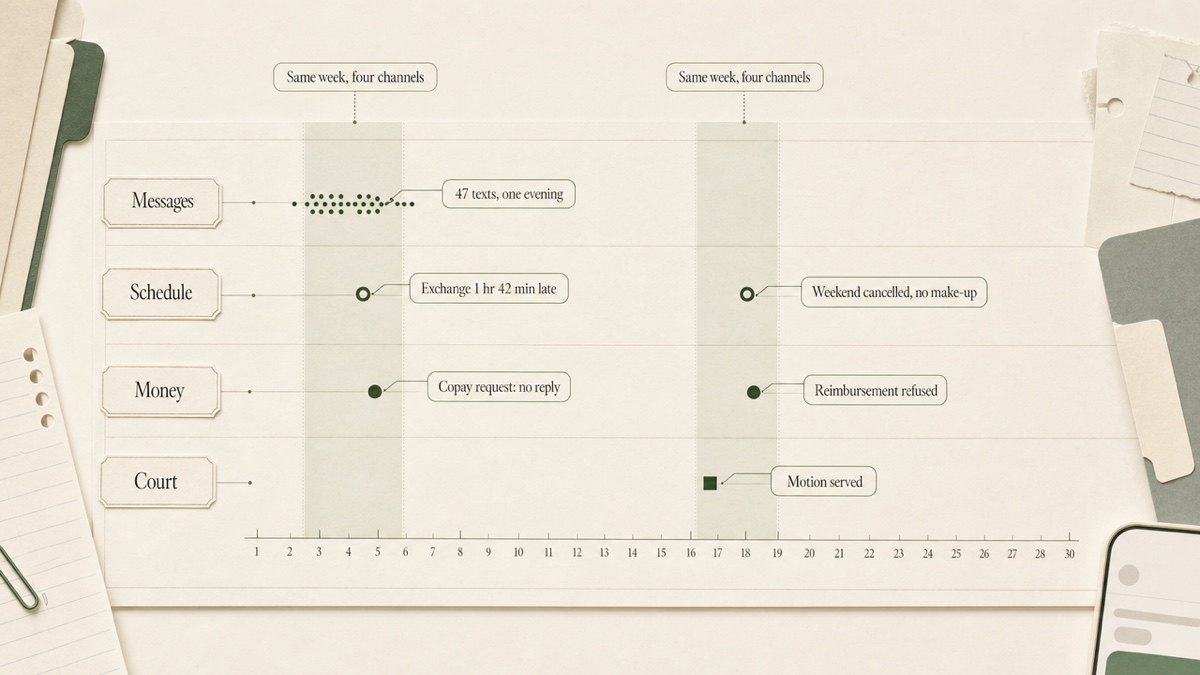
- What happens when you set a boundary? In ordinary conflict, a boundary often lowers the temperature. In a control pattern, it often triggers escalation in another channel, such as the schedule or money.
- Who is losing freedom? Whose job, travel, friendships, or spending are being constrained?
- Does disengaging work? If you stop responding and the behavior moves to the children, the school, or the court, that is useful information.
A risk worth knowing: protective behavior can look like conflict from the outside. Refusing an unscheduled exchange, insisting on written communication, or declining to answer at midnight can be framed as "both parents are difficult." A dated record of what came first answers that framing better than an argument does.
You don't have to label anything. Your log should describe behavior, not diagnose the other parent. Leave out "narcissist," "abuser," and "controlling" in entries. Write what was done, said, or withheld, and when.
How to log each category
Every entry, in every category, uses the same skeleton:
- Date and time it happened (not the day you got around to writing it).
- What happened, in facts: who, what, where, what was said, word for word where you can.
- What it affected: a missed overnight, a payment not made, a child's appointment moved.
- The attachment: a screenshot, a receipt, a photo, a served document.
- Witnesses, if any, by name.
"He was late again and wouldn't answer" is a feeling. "Pickup set for 6:00 p.m. Friday under the order. Arrived 7:42 p.m. Three calls and two texts unanswered between 6:05 and 7:30" is a record.
The method for building a general custody record is in how to document custody for court. Below is what changes when the problem is control.
Messages
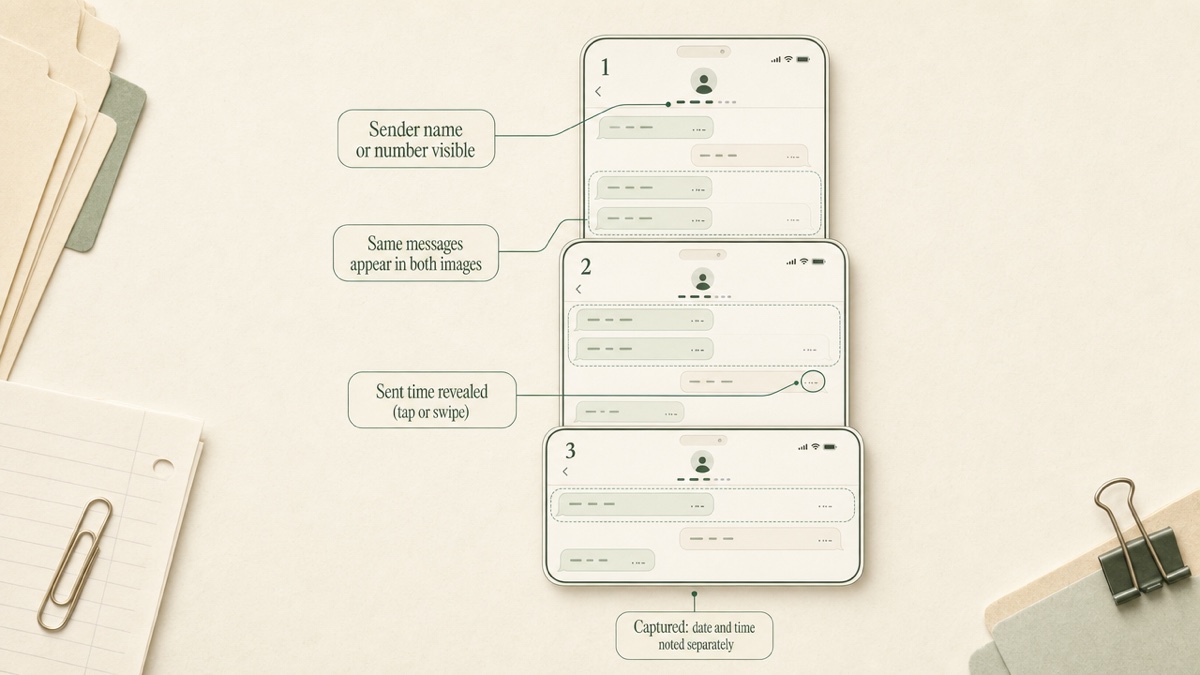
Preserve whole conversations, not a single message. Harassment is usually a series of interactions, and courts often want to see the full exchange.
- For long threads, take overlapping screenshots: scroll only halfway each time, so the bottom of one image becomes the top of the next.
- Capture the sent time of each message (on many phones you tap or swipe to reveal it) and note the date you took the screenshot.
- Make sure the phone number, username, or email address appears in the capture.
- Save voicemails with their date and time.
- Screenshot social media posts promptly. They can be deleted.
- If you can't screenshot, photograph the screen with another device.
Volume is part of the evidence. A note like "47 texts between 9:10 p.m. and 11:30 p.m. on March 3" says something a single screenshot can't.
Schedule interference
This is where competitors' advice stops, and where much of the control happens. A missed weekend is a date on a calendar. The useful format is planned versus actual: what the order said should happen, next to what did.
Log each deviation as it happens: the scheduled time, the actual time, any message cancelling or changing it, and whether make-up time was offered or refused. Also log the weeks that went as planned. A record of only the bad weeks invites the question "what about the rest?" A complete record answers it. Detailed logging of late and missed exchanges is covered in missed visitation and late pickups.
Money
Financial control often leaves the cleanest paper trail, because money has amounts and dates. For each shared child expense, record:
- the date incurred, amount, what it was for, and the receipt;
- the date you sent the reimbursement request, and how;
- the date of any response, and what it said;
- what was paid, when, and the remaining balance.
A status on each row (not requested, unpaid, partially paid, paid, disputed) turns a pile of receipts into a timeline of requests and non-payment. Also log unilateral spending decisions that affect the children: an activity enrolled without consultation, or a demand that you pay a provider they then refuse to share. The full system is in how to track unreimbursed child expenses. Whether a cost is actually shared, and what notice your order requires, are questions your order and your attorney answer.
Surveillance
Write down specific events: the date they appeared at your gym, the comment that showed they'd read your email, the child saying "Dad asked who comes to our house." Note how they could have known. If you suspect your device or accounts are being monitored, read the security section below before you change anything.
The children: observe, don't interview
Record what you see and hear, with dates. For example: "Came back Sunday 6:15 p.m. Didn't speak for an hour. At bedtime said, 'Mom said you're the reason we can't have a dog.'" Quote the child's words exactly. Describe behavior, such as sleep, appetite, or clinginess before exchanges, without concluding what caused it.
Don't question the children to build your record, ask leading questions, or ask them to report on the other home. That puts them in the role you are documenting the other parent for. If a child raises something worrying, listen, write it down afterward, and tell your attorney or the child's therapist or pediatrician. Children who are exposed to coercive control can show stress and hypervigilance, and those observations matter. Record them as behavior, not as a diagnosis.
Court and litigation
Litigation abuse becomes visible as a timeline: each filing, the date you were served, hearing dates, continuances requested, outcomes, and what each round cost you in fees and missed work. Your attorney has the docket. What they may not have is the overlay, meaning which filings landed the week of a holiday, a custody exchange, or a refused reimbursement. Keep served documents with the date you received them, and put hearing dates where you'll see them.
Secure your devices and accounts first
Before you start a record, make sure the other parent can't read it. Talk to a domestic violence advocate first if you can. Abrupt changes, such as suddenly disabling location sharing, can alert someone who is monitoring you, and an advocate can help you decide the order of steps.
Check:
- Passwords on email, phone, cloud storage, banking, and social accounts. Use new, unique passwords the other parent couldn't guess, and turn on two-factor sign-in.
- Location sharing in your phone's settings, map apps, and family-sharing plans.
- Shared cloud and family accounts: shared photo libraries, a family plan that syncs messages or backups, a shared streaming or shopping account that shows your history.
- Email forwarding rules and signed-in devices listed in each account's security settings.
- Unfamiliar apps or profiles on your phone. If you suspect monitoring software, an advocate or the hotline can talk through options.
- Gifted devices, including the children's tablets and phones, which may be tied to the other parent's account.
If your own device isn't safe, the hotline suggests options like a library computer or a device borrowed from someone you trust. Store documentation where the other parent can't or won't look.
In Custody Proof, the other parent never has an account and is never invited or notified, and evidence files are encrypted (AES-256) before they're stored. You sign in with email and password. Changing your password signs out your other devices, so if someone had your old login, they're out. Details are in your account, data, and privacy.
Working with attorneys and advocates
The log is raw material. Your attorney can advise on what to offer as evidence and in what form, though the judge decides what is admitted. Your attorney can also explain whether and how your state's law addresses coercive control or family violence in custody decisions, and how that applies to your facts. Exhibits also have to meet procedural requirements to be considered, which is another reason to involve counsel rather than file a binder yourself.
Questions worth asking your attorney:
- What format do you want: a summary first, full tables, or the underlying files?
- What date range matters for the next hearing?
- Should I keep logging the weeks that went as planned?
- How should I handle new messages: reply, don't reply, or reply only in writing?
- Is there anything I'm doing that could be framed as conflict on my side?
An advocate covers a different job: safety planning, court accompaniment, shelter and housing options, and referrals. Many offer services at no cost. If you can't afford an attorney, ask a local advocacy organization or legal aid office about representation.
Using Custody Proof for this
Custody Proof is a private documentation app for one parent. Everything described above lives in one place:
- Schedule: upload your order, or describe it in plain words, and it becomes a recurring calendar. The plan-versus-actual view lists missed, extra, and changed days by date. Days you flag as violations stay in your record, and a "Confirmed through" date shows you reviewed the full period, not only the exceptions.
- Evidence vault: seven categories, including Communications, Incidents, Emotional, Health, and Witness. Screenshots, PDFs, audio, and video can be attached to dated entries.
- Expenses: a ledger with receipts, each row's share, a running balance, a status, the amount received, and when notice was sent.
- Reminders: add hearing dates and order deadlines to your Deadlines & Reminders page.
- Exports: filtered PDF and CSV reports, and the Court Packet, which brings a summary, calendars with deviations marked, and a chronological journal into one document for your attorney.
On the Case Builder plan, Vero turns a pasted thread, a screenshot, or a voice note into dated drafts you review before anything saves. Vero never guesses a date. Documentation is $14.75/month or $144/year. Case Builder is $29/month or $278/year.
Start your private record. Your first charge is covered by a 30-day money-back guarantee, and the other parent is never invited.
Frequently asked questions
Will the other parent find out I'm documenting?
Not from Custody Proof. There is no shared account, no invitation, and no notification, and flagging an incident alerts no one. If you share your record, you do it yourself by exporting a file. The bigger risk is usually your own devices, so secure those first.
What if I'm not sure it's abuse and not just conflict?
You don't need to decide that to start. Log behavior with dates in every channel, including your own replies. The record will show whether the pattern runs both ways or one way, and your attorney or an advocate can help you read it.
Is coercive control illegal in my state?
It depends on the state. It depends on the state. Some states name coercive control in their domestic violence, protective-order or family law statutes, a few have considered or adopted criminal provisions, and many do not use the term at all. Definitions also differ from state to state. Ask a family law attorney in your state.
Can I add incidents from months ago?
Yes. Enter past events with their real dates and attach what you already have. Note that you wrote the entry later, and keep any original timestamps visible in screenshots.
Should I use a shared co-parenting app to keep things documented?
A shared app requires the other parent to participate, and it gives them a view into the platform you're using. A private log doesn't depend on their cooperation. Whether you also need a court-ordered communication channel is a question for your attorney.
Keep reading
- How to Deal With an Uncooperative Co-Parent
- How to Organize a Custody Binder
- Holiday Custody Schedule Examples and How to Track Them
- Which custody app fits your situation
Custody Proof is a documentation tool, not a law firm. Nothing on this page is legal advice. Whether and how a record is used in a case is a question for your attorney.