Parallel parenting in high-conflict cases: separate lanes, tight plan
By EJ Archuleta, Licensed attorney · Updated
Parallel parenting is a way for separated parents in high-conflict cases to raise the same children while having as little contact with each other as possible. Each parent runs their own household during their own time, and a detailed written plan settles the questions that would otherwise start arguments. The parents communicate only in writing and only about the children. It fits cases where cooperative co-parenting keeps turning into a fight.

The idea is to stop needing the other parent's cooperation for daily life. That also applies to how you document. A tool that only works when both parents participate pulls you back into the contact you are trying to reduce. A private, one-parent record keeps working regardless of what the other parent does.
This page is general information, not legal advice. Custody law and terminology vary by state, so talk with a family law attorney licensed where your case is.
What parallel parenting is, and how it differs from co-parenting
Sociologist Frank Furstenberg drew the distinction in the late 1980s. Co-parenting means parents who live apart cooperate in raising their children. Parallel parenting means each parent keeps a separate relationship with the children, with a tacit agreement not to interfere in the other's life.
West Virginia's court guide for parents puts it this way: each parent takes total responsibility for the children during their own time, and neither asks or expects the other to change schedules or rules. Nobody asks for changes, so there are no arguments over changes.
| Cooperative co-parenting | Parallel parenting | |
|---|---|---|
| Contact | Frequent, often in person | Minimal, mostly written |
| Schedule | Flexible, renegotiated as needed | Fixed, followed as written |
| House rules | Coordinated across homes | Each home sets its own |
| Events | Often attended together | Attended separately, or by turns |
| Disputes | Talked through | Handled by the plan, a go-between, or the court |
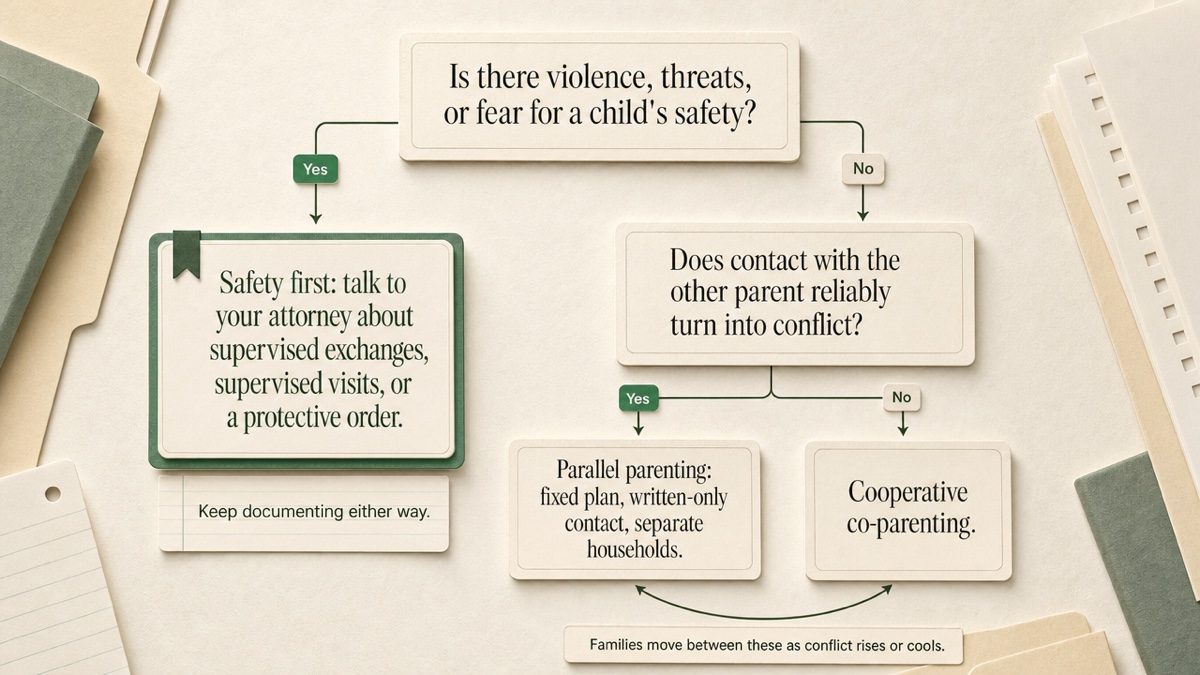
Most families fall somewhere between the two. Parallel parenting is a direction you can move in, not a box you have to fit.
Is it a legal term? Not everywhere. Some courts and parenting plans use the phrase. Some orders never use the term and simply include the structure: fixed schedules, neutral exchanges, written-only communication. Ask your attorney how courts where you live describe it.
When parallel parenting fits, and when safety calls for more
Parallel parenting is a good fit when:
- Every exchange or phone call turns into an argument, even about small things.
- One parent is willing to cooperate and the other is angry or hostile. Cooperation needs two willing people.
- The children are watching the conflict, or carrying messages between homes.
- You are early in a separation and emotions are still raw.
Furstenberg's explanation for why it works is simple. Separating each parent's activities reduces conflict. Fewer chances to watch the other parent with the child reduce strain. Parents and stepparents compete less. It costs some consistency between homes. Court-published parent guides still treat it as far better than exposing a child to ongoing conflict, and better than a parent dropping out of the child's life.
Parallel parenting is not a safety plan. It assumes the problem is conflict, not danger. If there is domestic violence, threats, stalking, substance abuse during parenting time, or fear for a child's safety, lower contact may not be enough. Supervised exchanges, supervised visitation, or a protective order may be the right request instead. Raise these concerns with your attorney or a local domestic violence advocate, and call 911 in an emergency. Keeping a careful record matters even more in these cases. It just doesn't replace protection.
Build a plan detailed enough that you rarely need to talk
In parallel parenting, the plan does the negotiating. Every question the plan answers is a conversation you don't have to have. California's court parenting course recommends a highly structured agreement with clear expectations and firm boundaries when ordinary reasoning has stopped working.
Bring this checklist to your attorney. What can go in an order, and how it is worded, depends on your state.
Exchanges
- Exact days, times, and locations. School, daycare, or a public place cuts down face-to-face contact. Some families use a grandparent's or neighbor's home, or a third person who handles transitions.
- Who may do the pickup if a parent can't.
- Basic clothes and toys kept at each home, so fewer items travel back and forth.
Holidays and vacations
- Every holiday spelled out by year, including which parent has it in odd and even years.
- How vacation dates are chosen, and the deadline for giving notice in writing.
- Rules for travel: how much notice, what itinerary details are shared, and whether out-of-state or international travel needs consent.
Decisions
- Which decisions are joint (often education, non-emergency medical care, religion) and which each parent makes alone during their own time (meals, bedtime, homework routines).
- What happens when parents disagree on a joint decision: a mediator, a parenting coordinator where courts use them, or a tie-breaking parent for a particular area.
Contingencies most plans leave out
- Late pickups: how long the other parent waits, and what happens after that window passes.
- Illness: whether a sick child still goes to the exchange, and how the time is handled.
- Emergency medical notice: how quickly the other parent is told about an emergency, and by what channel.
- Make-up time: whether missed time is made up, when, and who has to ask for it.
- Activities: no enrolling the child in activities that fall on the other parent's time without agreement. Court guides specifically warn against planning things during the other parent's time.
Keep communication written, short, and about the children
Written messages give both parents a record and give neither of them a live argument. A plan may also set a response window, even if the reply is only "received."
Habits that keep messages from turning into fights:
- Batch small items. Send one note with three or four points instead of four separate texts.
- Stick to the children. Schedules, health, school, logistics. Property and money disputes from the divorce go through attorneys, not the parenting channel.
- Write as if a judge will read it, because one might. Facts, dates, requests. No commentary on the other parent.
- Confirm agreements in writing. If you agree to swap a weekend or move an appointment, follow up with a short written confirmation.
- Never use the children as messengers. If something truly needs a go-between, use a trusted adult or a mediator.
If your order requires a particular communication platform, use it exactly as ordered.
Decisions and emergencies in separate lanes
During your time, you parent. You don't ask permission for dinner, homework rules, or bedtime, and you don't expect the other household to match yours.
Joint decisions follow whatever process the plan sets. Emergencies are the exception: get the child care first, then notify the other parent as the plan requires, in writing, with the facts. Note when you sent the notice. That record protects you if someone later claims they were never told.
Document deviations without engaging
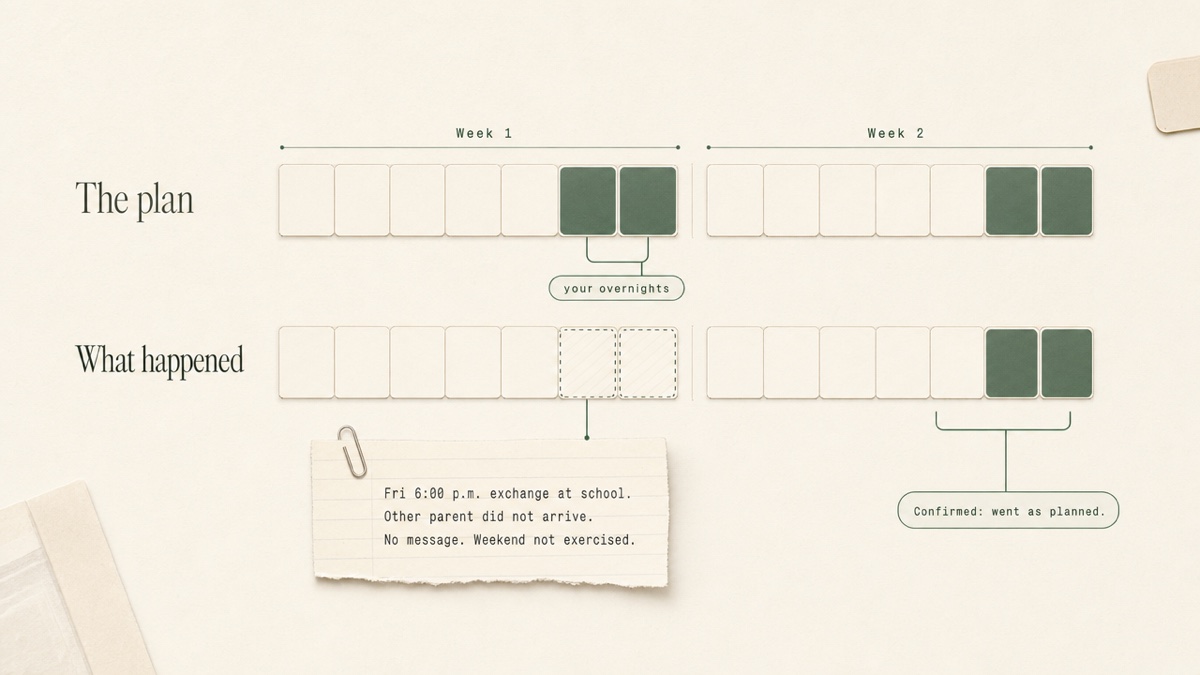
Parallel parenting reduces how often you have to respond to the other parent. It does not stop the problems: the pickup that's 75 minutes late, the weekend that doesn't happen, the holiday kept past its end date. Write those down, but don't argue about them in a message thread. A record you keep for yourself replaces the reply you would otherwise send.
What a useful entry looks like:
- Date and time of the event, written as close to when it happened as you can.
- What happened, in one or two plain sentences. "Scheduled exchange 6:00 p.m. at the school. Arrived 7:15 p.m. No message received."
- What the plan said should happen, so the gap is visible.
- Attachments that support it: the message, the email, a receipt.
What hurts your credibility:
- Editorializing. "Typical selfish behavior" adds nothing and makes a reader trust you less. The time stamp does the work.
- Over-reporting. Logging every eye roll buries the entries that matter. A reader looks for patterns, and noise hides them.
- Logging only the bad weeks. A record that also confirms the weeks that went as planned looks like a record. A record of complaints only looks like a case being built.
- Reconstructing months later. Entries written long after the fact are easier to challenge.
About texts: screenshots are easy to make and easy to dispute. Each state has its own rules on what evidence is admitted, and screenshots frequently fail them. Ask your attorney early whether a dedicated export of your message history would hold up better. More on which habits hold up: custody documentation and missed visitation and late pickups.
Moving toward cooperation if conflict cools
Parallel parenting is often a starting point. Court guides describe parents who start here while anger is high and move toward cooperation as things settle and they can talk without fighting.
Signs you might try more: messages get answered without hostility, exchanges stay calm, and a schedule swap gets settled in two messages instead of twenty. Try small steps, like both parents attending a school event, while the written plan stays in place as a fallback. If conflict comes back, go back to the plan. That isn't failure. It's what the plan is for.
Keep your record through any transition. Calm periods belong in it too.
Tools: shared platforms vs. a one-parent record, and using both
There are two kinds of tools here, and they do different jobs.
Shared communication platforms put both parents' messages in one place, with time stamps. Courts sometimes recommend or order them. Their limit is built in: they record what happens only when both parents use them. If the other parent ignores the platform, texts instead, or simply doesn't show up, the platform has little to record. Why co-parenting apps fail in high-conflict cases goes through this in more detail.
A one-parent record is a private log of your own time, the deviations, the expenses, and the evidence. It doesn't depend on whether the other parent participates, and the other parent never sees it.
Many parents use both. They use the shared platform for whatever communication the order requires, and their own record for everything else. Save a message from the shared platform into your own record next to the missed exchange it relates to, and you have one timeline instead of two. Side-by-side comparison: Custody Proof vs. co-parenting apps.
Where Custody Proof fits
Custody Proof is the one-parent side of that setup. It is not a messaging app and has no shared calendar. The other parent is never invited or notified.
- Upload your order or describe the schedule in plain words. It becomes a recurring calendar, including alternating holidays and summer blocks, and you review it before anything saves.
- Notice deadlines from your order ("designate in writing by April 1") can become in-app reminders.
- Log overnights and timed visits separately, and flag violations such as late pickups and missed visits.
- Plan vs. actual compares the schedule to what you logged. You can confirm weeks that went as planned, so the record isn't only complaints.
- Attach messages, photos, and documents to an encrypted evidence vault, and keep a child-expense ledger with receipts.
- Export PDF reports, including the Court Packet, to hand to your attorney.
Documentation is $14.75/month or $144/year. Case Builder, at $29/month or $278/year, adds Vero, an AI assistant that turns a voice note or pasted thread into a dated draft you review before saving. Both plans have a 30-day money-back guarantee on the first charge.
Frequently asked questions
Can I do parallel parenting if my order doesn't mention it?
Usually you can parent this way within your existing order: follow the schedule exactly, keep contact in writing, and run your own household. If the order requires more contact or joint decisions than parallel parenting allows, ask your attorney whether a modification makes sense.
What if the other parent won't use the shared app or ignores my messages?
You can't make them participate, and your record shouldn't depend on it. Send what the order requires through the required channel, note when you sent it, and keep logging deviations in your own record. A pattern of unanswered notices is itself something your attorney may want to see.
Will the other parent know I'm keeping a record in Custody Proof?
No. There is no shared account, invitation, or notification. If you share anything, you do it by exporting a file and handing it over yourself, usually to your attorney.
How much should I write down?
Enough to show the facts of each deviation and its date, plus confirmation that normal weeks went as planned. Leave out commentary and minor irritations. A short, consistent record is more persuasive than a long, emotional one.
Is parallel parenting bad for children?
It costs some consistency between homes. Court-published parent guides still describe it as far better than exposing children to ongoing conflict, and better than one parent pulling away entirely.
Keep reading
- How to Prove Parental Alienation in Court: Document Facts
- Custody Lawyer Consultation: What to Bring and Ask
- How to Document a Narcissistic Co-Parent
- Which custody app fits your situation
Custody Proof is a documentation tool, not a law firm. Nothing on this page is legal advice. Whether and how a record is used in a case is a question for your attorney.